Terrine vs Pâté: Two Classics of French Charcuterie
Walk into any French bistro, hotel charcuterie station or banquet buffet and you will meet two words that guests, and plenty of junior cooks, use as if they meant the same thing: pâté and terrine. They are close cousins, they often sit side by side on the same slate board, and they share the same seasoned, minced, cooked-and-chilled DNA. But they are not identical, and knowing the difference is one of those small marks of professionalism that separates a trained cook or service professional from an enthusiastic amateur.
This guide explains the difference in plain language, then goes deeper: what goes into each, how each is built, how to cook and cool them safely, how to slice and plate them, what to serve with them, and how to put them on a menu in a hotel or restaurant. It is written from the point of view of a working kitchen and dining room, not a textbook, so you will find food safety, costing and guest-service notes alongside the technique.
The Short Answer
The simplest way to remember it: pâté is defined by the preparation; a terrine is defined by the vessel and the structure.
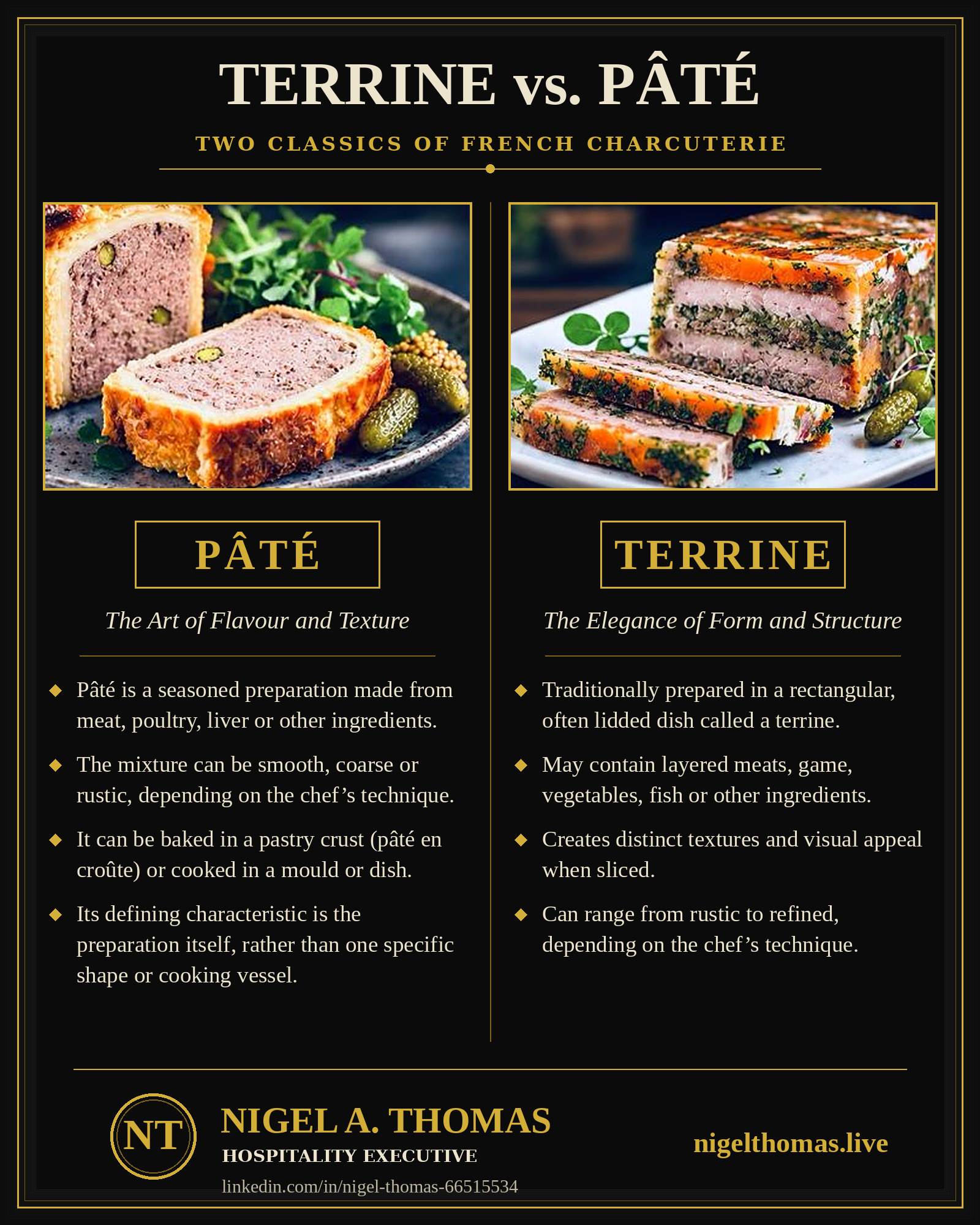
- Pâté is a seasoned preparation made from meat, poultry, liver or other ingredients. The mixture can be smooth, coarse or rustic, depending on the chef's technique. It can be baked in a pastry crust (pâté en croûte) or cooked in a mould or dish. It has no single required shape or cooking vessel.
- Terrine is traditionally prepared in a rectangular, often lidded dish that is itself called a terrine. It may contain layered meats, game, vegetables, fish or other ingredients, it creates distinct textures and visual appeal when sliced, and it can range from rustic to refined, depending on the chef's technique.
In everyday kitchen language the two words overlap heavily. A rustic pâté de campagne baked in a loaf dish is, to most cooks, a terrine too. The poster in this article sets out the classic contrast: on one side the golden pastry-wrapped pâté with its smooth, pistachio-studded slice; on the other the architectural, layered terrine with bands of colour running through every cut.
Pâté vs Terrine at a Glance
| Feature | Pâté | Terrine |
|---|---|---|
| Defining idea | The seasoned preparation itself | The dish it is cooked in and the structure inside |
| Typical base | Meat, poultry, liver, game or other ingredients | Layered meats, game, vegetables, fish or other ingredients |
| Texture | Smooth, coarse or rustic | Distinct layers and textures |
| Cooking vessel | Pastry crust, mould or dish | Rectangular, often lidded terrine dish |
| Visual appeal | Golden crust, even interior | Patterned cross-section when sliced |
| Style range | Rustic to refined | Rustic to refined |
| Classic examples | Pâté de campagne, pâté en croûte, liver pâté | Game terrine, vegetable terrine, fish terrine, foie gras terrine |
Where the Words Come From
The word pâté is French and is linked to the idea of paste, meaning a seasoned paste or forcemeat of ground ingredients, and historically, one wrapped in pastry. The word terrine comes from the French for an earthenware pot or dish. This is the key to everything: the name of the finished food and the name of the cooking vessel are the same word. When a cook says "terrine", they may mean the pottery dish, the method, or the sliced result on the plate.
Both belong to the French charcuterie tradition, the art of preparing, seasoning and preserving meats and meat preparations. Charcuterie rooms in classic brigades were built around making the most of every part of the animal: trimmings, livers, fat and offal became forcemeats that could be cooked, sealed with fat and kept. That practical, thrifty origin explains why these dishes are rich, well seasoned and designed to be served cold and sliced.
What Is Pâté?
A pâté starts with a forcemeat, a seasoned mixture of ground or puréed meat and fat. Depending on the style, the forcemeat may include pork, veal, chicken, duck, game, liver, or a blend of these, together with fat, a binder, seasoning and often alcohol. From there, the chef decides what the pâté will become.
Texture: smooth, coarse or rustic
- Smooth pâté is puréed or passed through a fine sieve until silky. Chicken liver pâté, where cooked liver is blended with butter, is the best-known example. It spreads like butter on toast.
- Coarse or country pâté (pâté de campagne) is ground through a larger plate and left with visible pieces of meat and fat. It slices cleanly but has a bite.
- Rustic pâté may include chunks of meat, whole pistachios, diced ham or tongue, and a generous seasoning of pepper and spices.
Pâté en croûte: the pastry-wrapped classic
Pâté en croûte is the showpiece. The forcemeat is encased in a firm pastry, baked until the crust is deep golden, and often finished by pouring a rich aspic (gelée) through a small chimney in the top to fill any gap between the meat and the crust. The result in the left half of the poster is exactly this: a gleaming golden crust, a pale, fine-textured interior and a scattering of green pistachio in each slice. It is among the most technical items in the cold kitchen, requiring a good pastry, a well-balanced forcemeat, careful baking and flawless chilling.
Pâté in a mould or dish
Many pâtés are simply baked in a mould or dish without any pastry. This is where the overlap with the terrine becomes obvious, and why many kitchens use the two words loosely. The defining characteristic of a pâté is the preparation itself, rather than one specific shape or cooking vessel.
What Is a Terrine?
A terrine is traditionally prepared in a rectangular, often lidded dish called a terrine, usually in earthenware, enamelled cast iron or porcelain. The straight sides and the lid matter for practical reasons: they hold the shape, protect the contents from drying and make it possible to press the finished product under a weight so that it slices cleanly.
Unlike many pâtés, a terrine is designed to look good when cut. The chef builds it in layers, and the slice becomes the presentation. A terrine may contain:
- Layered meats: strips of pork, chicken breast or ham set between layers of forcemeat.
- Game: rabbit, venison or pheasant, often with pistachio, dried fruit or herbs.
- Vegetables: roasted peppers, courgette, aubergine, carrot and spinach, bound with aspic or a light mousse. Vegetable terrines are an excellent option for vegetarian guests.
- Fish and shellfish: salmon, pike, scallop or prawn, usually bound with a delicate mousseline.
- Other ingredients: foie gras, cheese, fruit or herbs.
The terrine on the right of the poster shows this perfectly: a bright orange band, a layer of pale meat, a dark green herb-and-forcemeat layer, then pale meat again, framed by a fine herb edge. Every slice shows distinct textures and visual appeal, which is exactly why terrines are so popular on plated starters and buffets.
The Forcemeat Families
To understand both dishes, you need to understand the types of forcemeat behind them. Classical kitchens recognise several, and each suits different outcomes.
- Country-style (campagne): coarse, rustic, a mix of pork meat, fat and often liver. Hearty and sliceable.
- Straight forcemeat: a simple blend of lean meat and fat, ground and seasoned, with the ratio carefully controlled.
- Gratin forcemeat: made with meat or liver that is first lightly seared, which adds deeper roasted flavour.
- Mousseline: a light, delicate forcemeat made from white meat or fish, bound with egg white and cream. It is the foundation of most fish and poultry terrines.
- Liver-based: smooth, rich and mineral, built around chicken, duck, pork or goose liver.
The balance that makes or breaks it
The most important single factor in a good forcemeat is the balance of lean meat, fat and seasoning. As a working guide, many classic country forcemeats contain roughly a quarter to a third fat by weight. Too little fat and the finished product is dry and crumbly; too much and it can leak, taste greasy and feel waxy when cold. Salt is also vital, and because the dish is served cold, where flavours are muted, the seasoning must be a little bolder than you would expect. A reliable habit in every professional kitchen is to poach or pan-fry a small test portion of the raw mixture, taste it warm and cold, and adjust before filling the mould.
Common supporting ingredients
- Binders: eggs, or a panade of bread soaked in milk, to hold the mixture together.
- Alcohol: cognac, brandy, port, Madeira or white wine, for depth and aroma.
- Aromatics: shallot, garlic, thyme, bay and parsley.
- Spices: black pepper, nutmeg, and quatre épices (a French four-spice blend).
- Inclusions: pistachio, diced ham, mushrooms, dried fruit, olives or herbs.
- Curing salt: sometimes used for a pinker colour and cured flavour. Follow the supplier's instructions and the property's HACCP plan exactly.
Equipment for the Charcuterie Station
- A sharp meat grinder with a choice of plates (fine and medium), kept thoroughly chilled
- Food processor or high-speed blender for smooth pâtés and mousselines
- Terrine moulds with lids (earthenware, enamelled cast iron or stainless steel)
- Pâté en croûte hinged moulds for pastry work
- A deep roasting tray for the bain-marie (water bath)
- A probe thermometer, calibrated regularly
- Weights or a pressing board that fits the mould
- A long, thin slicing knife and a bowl of hot water for clean cuts
- Cling film, parchment and colour-coded boards and containers
How to Make a Classic Country Pâté or Terrine
The method below is a general professional framework, not a single fixed recipe. Adjust the proportions and ingredients to your house recipe and your HACCP plan.
- Chill everything. Meat, fat, grinder parts and bowls should all be very cold. Warm fat smears instead of grinding cleanly and ruins the texture.
- Marinate. Season the diced meat and liver with salt, pepper, spices, aromatics and alcohol. Cover and refrigerate, typically for several hours or overnight, to let the flavours develop.
- Grind. Pass the meat and fat through the grinder, keeping some portion coarser if you want a rustic texture. For smooth pâté, grind twice or purée in a processor.
- Mix and bind. Work in the egg, panade and any inclusions until the mixture turns slightly sticky and cohesive. Do the quenelle test: poach a small portion and taste it for seasoning.
- Line the mould. Traditional terrines are lined with thin sheets of pork back fat or bacon, which protects the contents and adds flavour. For a pâté en croûte, line with pastry, leaving an overhang.
- Fill and layer. Pack the mixture firmly into the mould, tapping to expel air pockets. For a layered terrine, alternate the forcemeat with strips of meat, vegetables or garnish, pressing each layer level.
- Cover. Fold over the fat or pastry, add the lid or foil and, for a pâté en croûte, cut a chimney to let steam escape.
- Cook gently. Place the mould in a bain-marie of hot water and bake in a moderate oven. The water bath moderates the heat so the edges do not overcook before the centre is done, which gives a moist, evenly cooked result.
- Check the core temperature. Use a probe thermometer in the centre and cook to the safe temperature required for the ingredients.
- Press and chill. Cool, place a weight on top and refrigerate overnight. Pressing compacts the structure so that it slices cleanly; resting develops the flavour.
- Finish. For pâté en croûte, pour in cooled aspic through the chimney and chill again. For terrines, seal the top with a layer of aspic or clarified fat if holding for several days.
Building a Layered Terrine
Layered terrines reward patience and planning. The goal is a clean, even pattern when the terrine is sliced. Some principles chefs rely on:
- Plan the cross-section first. Sketch the stripes you want. Think about colour contrast (orange carrot against green herb, pale meat against dark forcemeat) and flavour contrast.
- Keep layers level. Use a spatula or the back of a spoon to flatten each layer and press out air before adding the next.
- Prepare garnishes properly. Blanch vegetables, drain and dry them thoroughly. Water leaking from a vegetable will break the structure and weaken the slice.
- Use a binder that suits the ingredient. Aspic suits vegetables and delicate meats; mousseline suits fish and poultry; forcemeat suits robust meats.
- Press evenly. Weight the terrine overnight with a board and a modest weight so that the layers knit together without squeezing out the juices.
Food Safety: A Cold Kitchen Priority
Pâtés and terrines combine ground meat, long handling times and cold storage, which makes them a genuine food safety challenge. A well-run kitchen treats every step as a control point. The notes below follow widely used professional guidance, but always follow your local regulator and your property's HACCP plan.
Cooking temperatures
- Ground pork, beef and veal mixtures are commonly cooked to a minimum internal temperature of 68 °C (155 °F).
- Poultry-based mixtures need 74 °C (165 °F).
- Mixtures containing both should be cooked to the higher requirement.
Cooling
The cooling stage is where many outbreaks begin, because a dense block of cooked forcemeat holds heat for a long time. A commonly used standard is to cool cooked food from 57 °C (135 °F) to 21 °C (70 °F) within two hours, and then to 5 °C (41 °F) or below within a further four hours. Practical ways to do this include:
- Using shallow or smaller moulds rather than one very large block
- Placing the mould in an ice bath and stirring the water
- Using blast-chill equipment where available
- Not wrapping or lidding tightly until the core has cooled
Storage, labelling and service
- Store at or below 5 °C, away from raw foods, in a clean, covered container.
- Label every item with the product name, date made and use-by date, using the property's shelf-life policy. Many kitchens allocate only a few days for cut or opened items.
- Use clean utensils for each slice and never return unused portions from a guest-facing display to the main stock.
- Keep buffet displays on ice or in chilled cabinets and observe time limits for items out of refrigeration.
Listeria and vulnerable guests
Chilled, ready-to-eat products such as pâté are among those health authorities single out for Listeria risk, because the bacterium can grow at refrigeration temperatures. Public health guidance in many countries, including the UK, advises pregnant women to avoid pâté, and older, very young or immunocompromised guests may also be advised to avoid it. A good service team can mention this politely when asked, and menu descriptions should make it easy for guests to identify the dish.
Allergens and dietary notes
- Gluten: pâté en croûte contains wheat in the pastry.
- Egg and milk: used in many binders, panades and mousselines.
- Tree nuts: pistachios are common inclusions.
- Fish and shellfish: present in seafood terrines.
- Alcohol: cognac, port or wine is often used, which matters for guests who avoid alcohol for religious or personal reasons.
- Pork: a traditional ingredient. In hotels serving guests who do not eat pork, offer chicken, duck, lamb or vegetable alternatives, prepared and stored with separate equipment.
Troubleshooting Common Problems
| Problem | Likely cause | Fix |
|---|---|---|
| Dry, crumbly texture | Too little fat, overcooking or no water bath | Check fat ratio, use a probe thermometer and cook in a bain-marie |
| Greasy, waxy mouthfeel | Too much fat or poor emulsification | Reduce fat; keep ingredients cold while mixing |
| Grey colour inside | Over-processing, oxidation or overcooking | Mix gently, cook only to temperature, consider appropriate curing practice |
| Air pockets and holes | Mixture not packed firmly | Tap the mould, press layers, and fill completely |
| Fat or liquid pooling around the edges | Overheating or fast cooking | Lower the oven temperature and keep the mould in a water bath |
| Layers sliding apart when sliced | Wet garnishes, insufficient pressing | Dry vegetables well and press overnight under weight |
| Bland flavour | Under-seasoned or served too cold | Taste a test portion cold; bring to cool room temperature before serving |
| Pastry soggy or gap under crust | No aspic, moisture escaping into the pastry | Bake thoroughly, then fill the gap with cooled aspic through the chimney |
Slicing and Plating Like a Professional
A beautiful terrine or pâté can be spoiled in seconds by clumsy slicing. These habits make a difference:
- Serve cool, not ice cold. Remove from the refrigerator a little before service (within food safety time limits). Extreme cold dulls flavour and makes fat taste firm and waxy.
- Use a long, thin, sharp knife, dipped in hot water and wiped dry between slices. This gives clean, glossy edges.
- Cut generous, even slices. For a starter, roughly 60 to 80 g is a typical portion; for a tasting board, thinner slices are appropriate.
- Show the cross-section. Lay or lean the slice so the guest sees the pattern, as in the poster: a slice fanned in front of the whole loaf communicates both craft and abundance.
- Garnish with purpose. A few cornichons, a spoon of grain mustard, micro herbs and a crisp toast are plenty. Avoid crowding the plate.
What to Serve With Pâté and Terrine
These are rich, savoury dishes, so the best accompaniments add acidity, crunch, sweetness or freshness.
Classic accompaniments
- Cornichons and pickled vegetables: the sharp acidity cuts the fat. The little gherkins on both plates of the poster are the traditional choice.
- Mustards: Dijon or grain mustard (moutarde à l'ancienne), the small golden seeds visible on the pâté plate.
- Fresh bread and toasts: baguette, toasted brioche, sourdough or crisp crackers.
- Sweet relishes: onion marmalade, fig jam, apricot or cherry chutney, especially with liver pâté and duck.
- Salad leaves: peppery rocket, watercress or frisée dressed lightly, as on the pâté plate.
- Pickled onions, capers and olives.
Drink pairings
- Light, fruity reds such as Beaujolais, and gentle Pinot Noir, for country pâtés and game terrines
- Aromatic whites such as Alsace Riesling or Pinot Gris, for richer pâtés and fish terrines
- Sparkling wine or Champagne, whose bubbles and acidity refresh the palate between bites
- Sweet wines such as Sauternes, a classic pairing for foie gras terrines
- Dry cider or a crisp lager, for rustic styles
- Non-alcoholic options: sparkling apple or verjus-based drinks, or a dry tonic with a squeeze of lemon
Putting Pâté and Terrine on the Menu
Where they fit
- Plated starters at fine dining restaurants and banquets
- Charcuterie boards and sharing platters in bars and lounges
- Buffets, where a whole terrine can be a centrepiece
- Picnic hampers, room service and takeaway boxes, since they are served cold and transport well
- Sandwiches and canapés, using trimmed ends and offcuts
Menu description tips
Be accurate and appetising. "Rustic country pâté with pistachio, cornichons and toasted brioche" works better than "meat pâté". If it is a terrine, say what the layers are: "Chicken and herb terrine with roasted carrot, grain mustard and watercress." Declare the main allergens and any alcohol or pork content in line with local rules.
Costing and yield
- Cost the raw ingredients, the fat for lining, the pastry (if any), the aspic, the garnishes and the labour.
- Remember that cooking loss reduces yield; weigh the finished product, not just the raw mixture.
- Calculate the cost per portion from the sliced weight, and include end trim that cannot go on the plate unless it is reused in another dish.
- Use trimmings and ends in sandwiches, canapés, staff meals or sauces to reduce waste.
- Pâté en croûte carries significant labour cost. Price it accordingly or reserve it for banquets and special menus.
Training Points for Kitchen and Service Teams
If you train a brigade or a restaurant team, these are the key lessons worth putting on a one-page briefing sheet.
For the kitchen
- Keep everything cold during preparation; temperature control is flavour and safety.
- Always test-poach a small portion and taste it cold before filling the mould.
- Cook in a bain-marie and verify the core temperature with a calibrated probe.
- Cool quickly and safely; never leave a block of cooked forcemeat on the counter.
- Label, date and rotate every batch.
- Separate pork and non-pork production, and note allergens clearly.
For the service team
- Be able to explain the difference between a pâté and a terrine in one sentence.
- Know the allergens, whether it contains alcohol or pork, and which guests should be advised (for example, pregnant guests).
- Describe the accompaniments and suggest a suitable wine or drink.
- Handle and plate with clean, cold tools; keep display items chilled.
- Offer a vegetarian terrine alternative when the menu allows.
Frequently Asked Questions
Is a terrine a type of pâté?
In everyday kitchens, often yes, because both are seasoned, cooked and served cold. Strictly, a pâté is defined by the preparation itself, while a terrine is defined by the dish and its layered structure. A rustic pâté cooked in a terrine dish may legitimately be called either.
Does a pâté always contain liver?
No. Liver is common, especially in smooth pâtés, but many pâtés are made from pork, veal, poultry, game or a mix of meats. The base ingredients can vary widely.
Can a terrine be vegetarian?
Yes. Vegetable terrines made from roasted or blanched vegetables, herbs and a setting agent are a popular vegetarian option.
What is the difference between a pâté and a mousse or parfait?
A mousse or parfait is a very smooth, light preparation, often enriched with cream or butter and typically based on liver or fish. The terms are used inconsistently across kitchens, so check the recipe and describe the dish clearly on the menu.
Why is a pâté en croûte filled with jelly?
As the meat cooks it shrinks away from the pastry, leaving a gap. Chefs fill this with aspic through the chimney to bond the meat and crust, add moisture and improve flavour and slicing.
How long can a pâté or terrine be kept?
It depends on the recipe, the way it was cooked, sealed and cooled, and on your regulator and HACCP plan. Always follow your property's documented shelf-life rules and label every batch.
Can I use chicken or lamb instead of pork?
Yes. Many kitchens produce chicken, duck, turkey or lamb versions for guests who do not eat pork. Adjust the fat content, as lean poultry needs added fat to avoid dryness, and use separate equipment where required.
Final Thoughts
Pâté and terrine are two of the great pillars of French charcuterie. They share the same philosophy of careful seasoning, patient cooking and thoughtful chilling, but they express it in different ways. A pâté celebrates flavour and texture, whether silky, coarse or wrapped in golden pastry. A terrine celebrates form and structure, with layers that reveal themselves slice by slice.
For hospitality professionals, the lesson goes beyond vocabulary. Done well, these dishes show discipline in the cold kitchen, respect for food safety, a sense of presentation and the ability to explain a product confidently to a guest. Download the poster, pin it in the charcuterie room or the training area, and use it to start the conversation with your team.
Want the one-page summary for your kitchen or training room?