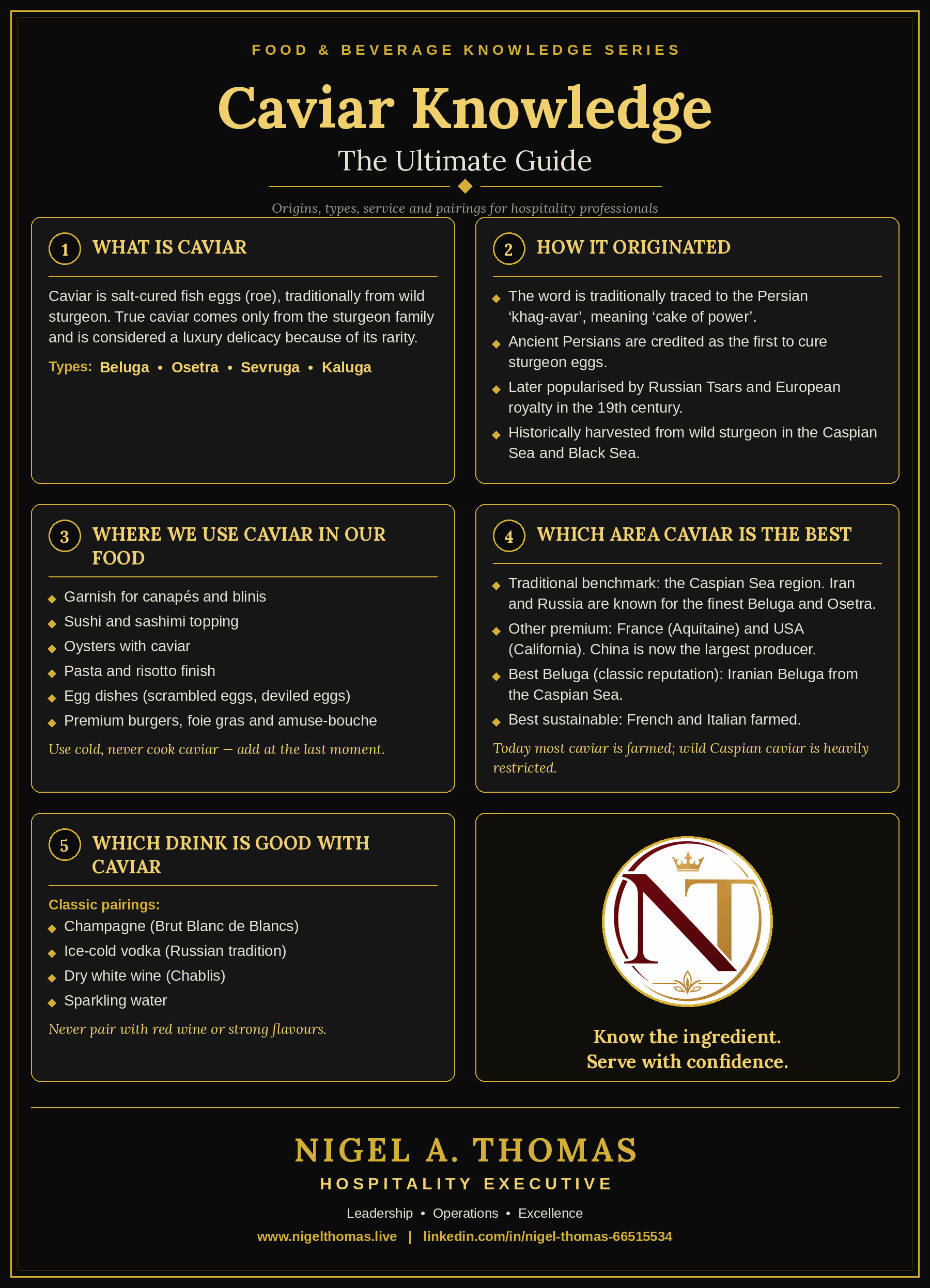
Few ingredients carry as much prestige as caviar. A single small tin can cost more than a full tasting menu, and a mishandled portion can ruin that value in seconds. For hotel, restaurant and cruise teams, caviar is not just a luxury garnish; it is a test of product knowledge, service discipline and food safety. This guide covers everything a hospitality professional should know: what caviar really is, where it comes from, how the main types differ, where it belongs on the plate, what to drink with it, and how to store and serve it safely. A free black and gold training poster at the bottom summarises the five key topics on one page.
1. What Is Caviar?
Caviar is salt-cured fish eggs, also called roe, and in the strict sense it comes only from the sturgeon family. These ancient, slow-growing fish live in the Caspian Sea, the Black Sea, the rivers of Russia and Central Asia, and in farms across Europe, North America and Asia. Because sturgeon take many years to mature, and because the eggs must be handled with great care, true caviar has always been rare. That rarity, plus its delicate flavour and its place in the history of fine dining, explains its status as a luxury delicacy.
Many other fish produce roe that is eaten around the world: salmon, trout, whitefish, lumpfish, flying fish and others. These are excellent products in their own right, but in most markets they must be labelled with the fish name, for example "salmon caviar" or "trout roe," rather than being sold simply as caviar. Training your team to use the correct words protects the guest and protects your credibility.
2. The Four Classic Types
The poster lists four well-known names: Beluga, Osetra, Sevruga and Kaluga. Each comes from a different sturgeon, and each has its own look, flavour and price point.
- Beluga: traditionally the most prized. The eggs are the largest, with a soft, delicate skin, and the colour runs from pale silver-grey to dark grey. The flavour is gentle, buttery and creamy rather than strongly salty.
- Osetra (also spelled Ossetra): medium-sized eggs ranging from golden to brown. Osetra is known for a nutty, slightly briny taste and a clean finish, and many chefs consider it the best all-round caviar for serving.
- Sevruga: smaller grey eggs with a more pronounced, savoury, oceanic flavour. It has traditionally been the most affordable of the three classic Caspian types.
- Kaluga: a large-grained caviar from a river sturgeon of the Amur basin, often described as a "river Beluga." It has a buttery, mellow flavour and is commonly produced on farms.
| Type | Egg size and colour | Flavour | Best for |
|---|---|---|---|
| Beluga | Largest; pale to dark grey | Delicate, buttery, creamy | Serving on its own |
| Osetra | Medium; golden to brown | Nutty, lightly briny | Tasting plates, blinis |
| Sevruga | Small; grey | Savoury, more intense | Garnish, canapés |
| Kaluga | Large; olive to amber | Buttery, mellow | Premium service, sushi |
Colour and size vary from batch to batch, so treat these descriptions as guidance, not a guarantee. Always taste a sample before you build a menu around a particular tin.
3. How Caviar Is Made
Although each producer has its own methods, the basic steps are similar. The roe is removed from a mature female sturgeon, carefully separated from its membrane by gently pressing it through a fine mesh, rinsed, graded by size, colour and firmness, and then lightly salted. Some modern farms use techniques that remove the eggs without killing the fish, which appeals to guests who care about sustainability.
You will often see the word malossol on a tin. It is a Russian term meaning "little salt," and it describes caviar cured with a low proportion of salt, usually only a few percent, so that the natural flavour comes through. Pasteurised caviar is heated gently to extend shelf life, but it usually has a softer texture and less delicate flavour than fresh caviar. Pressed caviar, made from broken or overripe eggs compressed into a dense paste, is a separate product with a strong, concentrated taste.
4. How Caviar Originated
The story of caviar begins in Persia. The word is traditionally traced to the Persian khag-avar, often translated as "cake of power," a reference to the energy people believed the eggs gave to those who ate them. Ancient Persians are credited as the first to cure sturgeon eggs with salt, a practice that spread along the shores of the Caspian Sea.
For centuries caviar was a regional food, eaten by fishing communities around the Caspian and in Russia. It became a symbol of luxury when Russian Tsars and European royalty embraced it, and in the 19th century it spread through the courts and grand hotels of Europe. Wild sturgeon from the Caspian Sea and Black Sea supplied almost all of it.
That success came at a heavy price. Overfishing, pollution and the damming of spawning rivers drove wild sturgeon populations to dangerously low levels. In response, sturgeon species were brought under international trade controls, and exports of wild Caspian caviar have been heavily restricted since the mid-2000s. This is why the industry now relies on farmed caviar, and why every hospitality professional should be able to explain the difference between the traditional story on the poster and the market of today.
5. Which Area Produces the Best Caviar?
Quality depends on the fish, the water, the producer's skill and the freshness of the product, but some regions have earned a reputation.
- Caspian Sea region (Iran and Russia): the traditional benchmark. Iranian Beluga from the Caspian Sea has the classic reputation for the finest caviar, and Iran and Russia have long been known for superb Beluga and Osetra.
- France (Aquitaine): the southwest of France has a well-established farming tradition and is known for refined, consistent caviar.
- Italy: farmed caviar from northern Italy is respected for quality and sustainable practices.
- USA (California): farms there raise white sturgeon and produce premium caviar for the domestic and export markets.
- China: now the largest producer by volume, supplying a large share of the world's farmed caviar.
If sustainability is your priority, farmed French and Italian caviar is widely regarded as the best sustainable choice. The honest answer to "which is best?" is that it depends on the guest, the dish and the budget. Judge each tin by its grain, firmness, shine, aroma and clean finish, not just by its country of origin.
6. Where We Use Caviar in Our Food
The poster lists six classic uses. One rule applies to all of them: use caviar cold, never cook it, and add it at the last moment. Heat turns the eggs rubbery and dulls the flavour, and long contact with hot or acidic food softens them and spoils the pop.
Canapés and blinis
Small buckwheat pancakes, called blinis, topped with a spoon of crème fraîche and a modest quantity of caviar are the classic presentation. Toast points, crisp potato rounds and thin cucumber slices also work. Keep the base neutral and slightly rich, so the caviar is the star.
Sushi and sashimi topping
A small spoonful on nigiri, a hand roll or a slice of white fish adds salinity and texture. Because the sushi rice already carries seasoning, use a lighter hand with soy sauce and avoid strong sauces that hide the caviar.
Oysters with caviar
A single drop of crème fraîche or a few drops of lemon, then a small quantity of caviar, turns a fresh oyster into a showpiece. Serve it very cold on crushed ice and send it quickly, since both the oyster and the caviar are at their best only briefly.
Pasta and risotto finish
Spoon caviar onto a creamy dish just before it leaves the pass. Never stir it in or cook it with the sauce. A delicate pasta in butter or cream, or a light champagne risotto, is the usual canvas.
Egg dishes
Soft scrambled eggs, deviled eggs and egg-based canapés are among the most natural partners for caviar. The richness of the egg softens the salt, and the caviar adds contrast. Add it on top once the eggs have cooled slightly.
Premium burgers, foie gras and amuse-bouche
Many luxury menus use a small spoonful of caviar to elevate a premium burger or to garnish foie gras. For an amuse-bouche, serve a single bite-sized portion, so the guest tastes the caviar with nothing to distract from it.
As a rough guide to portions, many restaurants serve around 15 to 30 grams when caviar is the main feature of a course, and only a few grams when it is a garnish. Always follow your own recipe card and costing sheet.
7. Which Drink Goes Best with Caviar?
The best pairings are clean, cold and crisp, since they refresh the palate between bites and do not compete with the delicate flavour. The poster lists four classics:
- Champagne (Brut Blanc de Blancs): made from Chardonnay, it has fine bubbles, high acidity and a clean, citrusy character. It is the most famous partner for caviar.
- Ice-cold vodka: the Russian tradition. Its clean, neutral taste and chill cleanse the palate without adding flavour.
- Dry white wine (Chablis): unoaked Chardonnay from Chablis has mineral and citrus notes that suit caviar well.
- Sparkling water: a simple, elegant choice that also works as a palate cleanser, and an option for guests who do not drink alcohol.
Avoid pairing caviar with red wine or strong flavours. The tannins in red wine can leave a metallic taste and overpower the eggs, and strong spices or smoky flavours hide the subtlety that guests are paying for. For more on describing wines to guests, see the wine terminology guide in the related reading below.
8. Tasting Caviar Like a Professional
Service staff, chefs and buyers should all know how to evaluate caviar, even in a few seconds. Professional tasters work through five simple steps:
- Look: the eggs should be glossy, whole and separate, with a consistent colour. Crushed, cloudy or oily eggs suggest age or poor handling.
- Smell: a fresh sea-like, slightly nutty aroma is ideal. Any sour, ammonia or strong fishy smell is a warning sign.
- Texture: press a few eggs gently against the roof of the mouth. Good caviar offers a light resistance and then a clean pop.
- Taste: notice the salt level, then the buttery, nutty, mineral or oceanic notes that follow.
- Finish: the best caviar leaves a long, clean, slightly sweet aftertaste without bitterness or a lingering metallic note.
Tasting regularly at the start of a delivery or a new batch lets the team learn what "good" looks like, and it gives chefs the confidence to describe the product honestly to guests.
9. Storage, Handling and Food Safety
Caviar is a delicate, ready-to-eat fish product, so food safety discipline is essential. The following rules should be part of every kitchen and bar training programme:
- Keep it cold. Store caviar in the coldest part of the refrigerator, usually around 0 to 4 degrees Celsius, and follow the producer's instructions on the tin. Never allow it to sit at room temperature.
- Never freeze it. Freezing damages the eggs and ruins the texture.
- Use opened tins quickly. Once opened, caviar deteriorates fast. Many producers recommend finishing an opened tin within two to three days, so label it with the date and time it was opened.
- Serve on ice. Keep the tin or serving dish nestled in crushed ice at the table.
- Use non-metallic spoons. Mother-of-pearl, bone, glass or good-quality plastic spoons avoid the metallic taste that some metals can give.
- Prevent cross-contamination. Use clean, sanitised utensils and gloves, and keep caviar away from raw proteins.
- Rotate stock. Apply first in, first out, and check the best-before date on every tin.
Caviar is also a fish product, so fish allergy is a real concern. Guests with fish allergies must be told clearly, and staff should know which dishes contain caviar. Pregnant guests and others who are advised to avoid cured, ready-to-eat fish should be allowed to make their own decision with accurate information from the team.
10. Step-by-Step Service at the Table
A consistent service routine protects both the product and the guest experience. A simple sequence works well for most venues:
- Prepare: chill the plates, bowls and glassware, and set out the accompaniments, such as blinis, crème fraîche and toast points, before the caviar leaves the refrigerator.
- Present: bring the tin or dish to the table on a bed of crushed ice, so the guest can see the product and hear a short description.
- Portion: use a non-metallic spoon and serve the agreed portion gently, without crushing the eggs.
- Pair: offer the matching drink, such as a glass of Brut Blanc de Blancs, ice-cold vodka or Chablis.
- Return the tin: take unfinished caviar back to the cold store promptly, cover it and label it with the date and time.
Moving at a calm, unhurried pace is part of the experience. Guests ordering caviar expect attention to detail, and they notice a rushed or careless presentation immediately.
11. Buying, Costing and Sustainability
Caviar is one of the most expensive items in the kitchen, so purchasing and costing deserve special attention. Buy from reputable suppliers who can show documentation, because international trade in sturgeon products is regulated and legitimate tins carry traceable labels. Check each delivery on arrival: the tin should be sealed and cold, the lid and label intact, and the eggs, when you open a sample, should be glossy, separate and firm, with a fresh, clean, slightly sea-like aroma. A strong fishy or ammonia smell, cloudy oil or mushy eggs means the product should be rejected.
Control costs with fixed portion sizes, calibrated spoons or scales, and clear instructions on every recipe card. Because the price of caviar is high, a small variation in portion size has a big effect on margin. Monitor waste daily and rotate the product through the menu so nothing expires.
Sustainability is part of the guest conversation. Most of the caviar on the market today is farmed, and farmed caviar from well-run operations takes pressure off wild populations. Be ready to explain where your caviar comes from and why you chose it.
12. Server Talk Track
A confident, simple explanation makes the guest comfortable and justifies the price. Teach servers to cover four points: what it is, where it comes from, how it tastes and how it is served. A short example might sound like this:
"This is Osetra caviar, from sturgeon raised on a farm in France. It has a nutty, lightly briny flavour and a very clean finish. We serve it on a warm buckwheat blini with crème fraîche, and I would suggest a glass of Blanc de Blancs champagne to go with it."
Servers should also know how to answer common guest questions, such as why caviar is so expensive, whether it is cooked, and whether the cheaper roe on the menu is the same thing. Honest, simple answers build trust.
13. Common Mistakes to Avoid
- Cooking or warming caviar, or adding it to a hot sauce long before service.
- Leaving the tin out of ice during service.
- Using metal spoons or heavy sauces that overpower the flavour.
- Pairing it with red wine, strong spices or heavily smoked food.
- Over-portioning, which wastes money, or under-portioning, which disappoints the guest.
- Failing to label and date opened tins.
- Describing other fish roe as caviar without naming the fish.
Pre-service checklist for the caviar station
- Caviar is at the correct temperature and stored in the coldest part of the refrigerator.
- Opened tins are labelled with the date and time, and the oldest stock is used first.
- Crushed ice, non-metallic spoons, chilled plates and accompaniments are ready.
- Portion sizes and costing sheets are posted at the station.
- All team members can name the types, the main allergen and the top pairings.
Caviar Vocabulary at a Glance
| Term | Meaning |
|---|---|
| Roe | Fish eggs in general |
| Caviar | Salt-cured roe from the sturgeon family |
| Malossol | Russian for "little salt," a light cure |
| Pasteurised caviar | Gently heated for longer shelf life |
| Pressed caviar | Compressed from broken or overripe eggs |
| Blini | Small buckwheat pancake used as a base |
| Blanc de Blancs | Champagne made only from white grapes |
Frequently Asked Questions
Is salmon roe the same as caviar?
No. Salmon roe is delicious and widely used, but true caviar comes from sturgeon. Other roe should be labelled with the fish name, such as salmon caviar or trout roe.
Why is caviar so expensive?
Sturgeon take years to mature, the eggs need skilled, careful handling, and the trade is regulated. Together these factors keep supply small and prices high.
Can caviar be cooked?
It should not be. Heat makes the eggs firm and rubbery and removes the flavour. Add it cold, at the last moment.
How long does an opened tin last?
Not long. Many producers recommend using an opened tin within two to three days, kept cold and covered. Follow the guidance on the tin, and label it with the opening date.
What is the best caviar to start with?
Osetra is a popular all-round choice for its nutty, balanced flavour. For a gentler taste, try a farmed Kaluga or Beluga when the budget allows.
Final Thoughts
Caviar rewards knowledge and discipline. Know what it is and where it comes from, serve it cold and at the last moment, pair it with clean, crisp drinks and respect its food safety rules. A team that understands these basics can present caviar with confidence and give guests an experience worth the price. Use the poster below in your training sessions, share it with your colleagues, and let every tin you open reflect the standards of your house.