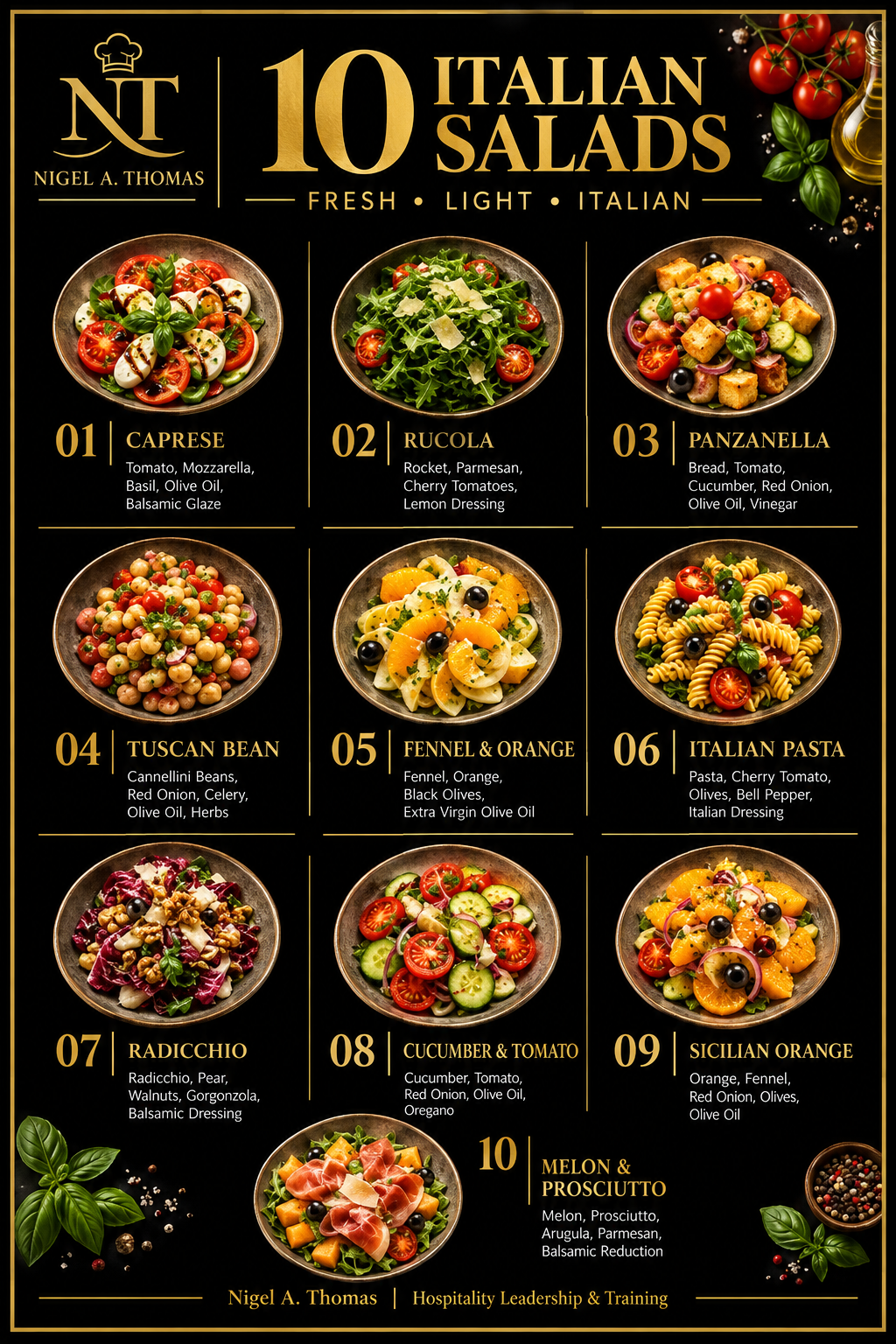
10 Italian Salads
A practical professional guide to ten Italian salads, their ingredients, kitchen preparation principles, menu applications and service standards for hotels, restaurants and hospitality training.
Why Italian Salads Matter in a Professional Kitchen
Salads are often treated as the easiest section of a menu because many of them do not require long cooking times. In a professional hotel or restaurant kitchen, however, a good salad is a test of discipline. The cook has to understand ingredient quality, knife work, portion control, seasoning, temperature, holding time, presentation and the relationship between acidity and fat. When a salad is simple, there are fewer places for poor technique to hide.
Italian salad traditions are particularly useful for kitchen training because they demonstrate how a small number of ingredients can create a complete dish. Tomatoes, herbs, olive oil, citrus, leafy vegetables, beans, bread, pasta, cheese and cured meats can be combined without making the plate unnecessarily complicated. The objective is not to bury the ingredients under a heavy dressing. The objective is to make the ingredients taste like themselves while creating balance.
The ten salads in this guide are useful references for hotel breakfast operations, all-day dining, banquets, buffets, room service, restaurant menus and culinary training. Some are composed salads, some are tossed salads and some are better understood as traditional combinations rather than rigid recipes. The ingredient lists shown here follow the supplied culinary poster and are intended as professional reference points rather than fixed formulas.
Kitchen Training Principle
When teaching salads, train the cook to ask five questions before plating: Are the ingredients fresh? Are the cuts consistent? Is the seasoning balanced? Is the portion controlled? Does the finished plate look intentional?
Contents
1. Caprese Salad
Caprese is one of the clearest examples of Italian cooking built around ingredient quality. The classic combination is tomato, mozzarella, basil and olive oil, with balsamic glaze commonly used as a finishing accent in modern restaurant presentation. The supplied poster places Caprese first because it is immediately recognisable and easy to understand.
For a professional kitchen, the important lesson is not simply how to arrange three or four ingredients. It is how to create visual balance. Tomatoes should be ripe and firm enough to hold their shape. Mozzarella should be handled gently so its texture remains intact. Basil should look fresh rather than bruised, and the oil should be applied with enough control that the plate does not become greasy.
2. Rucola Salad
Rucola, also known as rocket, provides a peppery character that works well with Parmesan and sweet, acidic cherry tomatoes. The supplied poster identifies rocket, Parmesan, cherry tomatoes and lemon dressing as the core combination. This is a useful training example because the leaves are delicate and the dressing must be controlled.
Rucola should not be drowned in dressing. A light lemon dressing can provide acidity and freshness while allowing the peppery leaf and salty Parmesan to remain prominent. In a restaurant kitchen, the salad should be dressed as close to service as practical so the leaves retain their structure. Parmesan can be shaved or finely grated according to the menu presentation.
3. Panzanella
Panzanella demonstrates how traditional food can turn a simple ingredient into a purposeful dish. The poster highlights bread, tomato, cucumber, red onion, olive oil and vinegar. In professional kitchens, it can be used as a rustic starter, a buffet salad or a seasonal menu item depending on the operation.
The bread is central to the character of the dish. It needs enough structure to absorb dressing and tomato juices without turning into an indistinguishable paste. Tomato should contribute moisture and acidity, while cucumber and red onion provide freshness and texture. Olive oil and vinegar complete the balance.
For hospitality operations, Panzanella also illustrates the value of menu engineering. A kitchen can create a satisfying salad from relatively straightforward ingredients while reducing unnecessary complexity. The recipe can be standardised by controlling bread quantity, vegetable ratios, dressing weight and final portion size.
4. Tuscan Bean Salad
The Tuscan bean salad shown in the poster combines cannellini beans, red onion, celery, olive oil and herbs. Beans make the dish more substantial than a leaf-only salad and provide a useful option for buffets, cold counters, staff meals and casual restaurant menus.
Cannellini beans need to be handled carefully because excessive mixing can break them. The objective is to coat the beans with dressing and seasoning while retaining their shape. Celery contributes crispness, red onion provides sharpness and herbs bring freshness. Olive oil ties the ingredients together.
In a commercial kitchen, bean salads are also a lesson in holding. The team should use a documented preparation and storage procedure, maintain appropriate food-safety controls and avoid leaving prepared salads at unsafe temperatures simply because they are cold dishes. Cold does not automatically mean safe; the complete food-safety process still matters.
5. Fennel & Orange Salad
Fennel and orange demonstrate the Italian approach to contrast. Fennel provides a crisp texture and aromatic anise character, while orange contributes sweetness and acidity. The poster adds black olives, extra virgin olive oil and mint, creating a combination of sweet, bitter, salty and herbal notes.
Knife work is particularly important here. Fennel should be sliced consistently so that every portion has a similar texture. Orange segments should be prepared cleanly, without excessive pith, and handled gently. Black olives provide a salty counterpoint, while mint should remain an accent rather than dominating the plate.
6. Italian Pasta Salad
Italian pasta salad is one of the most practical choices for hotel and restaurant operations because it can support buffet service, banquets, casual dining and packed meal applications. The supplied poster lists pasta, cherry tomatoes, olives, bell pepper and Italian dressing. The final recipe can be adapted to the operation, but the principle should remain consistent: pasta must remain pleasant to eat rather than becoming soft, oily or overloaded with dressing.
Cooking pasta correctly is the first control point. It should be cooked to the required texture, cooled according to the kitchen's food-safety procedure and dressed consistently. Cherry tomatoes add freshness, olives contribute saltiness and bell pepper provides colour and crunch. The dressing should be sufficient to coat the ingredients without pooling at the bottom of the container.
For buffet operations, portioning matters. A deep pan filled without a standard serving utensil can create large variations in food cost. A trained team therefore considers yield, batch size, portion size, replenishment frequency and holding time together rather than looking at the recipe in isolation.
7. Radicchio Salad
Radicchio gives a salad a deeper colour and a pleasant bitter character. The poster combines radicchio with pear, walnuts, Gorgonzola and balsamic dressing. This is a more assertive salad than Caprese and can work well as a restaurant starter or as part of a premium salad selection.
The success of the dish depends on balancing bitterness, sweetness, salt and richness. Pear provides sweetness and moisture. Walnuts add texture and roasted depth. Gorgonzola introduces a strong cheese character, while balsamic dressing provides acidity and sweetness. Each component has a job, so none should be used in excessive quantity.
For service teams, this is also a useful dish to explain to guests. If a guest asks why a bitter leaf is paired with sweet pear and a strong cheese, the server can explain the balance rather than simply listing ingredients. Product knowledge improves guest confidence and can support upselling when appropriate.
8. Cucumber & Tomato Salad
Cucumber and tomato create a familiar, refreshing combination. The supplied poster adds red onion, olive oil and oregano. Because the ingredient list is short, preparation quality becomes highly visible. Uneven cuts, watery tomatoes or excessive dressing can quickly reduce the quality of the finished dish.
For a professional kitchen, control the size of the cuts and the timing of assembly. If the salad is prepared too far ahead, salt and dressing can draw moisture from the vegetables and create a watery plate. Oregano should be used as a supporting herb, not as a substitute for fresh ingredient quality.
9. Sicilian Orange Salad
The Sicilian orange salad shown in the poster combines orange, fennel, red onion, olives and olive oil. It is a strong example of how citrus can be treated as a principal ingredient rather than simply a garnish. The combination can be refreshing on warm-weather menus and gives a kitchen a distinctive alternative to standard green salads.
The key is precision. Orange should be prepared neatly, fennel should be crisp and thinly sliced, and red onion should be controlled so that it contributes sharpness without overpowering the citrus. Olives provide salt and depth. Olive oil supplies richness and carries the flavours across the plate.
In menu planning, this salad can sit alongside richer dishes because its freshness helps create balance across a meal. That is an important culinary-management lesson: a menu is not only a list of individual dishes. The dishes must also work together.
10. Melon & Prosciutto
Melon and prosciutto brings fruit, cured meat and fresh salad elements together. The supplied poster combines melon, prosciutto, arugula, Parmesan and balsamic reduction. It can work as a starter, a light lunch item or a seasonal special depending on portion size and the rest of the menu.
Melon contributes sweetness and moisture. Prosciutto brings salt and a delicate cured-meat character. Arugula introduces pepperiness, Parmesan adds savoury depth and balsamic reduction gives a concentrated sweet-acid finish. The plate should not be overloaded; the visual appeal comes from the contrast between the ingredients.
This salad is also a good example of portion-cost awareness. Prosciutto and Parmesan can be comparatively expensive ingredients, so standard weights are important. A professional recipe card should specify the quantity per portion, the expected yield and the garnish standard. That protects both consistency and gross margin.
Professional Kitchen Standards for Italian Salads
A salad station may look simple, but it still needs the same discipline as any other section of a commercial kitchen. Mise en place should be planned around forecast covers, expected menu mix and holding time. Vegetables should be washed, trimmed and stored according to the kitchen's food-safety system. Knives and cutting boards should be clean and appropriately managed to reduce cross-contamination risks.
Portion control is especially important for salads because the ingredients are often individually visible. A cook who adds an extra handful of Parmesan, a little more prosciutto or an additional scoop of olives may not notice the difference on one plate, but the cumulative effect across a busy service can be significant. Recipe cards, portion tools and periodic checks help protect consistency.
Seasoning should normally be adjusted with the complete dish in mind. Salt, acid and fat interact. Cheese and olives already provide salt. Citrus, vinegar and balsamic provide acidity. Olive oil provides richness. A strong dressing can easily hide the flavour of delicate vegetables. The professional objective is balance rather than maximum intensity.
Presentation should also be standardised. A hotel operation may have several cooks working the same section across different shifts. The guest should receive the same visual experience regardless of who prepared the plate. A photograph, plating guide or simple training poster can help communicate the expected standard quickly.
Five-Point Salad Station Checklist
- Ingredients are fresh, correctly stored and within the approved use period.
- Knife cuts and portion sizes match the recipe standard.
- Dressing is prepared, labelled and controlled by batch.
- Assembly is timed to protect texture and appearance.
- Finished portions are checked before service or buffet presentation.
Quick Comparison Table
| Salad | Main Ingredients | Kitchen Character | Useful Application |
|---|---|---|---|
| Caprese | Tomato, mozzarella, basil, olive oil, balsamic glaze | Fresh, simple, composed | Restaurant starter, buffet |
| Rucola | Rocket, Parmesan, cherry tomatoes, lemon dressing | Peppery, light, acidic | Lunch, starter, side |
| Panzanella | Bread, tomato, cucumber, red onion, oil, vinegar | Rustic, substantial | Casual dining, buffet |
| Tuscan Bean | Cannellini beans, onion, celery, oil, herbs | Hearty, protein-rich | Buffet, cold counter |
| Fennel & Orange | Fennel, orange, olives, oil, mint | Crisp, citrusy | Seasonal starter |
| Italian Pasta | Pasta, cherry tomato, olives, pepper, dressing | Flexible, buffet-friendly | Banquet, buffet, casual dining |
| Radicchio | Radicchio, pear, walnuts, Gorgonzola, balsamic | Bitter-sweet, rich | Premium starter |
| Cucumber & Tomato | Cucumber, tomato, onion, oil, oregano | Fresh, familiar | Buffet, side dish |
| Sicilian Orange | Orange, fennel, onion, olives, oil | Bright, citrus-led | Seasonal menu |
| Melon & Prosciutto | Melon, prosciutto, arugula, Parmesan, balsamic | Sweet-salty, premium | Starter, light lunch |
Frequently Asked Questions
1. What are the best-known Italian salads?
Well-known examples include Caprese, Rucola, Panzanella, Tuscan bean salad, fennel and orange salad, Italian pasta salad, Radicchio salad, cucumber and tomato salad, Sicilian orange salad, and melon with prosciutto. The ten in this guide are presented as practical culinary references for hospitality kitchens.
2. Is Italian pasta salad suitable for hotel buffets?
Yes. Pasta salad can work very well on buffet and banquet menus when pasta is cooked correctly, cooled safely, dressed consistently and portioned with a controlled ingredient mix. Batch preparation and replenishment are preferable to uncontrolled overproduction.
3. What is the main principle behind a good Italian salad?
The central principle is balance. Fresh ingredients should remain recognisable, seasoning should be controlled, acidity and fat should support one another, and preparation should protect texture. Simplicity is not an excuse for poor technique.
4. Why is Caprese useful for culinary training?
Caprese is simple enough for trainees to understand quickly while still teaching ingredient quality, knife work, portion control, seasoning, plating and visual balance. It is an excellent exercise in doing a small number of things correctly.
5. How should salad preparation be controlled in a hotel kitchen?
Use standard recipes, measured portions, labelled mise en place, appropriate storage and controlled batch production. The exact food-safety requirements should follow the property's approved HACCP and local regulatory procedures.
6. Which of these salads is best for a buffet?
Italian pasta salad, Tuscan bean salad, cucumber and tomato salad and Panzanella can all be useful buffet choices, provided the kitchen controls temperature, replenishment, portioning and presentation. More delicate salads such as Rucola are often better assembled closer to service.
Professional Takeaway
The best salad is not necessarily the one with the longest ingredient list. It is the one where the ingredients are fresh, the cuts are controlled, the seasoning is balanced and the plate communicates confidence. Italian salads are valuable in hospitality because they teach this principle clearly. A tomato, a leaf, a bean, a citrus segment or a piece of melon can become a professional menu item when the kitchen controls the details.
For chefs, supervisors and hospitality trainers, these ten salads also provide a useful teaching sequence. Start with Caprese to teach composition. Move to Rucola for delicate leaves and dressing control. Use Panzanella to discuss texture and ingredient utilisation. Tuscan bean salad introduces batch preparation and holding. Fennel and orange demonstrate flavour contrast. Pasta salad introduces yield and buffet control. Radicchio teaches bitter-sweet balance. Cucumber and tomato reinforce freshness and timing. Sicilian orange highlights citrus-led composition. Finally, melon and prosciutto brings together premium ingredients, portion costing and presentation.
That is the wider kitchen lesson: culinary knowledge and operational knowledge should work together. A beautiful salad that is inconsistent, wasteful or poorly controlled is not a complete professional product. A well-costed salad that looks careless will also fail the guest experience. The strongest hospitality operation connects quality, consistency, safety, speed, presentation and cost on the same plate.