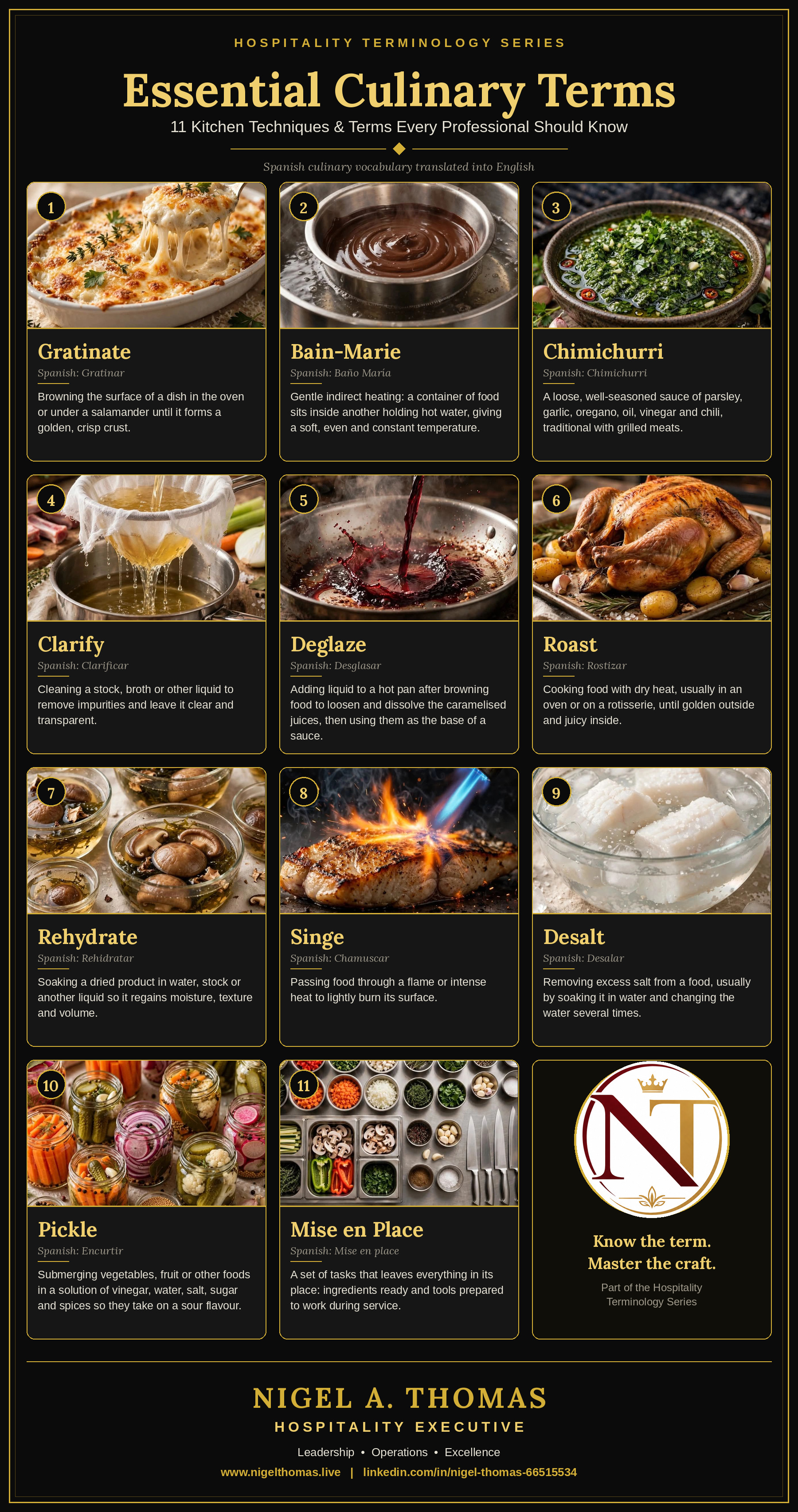
Every professional kitchen runs on a shared language. When a chef calls out "gratinate that," "deglaze the pan" or "get your mise en place done," there is no time to explain, and no room for guessing. These words carry a whole technique inside them, along with a quality standard and a safety habit. This guide takes eleven essential culinary terms, originally written in Spanish culinary vocabulary, and explains each one in plain English the way I would teach it to a new commis, a hospitality student or a hotel trainee on the first day of a kitchen rotation.
Spanish and English kitchen terms overlap more than most people expect, because modern professional cookery grew out of the French brigade system and then spread through Spain, Latin America, the Middle East and Asia, picking up local words on the way. A cook who trained in Madrid, Mexico City or Buenos Aires will say desglasar where a cook in London or Mumbai says "deglaze," and both mean exactly the same thing. Knowing both versions makes you more useful on a multinational brigade, which is exactly what most luxury hotels, resorts and cruise ships employ. The poster below the article summarises all eleven terms in one visual so you can print it, pin it in the training room or share it with your team.
1. Gratinate (Spanish: Gratinar)
To gratinate is to brown the surface of a dish, in an oven or under a salamander, until it forms a golden, crisp crust. The classic image is a bubbling gratin dish with cheese pulling in long strands as the first spoon lifts out, but the technique covers far more than cheese. Breadcrumbs, grated hard cheese, a layer of béchamel or Mornay sauce, a sprinkle of butter and herbs, or even a thin layer of sugar can all form the crust.
What makes it work is dry, intense heat from above. The dish underneath is normally already cooked or at least hot, so the only job left is to colour and crisp the top. That is why a salamander, the overhead broiler found in most hotel kitchens, is the usual tool. Working in a hot oven at roughly 200 to 230 degrees Celsius gives a similar result, only slower.
Practical points to teach:
- Start with a hot dish. A cold gratin will dry out long before the top browns.
- Keep the topping thin and even. A thick blanket of cheese turns oily instead of crisp.
- Watch constantly. A salamander can take a dish from golden to burnt in under thirty seconds.
- Use shallow, oven-safe dishes so more surface area meets the heat.
Common mistakes include adding the topping too early, so it sinks, and gratinating a sauce that is too thin, so it splits and turns greasy. In à la carte service, a gratin is often finished to order at the pass, which is a good reminder that this word describes a final act of cooking, not the whole recipe.
2. Bain-Marie (Spanish: Baño María)
A bain-marie is a technique of gentle, indirect heating. A container of food sits inside, or over, another container of hot water, so the food never meets direct flame or a hot metal base. The result is a soft, even and constant temperature. The name is traditionally credited to an early alchemist known as Mary, and the Spanish baño María keeps that history in the word itself.
In a hotel kitchen the bain-marie appears in three distinct jobs:
- Melting and tempering. Chocolate, butter and delicate sauces melt safely without scorching. The golden rule is that the bowl must sit above the water, not in it, and no steam or water droplets may reach the chocolate, because even a few drops can make it seize into a grainy paste.
- Gentle cooking. Custards, crème caramel, terrines, pâtés and cheesecakes are baked in a water bath so the edges cook at the same rate as the middle and the texture stays silky.
- Hot holding. Soups, sauces and sides are held in a steam table, often itself called a bain-marie, so they stay at a safe serving temperature through service.
For hot holding, food safety standards require food to be kept hot enough to prevent bacterial growth. The US Food Code sets the minimum at 57 degrees Celsius (135 degrees Fahrenheit), and many hotel groups set an internal standard of 60 to 63 degrees Celsius or higher for extra margin. Check with a probe thermometer, not with your hand, and record the readings. A bain-marie keeps food warm; it is not designed to heat cold food up, so reheat properly first.
For melting and sauces, keep the water at a gentle simmer, not a rolling boil. Rolling water gives too much heat, and the whole point of the technique is control.
3. Chimichurri (Spanish: Chimichurri)
Chimichurri is a loose, well-seasoned sauce made from parsley, garlic, oregano, oil, vinegar and chili, and it is the traditional partner of grilled meats across Argentina, Uruguay and much of South America. Unlike a creamy emulsified sauce, it is a rough, herb-heavy dressing, closer to a salsa than to a gravy. Spoon it over a grilled steak, a char-grilled fish, roast vegetables or sausages and the acidity cuts through the richness of the fat while the fresh herbs lift the whole plate.
A typical balanced version uses finely chopped flat-leaf parsley as the base, a small amount of dried or fresh oregano, plenty of chopped garlic, red wine vinegar, good olive oil, salt, and chili flakes or fresh chili for heat. Some cooks add a squeeze of lemon, a little onion or a touch of cumin. Red chimichurri, with roasted pepper or paprika, is another popular variation.
Tips from the kitchen:
- Chop by hand. A blender turns the herbs into a paste and bruises them, while hand chopping keeps a fresh, textured sauce.
- Rest it. Chimichurri tastes better after an hour or two, once the vinegar softens the garlic and the flavours marry.
- Season at the end, because the vinegar and salt both sharpen as it sits.
- Store it chilled. Fresh garlic and herbs in oil should not sit at room temperature for long, so refrigerate it, cover it, label it with the date and use it within a few days.
It also works as a marinade. Brush it on before grilling for added flavour, but keep a separate portion for serving so raw meat never touches the sauce you will pour on the finished dish.
4. Clarify (Spanish: Clarificar)
To clarify is to clean a stock, broth or other liquid so that impurities are removed and the result is clear and transparent. It is one of the more demanding skills in classical cookery, and it is the basis of consommé, the elegant, glass-clear soup that still appears on formal banquet menus.
The traditional method uses a clearmeat or raft. Cold stock is combined with lean minced meat or fish, egg whites, finely chopped vegetables and a little acid such as tomato. As the mixture heats slowly, the proteins coagulate and rise to the surface, forming a floating raft that traps tiny particles of fat and protein. The liquid then simmers gently beneath it, so it can filter itself through the raft for about an hour. It is finally ladled out carefully through muslin or a fine cloth, as shown in the poster.
The rules that matter most:
- Begin with a cold, well-skimmed, fat-free stock.
- Heat slowly and stir only until the raft begins to form, then leave it alone.
- Keep the liquid at a lazy simmer. A hard boil breaks the raft and clouds the soup.
- Ladle, never pour, and strain through a damp cloth.
The word also applies to butter. Clarified butter, or ghee in its browned form, has the milk solids removed, so it can be heated higher without burning. In both cases the idea is identical: remove what clouds or burns, and keep the pure part.
5. Deglaze (Spanish: Desglasar)
To deglaze is to add liquid to a hot pan after browning food, so the caramelised juices stuck to the bottom loosen and dissolve, then to use them as the base of a sauce. Those browned bits, called the fond, are concentrated flavour. Washing them down the sink would be one of the biggest wastes in a kitchen.
The sequence is simple. Sear or sauté the meat, poultry, fish or vegetables and remove them from the pan. Pour off excess fat. With the pan still hot, add the liquid. Red or white wine, stock, vinegar, brandy, beer, or even water all work. Scrape with a wooden spoon, let the liquid bubble and reduce, then finish with butter, cream, herbs or mustard to taste.
Which liquid you choose changes the sauce. Red wine suits beef and game, white wine suits chicken and fish, stock gives a neutral savoury base, and a splash of vinegar or lemon juice sharpens a rich pan sauce. Always reduce the liquid enough to cook off any raw alcohol taste and to thicken it slightly.
Safety and quality notes:
- Use a stainless steel or heavy pan. Non-stick pans do not build a fond.
- If adding spirits, take the pan off the flame first. Alcohol vapours can ignite, and a flare-up in a crowded kitchen is a real hazard.
- Do not let the fond burn black. Dark brown is flavour, black is bitterness.
6. Roast (Spanish: Rostizar)
To roast is to cook food with dry heat, usually in an oven or on a rotisserie, until it turns golden outside and stays juicy inside. In many Latin American kitchens rostizado is the everyday word for a whole roasted chicken, the same bird shown on the poster, surrounded by golden potatoes, garlic and rosemary.
Roasting works best for tender, well-structured cuts of meat, whole birds, root vegetables, and anything that benefits from caramelised surfaces. The dry heat browns the outside through the Maillard reaction while the interior cooks more gently, which is why oven temperature and timing matter so much. A common approach is to start hot, around 200 to 220 degrees Celsius, to build colour, then lower to 160 to 180 degrees to finish cooking through.
The keys to a good roast:
- Dry the surface well. Moisture produces steam, and steam prevents browning.
- Season generously and early, and bring large joints out of the refrigerator briefly before cooking, within food safety limits.
- Use a probe thermometer. Whole poultry should reach 74 degrees Celsius (165 degrees Fahrenheit) at the thickest part of the thigh, and whole cuts of pork and beef have their own target temperatures depending on the guest's preference and local regulations.
- Rest the meat before carving. Resting lets the juices redistribute, so they stay in the meat instead of running onto the board.
The pan juices from a roast also lead naturally to the previous technique. Deglaze the roasting tray, reduce, and you have a jus made from the roast itself.
7. Rehydrate (Spanish: Rehidratar)
To rehydrate is to soak a dried product in water, stock or another liquid so it regains moisture, texture and volume. The poster shows dried shiitake mushrooms and seaweed softening in glass bowls, but the technique reaches much further: dried beans and lentils, dried chilies, dried fruits, dried porcini, noodles, couscous and even gelatin sheets all depend on it.
The soaking liquid matters as much as the product. Mushroom soaking water is rich and savoury and makes an excellent base for sauces, risottos and soups, as long as you strain it through muslin or a coffee filter to remove grit. Dried fruit can be rehydrated in tea, juice or spirits for extra flavour.
Guidelines for different foods:
- Dried mushrooms and seaweed: soak in warm water for twenty to thirty minutes.
- Dried chilies: toast lightly, then soak in hot water until soft.
- Dried beans: long soaks, usually overnight, are best done in the refrigerator, because warm water left for many hours encourages bacterial growth.
- Gelatin: soak in cold water, never hot, then squeeze and dissolve gently.
Never discard the water without thinking. Either use it, or throw it away on purpose because it carries bitterness, as with some dried beans. And always label rehydrated products with the date, as they are now a perishable food.
8. Singe (Spanish: Chamuscar)
To singe, or chamuscar, is to pass food through a flame or intense heat so that its surface is lightly burnt. The poster shows a chef's blowtorch scorching a piece of fish, and this is the modern face of an ancient method. Traditional kitchens singe the fine pin-feathers off poultry over an open flame, blister peppers and eggplant directly over a burner, and char onions and ginger before adding them to broths for a deeper, smoky flavour.
The key word in the definition is "lightly." Singeing is about surface flavour, a quick kiss of flame, not about cooking the food through. In Japanese cuisine the same idea appears as aburi sushi, where a torch caramelises the top of the fish. In modern pastry the torch finishes a crème brûlée.
Torch and flame safety is part of the technique:
- Use a proper kitchen torch with a safety lock, and store the fuel away from heat.
- Keep the flame pointed away from yourself, from guests and from other staff.
- Do not use a torch near flammable items such as towels, paper or aerosol products.
- Remove the charred skin or ash where it is not wanted on the plate, for example from peppers, before serving.
As a bonus, singed ingredients add complexity to simple dishes. A torched tomato, a charred spring onion or a flame-kissed piece of fish tastes very different from its plain version, with almost no extra effort.
9. Desalt (Spanish: Desalar)
To desalt is to remove the excess salt from a food, normally by soaking it in water and changing that water several times. It is essential for salted and cured products, the most famous being salt cod, called bacalao in Spanish and baccalà in Italian. Without proper desalting the dish would be inedible, and with too much it would be tasteless.
The salt moves out of the food into the water by diffusion, so fresh water is needed repeatedly to keep the process going. For salt cod, typical soaking runs from twenty-four to forty-eight hours depending on thickness, with the water changed every six to eight hours. Cut the fish into portions first to speed things up.
Safe handling is critical, since soaking is a long period in the temperature danger zone if done carelessly:
- Soak in the refrigerator, or in a container with ice, as the poster shows. Keep the water cold, at or below 5 degrees Celsius.
- Cover the container and label it with the product and the start time.
- Taste a small cooked piece before deciding the fish is ready. Use your palate, not the clock alone.
- Cook it fully once desalted, and use it promptly.
The same technique helps with capers, anchovies, olives, cured ham offcuts, and over-salted preparations. Be aware that salt in a finished soup cannot reliably be removed, so season gradually.
10. Pickle (Spanish: Encurtir)
To pickle, or encurtir, is to submerge vegetables, fruit or other foods in a solution of vinegar, water, salt, sugar and spices so that they take on a sour flavour. The poster's jars of carrots, cauliflower, cucumbers, radishes and red onions show how colourful and varied pickles can be.
In professional kitchens, quick pickles are among the most useful tools for balancing rich food. A few slices of pickled red onion lift tacos, burgers and grilled meats, while pickled cucumbers and carrots cut through the fat in charcuterie boards. A simple brine often uses equal parts vinegar and water, a measure of salt and sugar, and aromatics such as peppercorns, mustard seeds, bay leaf, dill, garlic or chili.
Two different ideas are often confused:
- Quick pickles are made in minutes to hours, kept in the refrigerator and used within a short time.
- Preserved pickles are canned or fermented for shelf stability and need tested recipes and careful acidity control. The pH must stay at or below 4.6 to prevent dangerous bacteria, so do not improvise these.
Use clean glass jars and non-reactive pots, since aluminium reacts with acid. Pack the vegetables tightly, pour over the hot or cold brine as the recipe requires, cool, cover, label with the date and refrigerate. Always use clean, dry utensils to remove pickles, never fingers.
11. Mise en Place (French: "everything in its place")
Mise en place is the set of tasks that leaves everything in its place: ingredients ready and tools prepared to work during service. It is the only term on this list that has travelled into English and Spanish unchanged, and it is also the one that separates professionals from amateurs. The poster's photograph, with its neat bowls of chopped vegetables, herbs, spices and a row of knives, shows the ideal.
A good mise en place covers far more than chopping. It includes:
- Ingredients: washed, cut, portioned and stored at the correct temperature.
- Equipment: sharp knives, clean boards, calibrated thermometers and the right pans within reach.
- Sanitation: sanitiser buckets, clean cloths, colour-coded boards to prevent cross-contamination.
- Labelling: every container marked with its name and date, with first in, first out stock rotation.
- Station checklist: a written list of pars, so nothing is forgotten and nobody runs out in the middle of service.
The benefits are practical. A prepared cook works faster, makes fewer mistakes, wastes less food and stays calm when the printer starts firing tickets. It is also a pillar of food safety, because a clean, organised station is far less likely to cause cross-contamination. For a deeper look at how the concept differs from its theatre counterpart, see my article on Mise en Place vs Mise en Scène in the related reading below.
Leadership has a role as well. A head chef who checks mise en place before service, with the team lined up at the pass, sets the tone for the entire shift. In my own career across hotels, resorts and cruise operations, the kitchens that ran best were not the ones with the most talented individuals, but the ones where preparation was a daily ritual.
Spanish to English Quick Reference
| Spanish | English | In one line |
|---|---|---|
| Gratinar | Gratinate | Brown the top under dry heat |
| Baño María | Bain-Marie | Heat gently through hot water |
| Chimichurri | Chimichurri | Herb, garlic and vinegar sauce for grills |
| Clarificar | Clarify | Make a liquid clear |
| Desglasar | Deglaze | Dissolve pan juices with liquid |
| Rostizar | Roast | Cook with dry oven heat |
| Rehidratar | Rehydrate | Soak a dried food back to life |
| Chamuscar | Singe | Lightly burn the surface with flame |
| Desalar | Desalt | Remove excess salt by soaking |
| Encurtir | Pickle | Preserve in an acid and salt brine |
| Mise en place | Mise en place | Everything prepared and in its place |
Why Culinary Vocabulary Matters in Hospitality
Training a new team is, in large part, training them to speak the same language. A banquet kitchen preparing for four hundred covers cannot stop to define each instruction. When everyone knows what "clarify," "deglaze" or "gratinate" means, orders are understood the first time, quality is consistent and mistakes drop. Shared vocabulary also protects food safety. Terms like "desalt" and "rehydrate" carry built-in handling rules, such as keeping long soaks cold, that a trained cook applies automatically.
For hotel schools and training departments, I recommend turning these terms into a short daily briefing: one word, one demonstration, one safety point. Within a few weeks a new team will have a working kitchen vocabulary, and with a bilingual team, a bridge between Spanish and English that makes everyone more effective.
Frequently Asked Questions
Is the bain-marie the same as a double boiler?
They are very close. A double boiler is a pair of nested pots designed for the technique, while "bain-marie" can also describe a water bath in the oven or a steam table used for holding food hot.
What is the difference between deglazing and making a roux?
Deglazing dissolves the browned bits in a pan with a liquid, while a roux is a cooked mixture of fat and flour used to thicken. They are often used one after the other in the same pan, but they are separate steps.
How long can I keep homemade chimichurri?
Kept covered and refrigerated, it is best within a few days. Keep fresh garlic and herbs in oil chilled, and never leave it at room temperature for extended periods.
Can I speed up desalting salt cod?
Cutting the fish into smaller pieces helps, as does changing the water more often. Avoid warm water, because it can compromise food safety and the texture of the fish.
Is singeing the same as burning?
No. Singeing is deliberate, brief and controlled, and it adds flavour to the surface. Burning is uncontrolled and ruins the dish.
Final Thoughts
These eleven terms form a small but powerful toolkit. Learn them in both languages, practise each one until it becomes second nature, and teach them to the people you lead. A kitchen that understands its own vocabulary cooks better, wastes less, stays safer and communicates more clearly under pressure. Download the poster below, use it in your next training session and share it with a colleague who is just starting out. As always, pause before you react, prepare before you cook, and let the fundamentals do the work.
Free Poster: Essential Culinary Terms
All eleven terms on one black and gold infographic, ready to print for your kitchen or training room.