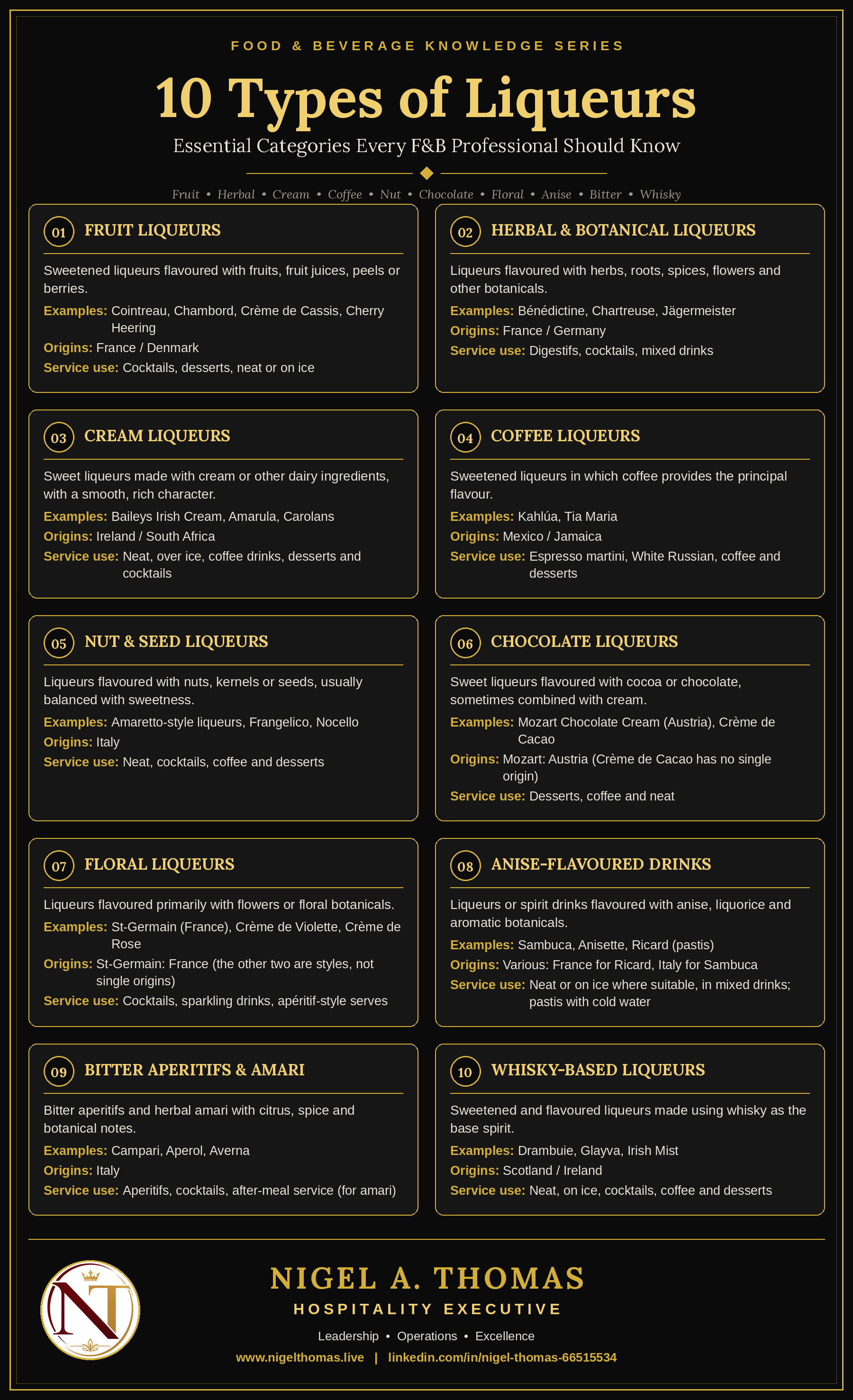
Walk into any well-stocked bar and the back shelf tells a story. Bottles of orange, coffee, hazelnut, herbs and cream sit next to the whisky and gin, and each one has a job: sweetening a cocktail, finishing a dessert, closing a long dinner or opening an evening as an aperitif. Liqueurs are the flavour layer of the beverage world, and a professional who can name the ten main categories, explain how they differ and recommend them with confidence adds real value to every guest interaction. This guide walks through what a liqueur is, how it is made, the ten essential types, how to serve and store them, and how to talk about them on the floor. A free black and gold poster summarising all ten categories is at the bottom of the page.
What Is a Liqueur?
A liqueur is a sweetened alcoholic drink made by combining a base spirit with sugar and flavouring ingredients such as fruit, herbs, spices, nuts, coffee, chocolate, flowers or cream. The base can be neutral grain spirit, brandy, rum, whisky or another spirit, and the flavourings are added by soaking, steeping or distilling them with the spirit. Sugar is the defining feature. Unlike gin, whisky or vodka, a liqueur is deliberately sweet, which is why it is used in small measures and why it behaves so differently in a glass.
Regulations vary by country. In the European Union, for example, a liqueur must contain a minimum amount of sugar per litre, and some styles such as crème de cassis must be even sweeter. The word "crème" on a bottle, as in crème de menthe or crème de cacao, refers to a high sugar content and a rich texture. It does not mean the drink contains cream. Most liqueurs fall between roughly 15 and 40 percent alcohol by volume, so they are lighter than most base spirits but still need responsible service.
It also helps to separate a few related words. A cordial is an older name for a sweet flavoured spirit and, in some countries, a non-alcoholic fruit syrup. A bitter is concentrated and used in drops. A spirit is not sweetened. An amaro is a bittersweet herbal liqueur, usually Italian. Being precise with these terms protects the guest and your own credibility.
How Liqueurs Are Made
Producers use four main methods, and many brands combine them:
- Maceration: fruit, peels, herbs or nuts are soaked in spirit so that the alcohol draws out flavour, colour and aroma.
- Percolation: spirit is slowly circulated through the flavouring ingredients, similar to brewing coffee.
- Distillation: the flavoured spirit is distilled again to capture only the aromatic compounds, which gives clean, bright flavours.
- Essence or compounding: concentrated natural extracts are blended with spirit and sugar. This method is common for mass-market liqueurs.
After flavouring, the liqueur is sweetened with sugar or syrup, sometimes with honey, then blended, rested, filtered and bottled. Cream liqueurs add dairy cream through a careful emulsifying process that keeps the cream stable in alcohol. Some herbal liqueurs, such as Chartreuse, are famous for their secret recipes and long maturation, while others, such as Cointreau, are prized for their consistent, clean style.
1. Fruit Liqueurs
Fruit liqueurs are sweetened liqueurs flavoured with fruits, fruit juices, peels or berries. This is the largest and most varied category, and it includes orange, blackcurrant, raspberry, cherry, peach and many more. Cointreau, an orange liqueur from France, is a bartender staple. Chambord brings a deep black raspberry flavour, crème de cassis delivers rich blackcurrant, and Cherry Heering, from Denmark, adds a dark, bittersweet cherry character.
They are used in cocktails and desserts, and they can also be served neat or on ice. A Cosmopolitan relies on orange liqueur, and a Kir, a glass of white wine with a spoonful of crème de cassis, shows how a small amount of liqueur transforms a drink. Fruit liqueurs also flavour cakes, sauces and fruit salads in the pastry kitchen.
2. Herbal and Botanical Liqueurs
These are liqueurs flavoured with herbs, roots, spices, flowers and other botanicals. Famous examples include Bénédictine and Chartreuse from France and Jägermeister from Germany. They tend to be complex, slightly bitter and aromatic, and many of them have long histories connected with monasteries and apothecaries.
Chartreuse, made by Carthusian monks in France, is known for its closely guarded recipe built from a large number of botanicals. The green version is notably strong, while the yellow version is milder and sweeter. These liqueurs are traditionally served as digestifs after a meal, and they appear in cocktails such as the Last Word, which combines gin, green Chartreuse, maraschino liqueur and lime. Jägermeister is traditionally served very cold, as a shot or in mixed drinks.
3. Cream Liqueurs
Cream liqueurs are sweet liqueurs made with cream or other dairy ingredients, with a smooth, rich character. Baileys Irish Cream from Ireland is the best-known name, and Amarula from South Africa, which is flavoured with fruit from the marula tree, and Carolans, also from Ireland, are other familiar examples.
They are served neat, over ice, in coffee drinks, in desserts and in cocktails. They are also excellent poured over ice cream or used in sauces and cheesecakes. Because they contain dairy, they need more careful handling than other liqueurs. Always follow the producer's guidance on storage and shelf life, keep bottles away from heat and sunlight, and discard any that smell sour or look curdled. Guests with dairy allergies or lactose intolerance should be told about the cream content.
4. Coffee Liqueurs
Coffee liqueurs are sweetened liqueurs in which coffee provides the principal flavour. Kahlúa, which comes from Mexico, and Tia Maria, which has Jamaican origins, are the two most recognised names. They taste of roasted coffee, caramel and vanilla and are usually made on a rum or neutral spirit base.
Coffee liqueurs star in the Espresso Martini, the White Russian and the Black Russian, and they pair naturally with coffee and desserts. They are also very good poured over vanilla ice cream or tiramisu. A simple suggestion at the end of a meal, such as a coffee liqueur over ice alongside an espresso, can lift the dessert course and add to the bill in a way guests appreciate.
5. Nut and Seed Liqueurs
Nut and seed liqueurs are flavoured with nuts, kernels or seeds, usually balanced with sweetness. Italy is the home of this category. Amaretto-style liqueurs, such as Disaronno, have a sweet almond-like flavour that often comes from apricot kernels, Frangelico delivers toasted hazelnut, and Nocello is made from walnuts.
They are served neat, in cocktails, with coffee and with desserts. The Amaretto Sour is a modern classic, and Frangelico works beautifully with chocolate and coffee. Nut allergies are a serious concern. Even if a liqueur is made from kernels or flavourings instead of whole nuts, staff must never guess. Check with the supplier and warn guests with allergies.
6. Chocolate Liqueurs
Chocolate liqueurs are sweet liqueurs flavoured with cocoa or chocolate, sometimes combined with cream. Mozart Chocolate Cream, from Austria, is a well-known example. Crème de cacao, available in clear and dark versions, is a classic cocktail ingredient with no single country of origin, since it is a style produced by many makers rather than one protected product.
Chocolate liqueurs are served with desserts, with coffee and neat. Crème de cacao is used in the Grasshopper and the Brandy Alexander, and a chocolate cream liqueur can be poured over ice or into hot chocolate for a winter menu. Pair them with orange, cherry, coffee or mint for the best results.
7. Floral Liqueurs
Floral liqueurs are flavoured primarily with flowers or floral botanicals. St-Germain, from France, is made from elderflower and is one of the most popular modern bar ingredients. Crème de violette and crème de rose are styles, not single brands, produced by several makers around the world.
Floral liqueurs are cocktail and sparkling-wine favourites. A splash of elderflower liqueur in a glass of sparkling wine or a spritz makes a delicate aperitif, and crème de violette gives the Aviation cocktail its pale purple colour and perfumed aroma. Use a light hand, because floral flavours can quickly become overpowering or soapy.
8. Anise-Flavoured Drinks
Anise-flavoured drinks are liqueurs or spirit drinks flavoured with anise, liquorice and other aromatic botanicals. The category is wide and the details vary by country. Sambuca comes from Italy, Ricard, a pastis, from France, and anisette is a sweet style made in several countries.
Service differs by type. Sambuca is often served neat or on ice, and it is traditionally garnished with coffee beans in Italy. Pastis such as Ricard is served as an aperitif with cold water, which turns the clear liquid cloudy, an effect called louching. Always add the water slowly, and let the guest decide how much. Because anise has such a strong aroma, these drinks are an acquired taste, so a short description helps guests decide.
9. Bitter Aperitifs and Amari
This category covers bitter aperitifs and herbal amari with citrus, spice and botanical notes. Italy dominates it. Campari, Aperol and Averna are the three examples on the poster. Campari is a vivid red, bold and bitter. Aperol is lighter, sweeter and more orange in flavour. Averna is a Sicilian amaro, richer and more caramel-like, and it is usually enjoyed after a meal.
The aperitifs are served before a meal to stimulate the appetite, in cocktails such as the Negroni, which uses equal parts gin, Campari and sweet vermouth, and the Aperol Spritz, built with prosecco, Aperol and soda water. Amari are traditionally served after the meal, neat or over ice, as a digestif. Teach staff to explain the difference, as guests often confuse the two.
10. Whisky-Based Liqueurs
Whisky-based liqueurs are sweetened and flavoured liqueurs made using whisky as the base spirit. Drambuie and Glayva come from Scotland, while Irish Mist comes from Ireland. They typically combine whisky with honey, herbs and spices, giving a warm, sweet and gently spiced character.
They are served neat, over ice, in cocktails, in coffee and with desserts. The Rusty Nail, made from Scotch whisky and Drambuie, is a classic, and a measure of whisky liqueur in hot coffee makes a popular winter drink. They are a gentle way to introduce guests who find whisky too dry to the flavours of Scotland and Ireland.
Classic Liqueur Cocktails Every Bartender Should Know
Liqueurs earn their place on the back bar through cocktails. The table below pairs ten classics with the liqueur that defines each one, so trainees can link a bottle to a drink in seconds. Always follow your own house recipe cards for exact measures.
| Cocktail | Key liqueur | Main ingredients |
|---|---|---|
| Cosmopolitan | Orange liqueur (Cointreau) | Vodka, cranberry juice, lime |
| Kir | Crème de cassis | Dry white wine |
| Espresso Martini | Coffee liqueur | Vodka, fresh espresso, sugar syrup |
| White Russian | Coffee liqueur | Vodka, cream |
| Amaretto Sour | Amaretto | Lemon juice, sugar syrup |
| Negroni | Campari | Gin, sweet vermouth |
| Aperol Spritz | Aperol | Prosecco, soda water |
| Rusty Nail | Drambuie | Scotch whisky |
| Grasshopper | Crème de menthe, crème de cacao | Cream |
| Brandy Alexander | Crème de cacao | Brandy or cognac, cream |
Notice how often the liqueur sits next to a spirit it complements: coffee with vodka, orange with vodka, Campari with gin, Drambuie with Scotch. For guides to those base spirits, see the whisky, gin, rum and tequila articles listed below, as well as the article on methods of making cocktails.
Pairing Liqueurs with Food and Desserts
Because liqueurs are sweet, they work best with food that balances that sweetness or echoes a flavour already on the plate. Some pairings that work well in a restaurant setting:
- Coffee liqueur over vanilla ice cream, or beside tiramisu and chocolate desserts.
- Orange liqueur with crêpes, dark chocolate or a citrus tart.
- Hazelnut and almond liqueurs with biscotti, chocolate mousse or a cheese board that includes mild, creamy cheeses.
- Cream liqueurs with coffee, brownies or bread pudding.
- Herbal liqueurs and amari after rich, heavy meals, where their bitterness refreshes the palate.
- Bitter aperitifs with olives, salted nuts and cured meats, which are salty enough to stand up to the bitterness.
- Pastis and other anise drinks with grilled fish, olives and Mediterranean starters.
Liqueurs are also useful in the kitchen. A few drops of orange liqueur lift a fruit salad, a coffee liqueur soaks sponge for tiramisu, and a splash of cream liqueur finishes a sauce. When cooking with alcohol, remember that not all of it burns off, so tell guests when a dish contains a liqueur.
How to Serve Liqueurs
Service depends on the style and on the guest's preference. Teach the team these options:
- Neat: served at room temperature in a small liqueur or snifter glass, usually in a measure of around 25 to 50 millilitres. Good for herbal liqueurs, amari, nut liqueurs and whisky liqueurs.
- On the rocks: poured over ice in a rocks glass. This softens sweetness and suits cream, coffee, fruit and anise liqueurs.
- In cocktails: used as a sweetener and flavour layer, from the Negroni to the Espresso Martini.
- With coffee: added to coffee, or served alongside an espresso at the end of a meal.
- With desserts: poured over ice cream, cakes or fruit, or used in sauces and syrups.
- As an aperitif or digestif: bitter aperitifs and pastis before the meal, herbal liqueurs and amari afterwards.
Use clean, appropriate glassware, keep measures consistent, and offer water. Responsible service matters with every drink that contains alcohol, and staff should always check age and monitor guests.
Storage, Shelf Life and Safety
Most liqueurs are stable because of their sugar and alcohol content, but they still need sensible handling:
- Store bottles upright, tightly closed, in a cool, dark place away from direct sunlight and heat.
- Follow the label for cream liqueurs, and discard any that smell sour or separate abnormally.
- Wipe sticky bottle necks and pourers regularly, since sugar attracts insects and mould.
- Rotate stock with first in, first out, because fruit and floral liqueurs can lose colour and flavour over time.
- Label allergens clearly, including dairy in cream liqueurs and nuts or kernels in nut liqueurs.
- Keep an eye on sulphites and other declared ingredients where guests ask.
Menu Planning, Costing and Upselling
Liqueurs add value in three ways: they are used in high-margin cocktails, they are served as after-dinner drinks, and they enhance dessert and coffee sales. A small back-bar selection covering the ten categories gives variety without tying up too much stock. Standardise measures, record pour costs and check usage weekly. Consider a short dessert and digestif list, offer a flight of three small liqueurs, and train servers to suggest a liqueur coffee or an amaro after a heavy meal.
Because liqueurs often sit on the shelf for long periods, review slow movers every month and look for ways to use them in specials, seasonal cocktails or pastry preparations before they lose quality.
Server Talk Track
Guests rarely know the category names, so teach servers to describe flavour first and name the type second. For example:
"If you enjoy something sweet after dinner, our Frangelico is a hazelnut liqueur from Italy, served over ice. If you would prefer something bitter and herbal, I can suggest an Averna, a Sicilian amaro that is wonderful with coffee."
Simple, honest descriptions build confidence. Servers should also be ready to explain what a liqueur is made from, how strong it is and whether it contains dairy or nuts.
Common Mistakes to Avoid
- Treating "crème de" liqueurs as if they contain cream.
- Over-pouring sweet liqueurs in cocktails, which leaves the drink flat and cloying.
- Storing cream liqueurs in a hot back bar.
- Forgetting to warn guests about dairy, nut and other allergens.
- Confusing aperitifs with digestifs and serving them at the wrong point in the meal.
- Ignoring sticky bottles and slow-moving stock.
- Calling every anise drink "sambuca" or every bitter drink "Campari."
Liqueur Vocabulary at a Glance
| Term | Meaning |
|---|---|
| Liqueur | Sweetened spirit flavoured with fruit, herbs, nuts, coffee, chocolate, flowers or cream |
| Crème de | A high-sugar style of liqueur, such as crème de cassis. It does not contain cream. |
| Amaro | Bittersweet Italian herbal liqueur, usually served after a meal |
| Aperitif | A drink served before a meal to stimulate the appetite |
| Digestif | A drink served after a meal |
| Louche | The cloudy effect when water is added to anise drinks such as pastis |
| Maceration | Soaking flavourings in spirit to extract their taste and colour |
| Neat | Served on its own at room temperature, without ice or mixer |
Frequently Asked Questions
What is the difference between a liqueur and a spirit?
A spirit such as gin, vodka or whisky is not sweetened, while a liqueur has sugar and flavourings added and is usually lower in alcohol.
Does crème de cassis contain cream?
No. "Crème" refers to the rich, sweet, syrupy texture. Crème de cassis is a blackcurrant liqueur.
Should cream liqueurs be refrigerated?
Follow the producer's label. Many suggest a cool place away from heat and light, and some recommend refrigeration after opening. Check the smell and appearance before serving.
Are amari and aperitifs the same?
No. Bitter aperitifs such as Campari and Aperol are served before a meal, while amari such as Averna are usually served after it, although the two groups overlap.
Which liqueurs are best for beginners?
Orange, coffee, cream and amaretto-style liqueurs are approachable and easy to enjoy neat, on ice or in a simple cocktail.
Final Thoughts
Liqueurs reward curiosity. Once you understand the ten categories, you can walk along any back bar and know what each bottle is for. Learn the examples, taste them regularly, serve them with care and speak about them simply. A team that does this gives guests more choice, lifts dessert and cocktail sales and brings a little of the world's tradition to every glass. Download the poster below for your next training session, and explore the whisky, rum, gin and tequila guides for the rest of the back bar.