The Story of Tequila
Tequila is the great spirit of Mexico, distilled from the heart of a single plant, the blue Weber agave. It carries the landscape of Jalisco in every glass: red volcanic soil, hot days, cool nights and generations of farming knowledge. Yet it is also one of the most misunderstood spirits in the world, too often reduced to salt, lime and a regretful shot. This guide takes tequila seriously, from the field to the glass, so that bartenders, servers and enthusiasts can speak about it with confidence.
Ancient Roots
Long before the Spanish arrived, the peoples of central Mexico fermented the sap of agave plants into a mildly alcoholic drink known as pulque. Agave was a sacred and practical plant, providing food, fibre, medicine, building material and drink. When the Spanish colonisers brought distillation technology in the sixteenth century, they began distilling fermented agave hearts, and the earliest ancestors of today's mezcal and tequila were born around the town of Tequila in what is now Jalisco.
From Village Spirit to Global Icon
Commercial production grew through the seventeenth and eighteenth centuries. The Cuervo family received an early licence to produce agave spirit in 1795, and José Cuervo is widely recognised as the oldest tequila house. Other families, including the Sauza and Romo families, built distilleries through the nineteenth century, and tequila began travelling by rail to northern Mexico and the United States. The twentieth century brought legal protection: tequila received its Denomination of Origin in 1974, which ties the name to specific regions and rules in the same way that Champagne and Cognac are protected in France.
The Modern Renaissance
Over the last few decades tequila has moved from party spirit to premium sipping spirit. Craft-minded producers revived traditional methods such as stone-wheel crushing and slow oven cooking, and consumers began to look for 100% agave bottlings, single-estate expressions and long-aged tequilas that are enjoyed the way fine whisky or cognac is enjoyed. Today tequila is one of the fastest-growing premium spirits categories worldwide.
What is Tequila?
Tequila is a distilled spirit made from the fermented juice of the blue Weber agave (Agave tequilana Weber, variety azul) and produced within the area defined by its Denomination of Origin. That area covers the state of Jalisco and designated municipalities in Guanajuato, Michoacán, Nayarit and Tamaulipas. The rules are overseen by the Consejo Regulador del Tequila (CRT), and every bottle carries a NOM number, a code that identifies the distillery where it was made. Looking for the NOM on the label is one of the simplest ways to learn which distillery really produced a brand.
Tequila is bottled at 35 to 55 percent alcohol by volume, with most bottles sitting at 38 to 40 percent. It is a spirit of two broad families: 100% agave tequila, which uses only blue agave sugars, and mixto tequila, which must contain at least 51 percent agave sugars and may be made up with other sugars.
The Blue Weber Agave
Agave is not a cactus, as many guests believe. It is a succulent related to the lily and asparagus families. The blue Weber agave grows as a rosette of thick, blue-green, spiked leaves and takes five to eight years, and sometimes longer, to reach maturity. During those years the plant stores energy as complex carbohydrates in its heart, called the piña because it resembles a giant pineapple. A single piña can weigh forty kilograms or more.
Agave is propagated mainly through offshoots called hijuelos rather than seeds, so plants within a field are often genetic clones. This makes fields efficient but vulnerable to disease and pests, which is one reason why some craft producers experiment with seed-grown plants to restore genetic diversity.
Terroir: Highlands and Lowlands
Where agave grows shapes the spirit it makes. Two broad zones are recognised:
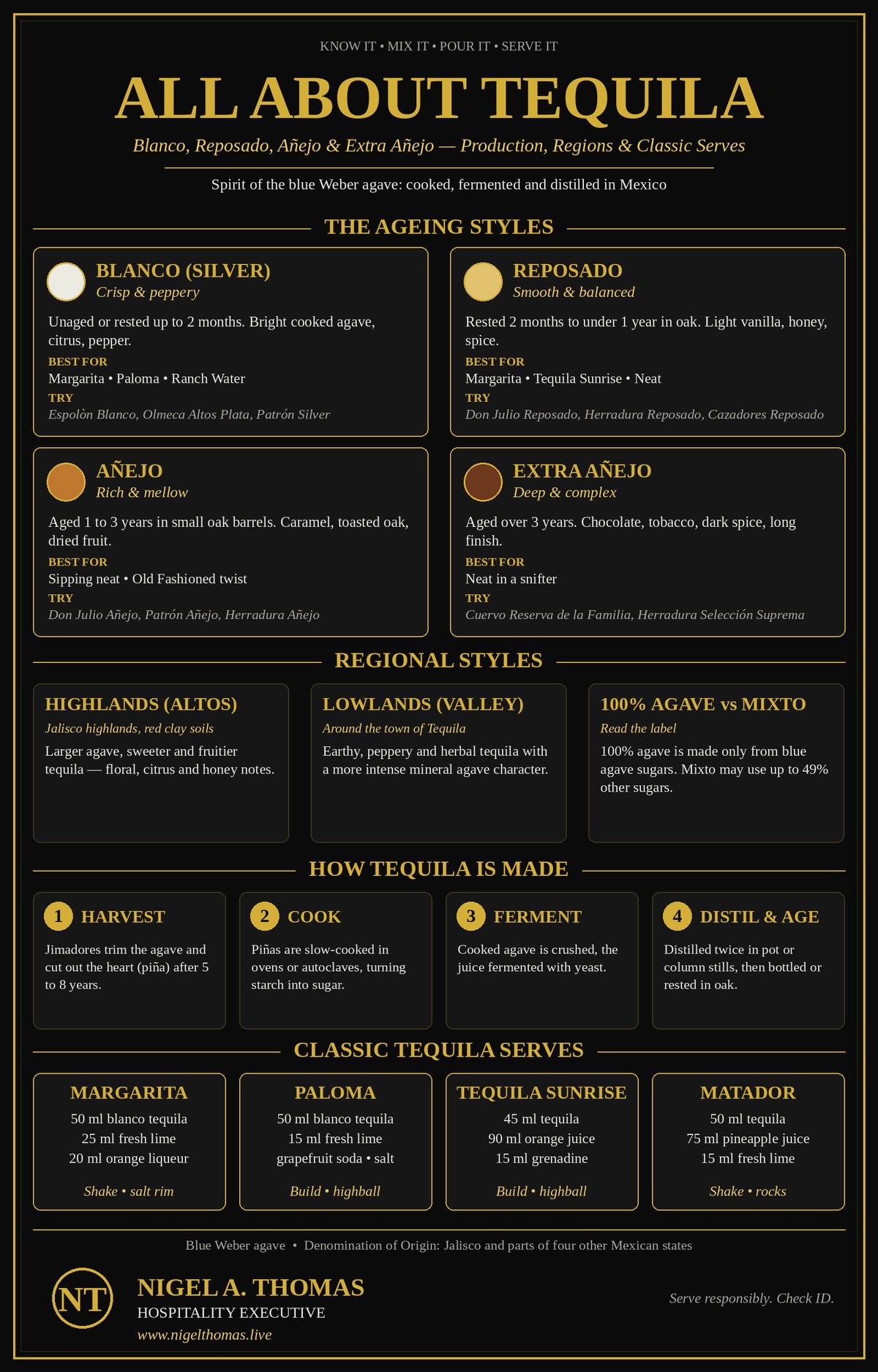
- The Highlands (Los Altos): The cool, elevated region around Arandas and Atotonilco el Alto, with iron-rich red clay soil. Agave here grows larger and sweeter, producing tequila that is often fruity, floral and honeyed, with notes of citrus and cooked agave.
- The Lowlands (the Valley): The warmer region around the town of Tequila and the volcano that rises behind it. Agave here tends to be smaller and its tequila is earthy, peppery and herbal, with a mineral edge that many enthusiasts adore.
Neither region is better. The two styles simply give bartenders and drinkers a useful vocabulary: soft and fruity from the Highlands, bold and earthy from the Valley.
How Tequila is Made
Every stage of production leaves a fingerprint on the finished spirit. Understanding the process also explains the price differences between a basic bottle and a premium one.
1. Harvest (La Jima)
Harvesting is done by skilled jimadores, who use a sharp, long-handled blade called a coa to cut away the spiked leaves and extract the piña. The work is physical and exacting. A good jimador knows by sight and touch when an agave is ripe, because the sugar content at harvest decides the quality of the spirit. Pickers working with ripe agave produce a sweeter and more complex distillate.
2. Cooking
Raw agave is mostly inulin, a starch that yeast cannot ferment. Cooking breaks it down into fermentable sugars and gives tequila its signature sweet, roasted-vegetable aroma. There are three common methods:
- Traditional brick ovens (hornos): Piñas are slow-steamed for one to three days, producing deep, caramelised and sweet flavours.
- Autoclaves: Pressure cookers that work in around twelve hours, efficient and consistent, with a brighter, cleaner result.
- Diffusers: Industrial machines that use hot water and sometimes acid to extract sugars from raw fibre. They are fast and cheap, and are usually associated with mixto tequilas and lighter profiles.
3. Extraction
Cooked piñas are shredded and pressed to release the sweet juice, called aguamiel. The most traditional tool is the tahona, a giant volcanic stone wheel pulled in a circle, which crushes the fibre gently. Most distilleries use roller mills, which are faster and more efficient. Some producers ferment with the fibre (bagazo) left in, which adds a richer vegetal character.
4. Fermentation
The juice is fermented in stainless steel tanks or wooden vats, using cultivated yeast or ambient wild yeast. Fermentation takes from two to seven days. Slower, cooler fermentations preserve more floral and fruity aromas, while quick fermentations tend to give cleaner but simpler spirits.
5. Distillation
Tequila is distilled twice. The first pass, called destrozamiento, produces a low-alcohol liquid of roughly 20 to 25 percent. The second pass, rectificación, refines it to around 55 percent. Pot stills, often copper, give fuller and oilier spirits, while column stills give lighter, cleaner distillates. Skilled distillers make careful cuts, separating the heads and tails from the heart of the run, which defines the final quality.
6. Ageing and Bottling
After distillation, tequila is diluted with water to bottling strength. Blanco is bottled almost straight away, while other categories rest in oak. Most producers use ex-bourbon American oak barrels, and some use French oak, ex-wine or ex-sherry casks. By law the barrels cannot exceed 600 litres. Mexico's warm climate speeds ageing, so a tequila can look and taste mature in far fewer years than a Scotch whisky.
The Tequila Categories
Tequila is classified by how long it spends in wood. The five core categories form a spectrum from fresh and vegetal to rich and mellow.
Blanco (Silver or Plata)
Profile: Crisp and peppery.
Ageing: Unaged, or rested for up to two months in neutral containers.
Flavour: Cooked agave, citrus peel, black pepper, mint and sometimes olive brine.
Best For: Margarita, Paloma, Ranch Water, and sipping to appreciate the raw character of the agave.
Examples: Espolòn Blanco, Olmeca Altos Plata, Patrón Silver.
Blanco is the truest expression of the plant. Connoisseurs often judge a distillery by its blanco, because there is no barrel to hide behind.
Reposado ("Rested")
Profile: Smooth and balanced.
Ageing: A minimum of two months and less than one year in oak.
Flavour: Light vanilla, honey, baking spice and a gentle round sweetness, while the agave remains clearly present.
Best For: Margarita variations, Tequila Sunrise, and neat sipping.
Examples: Don Julio Reposado, Herradura Reposado, Cazadores Reposado.
Reposado is the most versatile style. It offers enough oak to add comfort without covering the character of the agave.
Añejo ("Aged")
Profile: Rich and mellow.
Ageing: One to three years in oak barrels of no more than 600 litres.
Flavour: Caramel, toasted oak, dried fruit, cinnamon and cocoa.
Best For: Sipping neat, or in spirit-forward cocktails such as a tequila Old Fashioned.
Examples: Don Julio Añejo, Patrón Añejo, Herradura Añejo.
Añejo behaves much like a mellow whisky or brandy and rewards slow drinking from a proper glass.
Extra Añejo ("Extra Aged")
Profile: Deep and complex.
Ageing: More than three years in oak.
Flavour: Chocolate, tobacco, leather, dark spice and a long, warming finish.
Best For: Sipping neat in a snifter or tulip glass, with no ice and no mixer.
Examples: Cuervo Reserva de la Familia, Herradura Selección Suprema.
Extra añejo is a relatively recent official category, created in 2006, and is priced as a luxury spirit.
Joven and Cristalino
Joven (also called gold or oro) is typically a blend of blanco and aged tequila, or a mixto coloured and sweetened with caramel. It is often found in basic shots and cheap margaritas. A rare joven made from 100% agave can be excellent, so read the label rather than the colour.
Cristalino is a newer style. A tequila, usually añejo or extra añejo, is aged and then filtered through charcoal to remove colour, producing a clear liquid that keeps the smooth, rounded sweetness of ageing. It is popular for sipping and for visually clean cocktails.
Tequila vs. Mezcal
All tequila is a mezcal, but not all mezcal is tequila, in the same way that Cognac is a brandy but not all brandy is Cognac. Mezcal can be made from many agave species and in several Mexican states, most famously Oaxaca. Traditional mezcal is roasted in underground pits, which gives it the smoky character the category is known for. Tequila uses only blue Weber agave and is usually steam-cooked, so it tastes cleaner, sweeter and less smoky. Guests who say they dislike tequila often fall in love with it once they taste a quality 100% agave expression.
A word about the worm: there is no worm in tequila. The insect larva in some bottles of mezcal was a marketing idea from the twentieth century and is not a sign of quality.
Major Tequila Brands to Know
José Cuervo
The oldest tequila house, with a licence dating to 1795 and an extensive range. Cuervo Especial is a famous gold mixto, while the Reserva de la Familia is an extra añejo made in limited quantities. Cuervo is a good example of how one producer can span everything from bar staple to collector bottle.
Sauza
Founded by Don Cenobio Sauza in the 1870s, Sauza is credited with promoting the idea of blue agave as the only proper tequila plant and played a major role in exporting tequila beyond Mexico. The family's history is closely tied to the development of the Denomination of Origin.
Herradura
Founded in 1870 by Feliciano Romo near the town of Amatitán, Herradura is known for its traditional production, including brick-oven cooking and long ageing. Its Reposado and Añejo are widely respected, and its high-end bottlings are collector favourites.
Don Julio
Created in 1942 by Don Julio González in Atotonilco el Alto, Don Julio is one of the key Highlands brands. Its Blanco, Reposado and Añejo form a popular trio, and its 1942 expression helped establish the idea of a luxury sipping añejo.
Patrón
Launched in 1989, Patrón was a leader in the move to premium 100% agave tequila and made the stylish, hand-numbered bottle a global image of luxury tequila. It combines tahona-crushed and roller-mill agave in its blends.
Espolòn and Other Value Favourites
Espolòn is a favourite in bars for being a well-made 100% agave blanco at a fair price, with a crisp, peppery style that suits cocktails. Many bartenders keep a bottle like this as their house margarita tequila, and then keep a more expensive reposado or añejo for sipping.
Craft and Small-Batch Names
Enthusiasts should also explore producers focused on terroir and tradition, such as Tequila Ocho (a single-estate, single-vintage tequila), Fortaleza (a tahona-driven, slow-cooked style) and others that use natural fermentation and traditional stills. These bottles show how far the category has moved beyond party shots.
Tasting Notes & Flavour Vocabulary
Tequila offers a richer palette than most guests realise. Use these descriptors to speak about the glass:
- Cooked Agave: Sweet, earthy, baked-vegetable notes, like roasted sweet potato.
- Citrus: Lime, grapefruit and orange peel, common in blanco.
- Black Pepper & Herbs: Spicy, green and sometimes minty notes, typical of Lowlands styles.
- Vanilla & Honey: Soft, rounded notes from oak and from concentrated agave sugars.
- Caramel & Toasted Oak: Warm, sweet notes from barrel ageing.
- Dried Fruit & Cinnamon: Raisin, fig and baking spice in añejo.
- Chocolate & Tobacco: Deep notes in extra añejo.
- Mineral & Salty: A flinty or brine-like edge that many people connect to volcanic soils.
How to Taste and Serve Tequila
Skip the lick-salt-and-slam routine, which was designed to hide the taste of cheap spirit. To taste tequila properly, pour a small measure into a tulip-shaped tequila glass, a snifter or a small copita. Look at the colour and legs, then nose it gently with your mouth slightly open to avoid being overwhelmed by alcohol. Take a small sip and let it coat the tongue before swallowing. Add a few drops of water if the spirit is strong, and compare how the aromas open.
In Mexico, fine tequila is often served alongside sangrita, a spicy, savoury chaser made from orange and tomato juices, lime and chilli. It is sipped in between sips of tequila to refresh the palate rather than to cover the flavour. This is a wonderful pairing to offer guests who want a traditional experience.
For serving temperature, blanco can be lightly chilled for cocktails, while reposado, añejo and extra añejo are best served at room temperature or very slightly cool, so that their aromas can open.
Classic Tequila Serves
A good tequila cocktail respects the spirit. Use fresh citrus juice, good ice and a 100% agave tequila.
Margarita (Shaken)
The most famous tequila cocktail in the world.
Recipe: 50 ml blanco tequila, 25 ml fresh lime juice, 20 ml orange liqueur.
Method: Rim half of a chilled glass with salt. Shake all ingredients vigorously with ice and strain into the glass over fresh ice, or serve straight up in a coupe. Garnish with a lime wheel.
Tip: Never use sour mix. Fresh lime juice and a quality orange liqueur make the drink.
Paloma (Built)
Widely regarded as Mexico's favourite tequila highball.
Recipe: 50 ml blanco tequila, 15 ml fresh lime juice, pinch of salt, grapefruit soda to top.
Method: Build in a highball glass over ice. Stir gently and garnish with a grapefruit wedge.
Tip: For a drier version, use fresh grapefruit juice and soda water.
Tequila Sunrise (Built)
A layered classic that looks as good as it tastes.
Recipe: 45 ml tequila, 90 ml orange juice, 15 ml grenadine.
Method: Pour tequila and orange juice over ice in a highball glass. Slowly pour grenadine down the inside of the glass so that it sinks and creates a sunrise gradient. Garnish with an orange slice and a cherry.
Matador (Shaken)
A fruity, refreshing drink for warm evenings.
Recipe: 50 ml tequila, 75 ml pineapple juice, 15 ml fresh lime juice.
Method: Shake with ice and strain over fresh ice in a rocks glass. Garnish with a pineapple leaf.
Tommy's Margarita (Shaken)
A modern classic created by Julio Bermejo in San Francisco, which replaces orange liqueur with agave syrup to let the tequila shine.
Recipe: 60 ml blanco tequila, 30 ml fresh lime juice, 15 ml agave syrup.
Method: Shake with ice and strain over fresh ice in a rocks glass. Garnish with a lime wheel.
Ranch Water (Built)
A crisp, low-sugar highball.
Recipe: 50 ml blanco tequila, 15 ml fresh lime juice, sparkling mineral water to top.
Method: Build in a tall glass over plenty of ice and garnish with a lime wedge.
Bartender Talk Track
Guests often have strong opinions about tequila, many of them formed by a single bad night. Your job is to replace the memory with a better one.
Guest says: "I don't like tequila."
Response: "Many people feel that way because of cheap mixto shots. May I offer you a small taste of a 100% agave reposado? It's smooth, with vanilla and honey notes."
Why this works: It acknowledges the guest's experience without arguing and offers a low-risk way to change their mind.
Guest says: "What's the difference between blanco and reposado?"
Response: "Blanco is unaged, so you taste the pure agave, bright and peppery. Reposado rests in oak for a few months, which adds a touch of vanilla and softness. Blanco is great for margaritas, and reposado is lovely for sipping."
Why this works: It is short, clear and links each style to a use.
Guest says: "Is tequila the same as mezcal?"
Response: "They're related. Tequila is a type of mezcal made only from blue Weber agave, usually steam-cooked, so it's cleaner and sweeter. Mezcal can use many agaves and is often smoky from pit roasting."
Why this works: It corrects a common mix-up in one breath.
Guest says: "Can I have a shot with salt and lime?"
Response: "Of course. If you like, I can also bring a small glass of our reposado to sip and a little sangrita on the side, the traditional way."
Why this works: It respects the request while gently introducing a better experience.
Buying and Storing Tequila
When buying, check three things on the label. First, look for the words "100% de agave" or "100% agave". Second, look for the NOM number, which tells you the distillery. Third, confirm the category: blanco, reposado, añejo or extra añejo. Be cautious of very cheap bottles labelled "tequila" without a 100% agave statement, because they are mixto.
Store bottles upright, away from heat and direct sunlight. Because tequila is bottled at strength and doesn't continue to age in the bottle, an unopened bottle keeps well for years. Once opened, a bottle stays pleasant for a long time, but strong oxidation can slowly flatten the aromas, so finish bottles within a year or two for the best experience.
Key Facts to Remember
- Base Material: Blue Weber agave only.
- Regions: Jalisco and designated municipalities in Guanajuato, Michoacán, Nayarit and Tamaulipas.
- Distillation: Twice, in pot or column stills.
- Categories: Blanco, Reposado (2–12 months), Añejo (1–3 years), Extra Añejo (3+ years), plus Joven and Cristalino.
- Labels: "100% agave" versus mixto, which needs at least 51% agave sugars.
- Key Brands: José Cuervo, Sauza, Herradura, Don Julio, Patrón, Espolòn.
- Regulator: Consejo Regulador del Tequila (CRT); look for the NOM number.
Important Interview Questions
If you are preparing for a bartending interview or a spirits exam, these questions are essential:
Q: What plant is tequila made from?
A: The blue Weber agave, Agave tequilana Weber, variety azul.
Q: What is the difference between 100% agave and mixto?
A: 100% agave tequila uses only blue agave sugars. Mixto must contain at least 51% agave sugars and may use other sugars for the rest.
Q: How long is reposado aged?
A: At least two months and less than one year in oak.
Q: What is a jimador?
A: A skilled agave harvester who cuts the piña from the plant with a coa.
Q: What is the difference between tequila and mezcal?
A: Tequila uses only blue Weber agave and is typically steam-cooked. Mezcal can use many agave species and is often pit-roasted, giving a smoky character.
Q: Name three classic tequila cocktails.
A: Margarita, Paloma and Tequila Sunrise.
Tequila is a spirit of patience, a plant that waits up to a decade to give its heart. Whether you pour it in a crisp margarita or sip an extra añejo by itself, treat it with the respect that the farmers, jimadores and distillers have earned. Always serve responsibly, check ID and follow local licensing laws. Never serve guests who have had enough.