Why Traditional Foods Matter in Hospitality
Food tells the story of a place faster than any guidebook. A single bowl can carry the history of a river, the memory of a festival, the trade routes of a spice and the habits of an entire family. For anyone working in hotels, restaurants, cruise lines or catering, understanding these dishes is not a luxury. It is part of the job. Guests rely on their servers to explain what is on the plate, to recommend what suits them and to keep them safe from ingredients they cannot eat.
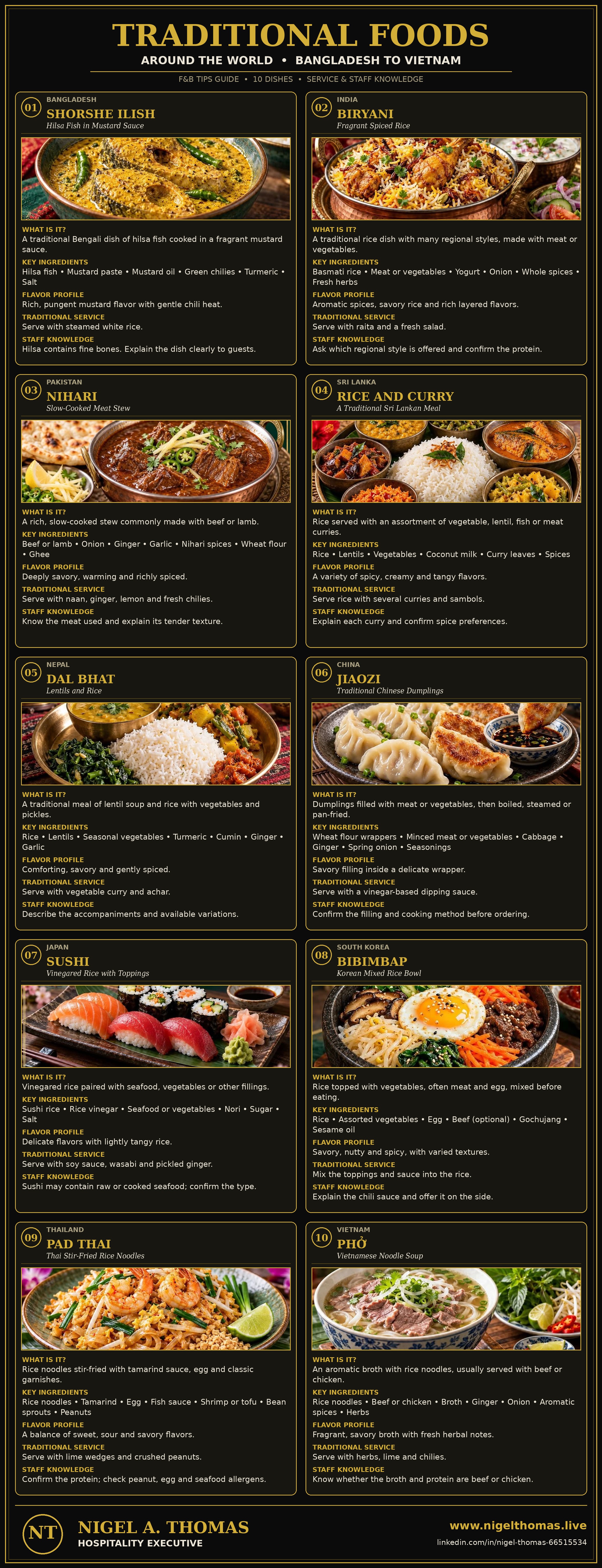
This guide brings together ten traditional dishes from across Asia, beginning in Bangladesh and ending in Vietnam: Shorshe Ilish from Bangladesh, Biryani from India, Nihari from Pakistan, Rice and Curry from Sri Lanka, Dal Bhat from Nepal, Jiaozi from China, Sushi from Japan, Bibimbap from South Korea, Pad Thai from Thailand and Phở from Vietnam. For each dish you will find what it is, the key ingredients, the flavor profile, the traditional way to serve it, and the knowledge a professional service team should have before taking an order.
It follows the same F&B Tips format used in the poster at the bottom of this page: what is it, key ingredients, flavor profile, traditional service and staff knowledge. Use the poster as a quick reference at the pass or in the briefing room, and use the article for the fuller background that helps you speak about each dish with confidence.
Shorshe Ilish
Hilsa Fish in Mustard Sauce
Shorshe ilish is one of the great dishes of Bengali cooking, and hilsa, the silvery river fish at its heart, is the national fish of Bangladesh. The fish is prized for its oily, deeply flavored flesh, and in the monsoon season it becomes the centerpiece of family meals and festive tables across Bengal. The dish is made by cooking hilsa steaks in a sauce of ground mustard seeds, mustard oil, turmeric, salt and slit green chilies, either simmered gently in a pan or steamed in a sealed container.
The flavor is unmistakable. Raw mustard paste delivers a sharp, nasal pungency, mustard oil adds a raw, peppery depth, and the green chilies bring a clean, gentle heat rather than a burning one. Cooks are careful with the mustard: over-grinding or over-cooking the paste can turn it bitter, so the sauce is usually made quickly and the fish is cooked only until tender. The result is a thin, golden, grainy sauce that clings to the fish.
For service teams, the key point is the bones. Hilsa is famously full of fine, forked bones, and guests who have never eaten it need a clear explanation before the plate arrives. Tell them it is eaten slowly, with the fingers if they wish, working the flesh away from the bones, and always with plenty of hot steamed rice. Mention that mustard and fish are both declared allergens, and that the dish has a strong, assertive taste that will not suit every palate.
Biryani
Fragrant Spiced Rice
Biryani is not one dish but a family of dishes, and that is exactly why it deserves careful explanation on a menu. At its core, it is long-grain basmati rice layered with marinated meat or vegetables, fried onions, fresh herbs, saffron and whole spices, then sealed and cooked slowly so that steam carries the aroma through every grain. It is celebrated across India and beyond, and almost every region has its own claim to the best version.
The differences matter. Hyderabadi biryani is known for its marinated meat cooked together with the rice in a sealed pot, with a pronounced use of chili and herbs. Lucknowi or Awadhi biryani is subtler and more perfumed, with a gentle spice profile. Kolkata biryani is recognized for its potato and a lighter hand with chili, while Malabar and Thalassery styles from Kerala use a short-grain fragrant rice and a distinct masala. Whichever style a kitchen follows, the rice should be separate and fluffy, never mushy, with the meat or vegetables tender and well seasoned.
Guests often assume biryani is simply spicy rice, so the server's first job is to name the regional style and the protein, whether chicken, mutton, prawn, egg or vegetable. Serve it with cool raita to balance the spices, and a fresh salad of onion, cucumber and tomato. Remind guests that whole spices such as cardamom, cloves and bay leaf are part of the cooking and are not meant to be eaten. Yogurt in the marinade and the raita means dairy is present, and some recipes add nuts, so always confirm allergens.
Nihari
Slow-Cooked Meat Stew
Nihari is a slow-cooked meat stew with deep roots in the Mughal kitchens of old Delhi, carried to Pakistan where it became a signature dish of cities such as Karachi and Lahore. The name is commonly linked to an Arabic word for morning, because the dish was traditionally simmered overnight and eaten at dawn, a hearty meal for those starting a long day. Today it is enjoyed at breakfast, lunch and dinner, especially in cooler weather and on weekends.
The cooking is all about patience. Beef shank or lamb, often with bones and marrow, is simmered for many hours with onions, ginger, garlic, ghee and a special nihari spice blend until the meat is meltingly soft and the gravy has body and gloss. A little wheat flour is used to thicken the stew, which gives it its characteristic velvety texture. The flavor is deeply savory, warming and richly spiced, more about depth than sharp heat.
The traditional garnish is as important as the stew itself: fine julienne of fresh ginger, sliced green chilies, fresh coriander and a squeeze of lemon, with hot naan to scoop it up. Servers should know which meat is used and be ready to describe the tender, almost shredded texture, particularly for guests who might expect a thin curry. Because the gravy is thickened with wheat flour and finished with ghee, gluten and dairy are present, which is worth stating up front.
Rice and Curry
A Traditional Sri Lankan Meal
Rice and curry is the everyday meal of Sri Lanka and also its celebration food. It is not a single curry poured over rice, but a spread: a mound of rice surrounded by several separate dishes, each with its own character. A typical table might include a lentil curry, a vegetable curry, a fish or meat curry, a leafy green mallung with grated coconut, and a fiery sambol on the side.
Coconut is the thread that ties the cuisine together. Coconut milk gives many of the curries a creamy richness, while fresh scraped coconut brightens sides such as mallung and sambols. Curry leaves, mustard seeds, cinnamon, cardamom, cloves and chili build layers of aroma, and a touch of tamarind or lime adds the tangy note that keeps the plate lively. The balance of spicy, creamy and sour across the dishes is the point of the meal.
In a restaurant, the experience depends on the server. Walk guests through each bowl, saying what it is, whether it contains fish, meat or only vegetables, and how hot it is. Ask about spice preference at the start, since Sri Lankan food can be quite fiery, and offer the milder curries first. Guests are meant to mix a little of several dishes with the rice in each mouthful, so encourage them to try combinations. Coconut and fish products may be present in several dishes, so allergen questions should be answered dish by dish.
Dal Bhat
Lentils and Rice
Dal bhat, literally lentils and rice, is the daily meal of Nepal, eaten once or twice a day in homes, tea houses and restaurants from the Kathmandu valley to the mountain trails. Mountain guides and trekkers are fond of saying that it provides the energy to keep going all day, and it is also the dish most Nepalis would name as the taste of home.
A full plate, usually called dal bhat tarkari, centers on steamed rice with a bowl of thin, savory lentil soup spiced with turmeric, cumin, ginger and garlic, and often finished with a hot tempering of spices in oil or ghee. Around it come a seasonal vegetable curry, a sautéed leafy green, and achar, the tangy pickle that cuts through the richness. Depending on the region and the occasion, there may also be fermented greens, a meat or egg curry, or a spoonful of yogurt.
Because the plate has many parts and many variations, the service team should describe each accompaniment and explain what is vegetarian, what contains ghee or dairy, and what can be added. In traditional settings, refills of rice and dal are offered generously, which can be a charming touch for guests if explained. Lentils are a legume, so legume allergies should be flagged, and guests who prefer less heat can be reassured that the main dish is comforting and only gently spiced, with the chili usually concentrated in the pickle.
Jiaozi
Traditional Chinese Dumplings
Jiaozi are the best-known dumplings of northern China and a core part of Lunar New Year celebrations, when families gather to fold and eat them together. Their crescent shape is often compared to old Chinese gold ingots, which is why eating jiaozi is associated with wishes for prosperity in the year ahead.
The dumpling is simple in concept: a thin wheat flour wrapper filled with minced pork, beef, lamb, shrimp or vegetables, seasoned with ginger, spring onion, soy sauce and sesame oil, with cabbage, chives or other vegetables for moisture and flavor. What changes the experience is the cooking method. Boiled jiaozi are soft and juicy, steamed ones are delicate and tender, and pan-fried jiaozi, often called potstickers, have a crisp golden base with a soft top. Each version suits a different mood and menu.
The traditional dip is a vinegar-based sauce, often black vinegar with fresh ginger and sometimes soy sauce or chili oil, whose acidity lifts the richness of the filling. Before taking an order, servers should confirm the filling and the cooking method, since guests often assume all dumplings are the same. Wheat is the main allergen, and soy and sesame are common, while shrimp or egg appear in some fillings. For vegetarian guests, confirm that the filling and the dipping sauce contain no meat or seafood.
Sushi
Vinegared Rice with Toppings
Sushi is defined by its rice, not by raw fish. The word refers to the vinegared rice, seasoned with rice vinegar, sugar and salt, that is paired with seafood, vegetables or other fillings. Over the centuries the dish has evolved from a method of preserving fish in fermented rice into the refined, hand-made food that is recognized worldwide.
Menus typically include several formats. Nigiri is a hand-pressed mound of rice with a slice of fish or other topping, maki is rice and fillings rolled in nori seaweed and cut into pieces, temaki is a hand-rolled cone, and chirashi is a bowl of rice topped with assorted ingredients. The flavor is delicate: lightly tangy rice, clean-tasting seafood, a touch of nori, with wasabi, soy sauce and pickled ginger as the traditional accompaniments. The ginger is eaten between pieces to refresh the palate, not placed on top of the sushi.
Staff knowledge matters more here than almost anywhere else on a menu. Sushi may contain raw or cooked seafood, so servers must be able to say clearly which items are raw, which are cooked and which are vegetarian. Raw fish carries a higher food safety risk for pregnant guests, older guests, young children and anyone with a weakened immune system, and they should be told. Fish, shellfish, soy, sesame and gluten, for example in soy sauce, are common allergens, and egg appears in some items such as tamago.
Bibimbap
Korean Mixed Rice Bowl
Bibimbap means mixed rice, and the name describes the way it is eaten. A bowl of warm rice is topped with an array of seasoned vegetables, often beef and a fried egg, then mixed thoroughly with a spoonful of chili paste and a drizzle of sesame oil just before eating. The city of Jeonju is especially famous for its version of the dish.
The beauty of bibimbap is in the toppings, arranged in separate colorful sections: sautéed spinach, bean sprouts, carrots, cucumber, mushrooms and other vegetables, each seasoned individually, with marinated beef and an egg in the center. The flavor is savory, nutty and gently spicy, with contrasts of crisp, soft, cool and warm in every bite. In the stone-pot version, known as dolsot bibimbap, the rice crisps against the hot bowl, creating a crunchy golden layer at the bottom that many guests consider the best part.
At the table, tell guests to add the sauce and mix everything well, and offer the gochujang on the side so that people who prefer less heat can add it gradually. In a stone pot, warn guests that the bowl is extremely hot and keeps cooking the rice as they eat. Eggs, soy and sesame are present in the standard recipe, gochujang commonly contains wheat or soy, and the beef can be left out for a vegetarian version, though the guest should confirm that no meat-based stock or sauce is used.
Pad Thai
Thai Stir-Fried Rice Noodles
Pad Thai is one of the world's most recognizable Thai dishes, and its popularity owes much to history. It rose to prominence in the 1930s and 1940s, when Thailand's government promoted rice noodle dishes as part of a national identity campaign, and it has since become both a street food classic and a restaurant staple.
The dish is built on flat rice noodles stir-fried at high heat in a wok with a sauce of tamarind, fish sauce and palm sugar, which gives the signature balance of sweet, sour and savory. Egg is scrambled into the noodles, and the dish typically includes shrimp, chicken or tofu, with bean sprouts and garlic chives for freshness. It is finished with crushed roasted peanuts and a wedge of lime, and often served with extra chili flakes and sugar on the side so guests can adjust the flavor themselves.
Pad Thai is also one of the dishes where allergen knowledge is essential. Peanuts, egg, shrimp and fish sauce are all central to a classic version, and dried shrimp may be included as well. Servers should confirm the protein with the guest, explain that the peanuts are served on top and can be left off, and check with the kitchen before promising that any version is free of an allergen. Guests who avoid gluten should also ask whether soy sauce has been added to the sauce.
Phở
Vietnamese Noodle Soup
Phở is Vietnam's national noodle soup, associated with Hanoi in the north and since spread throughout the country and around the world. The dish took its modern form in the early twentieth century and is eaten at any time of day, though it is especially loved as a breakfast and a late-night meal.
Everything depends on the broth. Beef bones or chicken are simmered for hours with charred ginger and onion and a blend of aromatic spices such as star anise, cinnamon and cloves, producing a clear, fragrant, deeply savory liquid. Silky rice noodles are placed in the bowl, topped with thin slices of beef, which cook in the hot broth, or with poached chicken, then garnished with spring onion, onion and fresh coriander.
Phở is served with a plate of fresh herbs, bean sprouts, lime wedges and sliced chilies so guests can season the soup to their own taste, and hoisin and chili sauce are often available at the table. Servers must know whether the broth and protein are beef or chicken, since guests who avoid beef need to be sure about the stock as well as the meat. Fish sauce and the soy in hoisin are common allergens, and the herbs should be offered as a side, not tossed in unasked.
Serving Traditional Dishes With Confidence
Great service begins with knowing the menu. When a guest asks what a dish is, a confident, accurate answer in two or three sentences does more for the experience than any amount of decoration. A good description names the dish, says where it comes from, mentions the main ingredients and the main flavors, and ends with what the guest needs to know, such as heat level, bones, raw fish or nuts.
Across the ten dishes in this guide, a few habits repeat. Name the regional style or variation whenever there is one, as with biryani and rice and curry. Confirm the protein before the order is taken, as with biryani, jiaozi, pad thai and phở. Warn guests about physical hazards, such as the fine bones in hilsa and the scorching stone bowl of bibimbap. Offer the strong flavors on the side, such as chili sauce, so that the guest controls the heat. And explain how the dish is meant to be eaten, whether that means mixing, dipping, tearing naan or squeezing lime into a broth.
These small actions are the difference between a guest who politely tolerates an unfamiliar dish and a guest who enjoys it and orders it again. They also show respect for the culture that created the food, which is a quiet but real part of professional hospitality.
Allergens and Guest Safety
Allergen knowledge is the most important safety responsibility of any service team. Several of the dishes here carry well-known allergens, and the exact content always depends on the individual kitchen's recipe, so the final answer must always come from the chef or the recipe card, never from assumption.
Fish and shellfish appear in shorshe ilish, sushi, pad thai (through shrimp and fish sauce) and many Sri Lankan curries. Mustard is central to shorshe ilish. Peanuts, egg and fish sauce define pad thai. Wheat appears in the nihari gravy, in jiaozi wrappers, in soy sauce and in some chili pastes. Soy and sesame appear in jiaozi, bibimbap, sushi and phở condiments. Dairy appears in biryani, raita and nihari, through yogurt and ghee. Lentils are legumes and are the basis of dal bhat. Coconut is used in many Sri Lankan dishes.
If a guest declares an allergy, stop, listen and write it down. Never guess, never say a dish is probably fine, and never let the guest leave the decision to chance. Check with the kitchen, confirm the ingredients and the cross-contact risk from shared fryers, woks and boards, and tell the guest honestly what can and cannot be done.
Final Thoughts
The ten dishes in this guide show how much variety lives in a single region of the world. Some are slow and patient, like nihari and biryani. Some are fast and fiery, like pad thai. Some are quiet and comforting, like dal bhat, and some are delicate and exacting, like sushi. What they share is a deep connection between food, place and people, and an expectation that the person serving them understands what they are putting on the table.
Whether you are training new staff, writing a menu description, preparing a themed food festival or simply curious about the dishes you love, use this guide as a starting point. Study the poster, practice the descriptions out loud, and keep learning from the chefs and guests you meet. In hospitality, the more you know about the food, the better the guest experience will be.