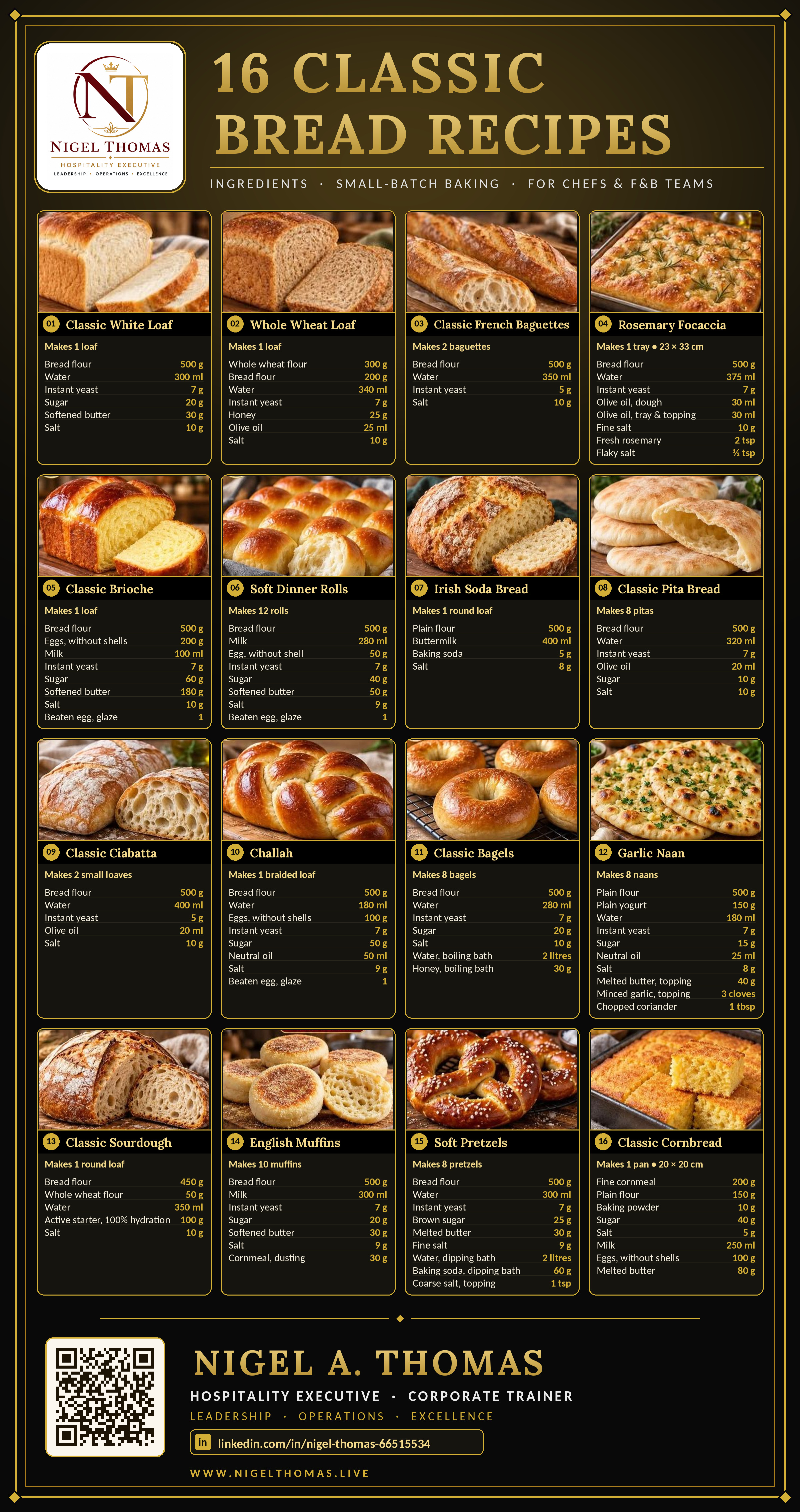
Bread is the first thing a guest tastes and the last thing a kitchen gets time to perfect. Flour, water, yeast and salt look simple, yet the same recipe can give a dense loaf one day and a beautiful open crumb the next, depending on how it was weighed, mixed, proved and baked. Consistency is the whole craft.
This guide gives you 16 classic bread recipes with exact ingredient weights and the yield each one makes, so they scale cleanly from a small batch to a full service. Every recipe has a short method with oven temperatures in Celsius and Fahrenheit. The poster at the bottom of the page puts all 16 on one sheet you can print for the bakery section or the kitchen.
"Bread does not forgive guesswork. Weigh everything, watch the dough rather than the clock, and bake the same way every time."
01 Why Weigh Everything
Professional bakers weigh every ingredient, including water, because volume measures vary too much from one scoop to the next. A 500 g flour base keeps recipes easy to compare, scale and cost, and it makes mistakes obvious. The same discipline supports menu costing, which we cover in Food Cost Basics and Types of Menus in F&B Service.
Most of the 16 recipes share the same core of bread flour, water, yeast and salt, and differ in enrichment, shaping and bake. That overlap keeps purchasing simple while the bread basket stays varied.
02 Collection 1: Everyday Loaves
The four loaves every breakfast buffet, bakery counter and bread basket relies on.
1. Classic White Loaf
- Bread flour - 500 g
- Water - 300 ml
- Instant yeast - 7 g
- Sugar - 20 g
- Softened butter - 30 g
- Salt - 10 g
Method: Makes 1 loaf. Knead until smooth, prove until doubled, shape, prove again and bake at 200°C (400°F) for 30 to 35 minutes.
2. Whole Wheat Loaf
- Whole wheat flour - 300 g
- Bread flour - 200 g
- Water - 340 ml
- Instant yeast - 7 g
- Honey - 25 g
- Olive oil - 25 ml
- Salt - 10 g
Method: Makes 1 loaf. Knead to a smooth, slightly tacky dough, prove until doubled, shape and bake at 200°C (400°F) until it sounds hollow when tapped.
3. Classic French Baguettes
- Bread flour - 500 g
- Water - 350 ml
- Instant yeast - 5 g
- Salt - 10 g
Method: Makes 2 baguettes. Mix a wet dough, fold it during a long rise, shape into baguettes, score and bake with steam at 230°C (450°F) until deep golden.
4. Rosemary Focaccia
- Bread flour - 500 g
- Water - 375 ml
- Instant yeast - 7 g
- Olive oil, dough - 30 ml
- Olive oil, tray & -
- topping - 30 ml
- Fine salt - 10 g
- Fresh rosemary - 2 tsp
- Flaky salt - ½
- tsp -
Method: Makes 1 tray • 23 × 33 cm. Rest a wet dough in an oiled tray, dimple with oiled fingers, top with rosemary and flaky salt, and bake at 220°C (425°F) until golden.
03 Collection 2: Enriched and Quick Breads
Rich brioche and soft rolls, plus a no-yeast soda bread and the classic pocket pita.
5. Classic Brioche
- Bread flour - 500 g
- Eggs, without shells - 200 g
- Milk - 100 ml
- Instant yeast - 7 g
- Sugar - 60 g
- Softened butter - 180 g
- Salt - 10 g
- Beaten egg, glaze - 1
Method: Makes 1 loaf. Knead the flour, eggs and milk, add the butter gradually until silky, prove, chill, shape, glaze and bake at 180°C (350°F).
6. Soft Dinner Rolls
- Bread flour - 500 g
- Milk - 280 ml
- Egg, without shell - 50 g
- Instant yeast - 7 g
- Sugar - 40 g
- Softened butter - 50 g
- Salt - 9 g
- Beaten egg, glaze - 1
Method: Makes 12 rolls. Knead a soft dough, divide into 12 equal rolls, prove until puffy, glaze with beaten egg and bake at 190°C (375°F) until golden.
7. Irish Soda Bread
- Plain flour - 500 g
- Buttermilk - 400 ml
- Baking soda - 5 g
- Salt - 8 g
Method: Makes 1 round loaf. Mix the dry ingredients with the buttermilk without overworking, shape a round, cut a deep cross and bake at 200°C (400°F) for about 35 minutes.
8. Classic Pita Bread
- Bread flour - 500 g
- Water - 320 ml
- Instant yeast - 7 g
- Olive oil - 20 ml
- Sugar - 10 g
- Salt - 10 g
Method: Makes 8 pitas. Knead, rest, divide into 8 rounds, roll thin and bake on a very hot surface at 250°C (480°F) until the pitas puff.
04 Collection 3: Artisan and Festive Breads
Open-crumb ciabatta, braided challah, chewy bagels and garlic naan for showcase and banquet service.
9. Classic Ciabatta
- Bread flour - 500 g
- Water - 400 ml
- Instant yeast - 5 g
- Olive oil - 20 ml
- Salt - 10 g
Method: Makes 2 small loaves. Mix a very wet dough, fold it during a long rise, divide gently without knocking out the air and bake with steam at 230°C (450°F).
10. Challah
- Bread flour - 500 g
- Water - 180 ml
- Eggs, without shells - 100 g
- Instant yeast - 7 g
- Sugar - 50 g
- Neutral oil - 50 ml
- Salt - 9 g
- Beaten egg, glaze - 1
Method: Makes 1 braided loaf. Knead a rich dough, prove, braid, glaze with beaten egg and bake at 180°C (350°F) until deep golden.
11. Classic Bagels
- Bread flour - 500 g
- Water - 280 ml
- Instant yeast - 7 g
- Sugar - 20 g
- Salt - 10 g
- Water, boiling bath - 2 litres
- Honey, boiling bath - 30 g
Method: Makes 8 bagels. Knead a stiff dough, shape into rings, prove, boil briefly in the honey bath, then bake at 220°C (425°F) until glossy and golden.
12. Garlic Naan
- Plain flour - 500 g
- Plain yogurt - 150 g
- Water - 180 ml
- Instant yeast - 7 g
- Sugar - 15 g
- Neutral oil - 25 ml
- Salt - 8 g
- Melted butter, topping - 40 g
- Minced garlic, topping - 3 cloves
- Chopped coriander - 1 tbsp
Method: Makes 8 naans. Mix the yogurt dough, prove, roll out, cook on a very hot pan or grill, then brush with garlic butter and coriander.
05 Collection 4: Classic Specialities
Sourdough, English muffins, soft pretzels and cornbread for breakfast, bar and bistro menus.
13. Classic Sourdough
- Bread flour - 450 g
- Whole wheat flour - 50 g
- Water - 350 ml
- Active starter, 100% hydration - 100 g
- Salt - 10 g
Method: Makes 1 round loaf. Mix flour, water and starter, rest, fold through a long fermentation, shape, proof and bake in a hot covered pot at 230°C (450°F).
14. English Muffins
- Bread flour - 500 g
- Milk - 300 ml
- Instant yeast - 7 g
- Sugar - 20 g
- Softened butter - 30 g
- Salt - 9 g
- Cornmeal, dusting - 30 g
Method: Makes 10 muffins. Make a soft dough, prove, cut rounds and dust with cornmeal, then cook on a griddle over low heat until golden and cooked through.
15. Soft Pretzels
- Bread flour - 500 g
- Water - 300 ml
- Instant yeast - 7 g
- Brown sugar - 25 g
- Melted butter - 30 g
- Fine salt - 9 g
- Water, dipping bath - 2 litres
- Baking soda, dipping bath - 60 g
- Coarse salt, topping - 1 tsp
Method: Makes 8 pretzels. Knead, shape into pretzels, dip briefly in the baking soda bath, add coarse salt and bake at 220°C (425°F) until deep brown.
16. Classic Cornbread
- Fine cornmeal - 200 g
- Plain flour - 150 g
- Baking powder - 10 g
- Sugar - 40 g
- Salt - 5 g
- Milk - 250 ml
- Eggs, without shells - 100 g
- Melted butter - 80 g
Method: Makes 1 pan • 20 × 20 cm. Mix the dry and wet ingredients just until combined, pour into a greased pan and bake at 200°C (400°F) until golden and set.
06 Bakery Standards for Every Loaf
- Weigh every ingredient, including water, and keep a scale at the bake station
- Check water and dough temperature, because warm dough proves faster and cold dough slower
- Judge proofing by the dough, which should look puffy and spring back slowly, not only by the clock
- Bake loaves until they sound hollow when tapped, at roughly 90–99°C (195–210°F) inside depending on the dough
- Cool bread on a rack before slicing so the crumb can set
- Treat raw flour and raw egg dough as raw ingredients: do not taste raw dough, and wash hands and surfaces after handling
- Flag allergens at order: wheat (gluten), egg, milk and honey appear across these recipes
07 Frequently Asked Questions
Why weigh flour and water instead of using cups?
A cup of flour can vary by 20 percent or more depending on how it is scooped. Weighing gives the same dough every time, which is what makes bread consistent and costable.
Can these recipes be scaled for service?
Yes. Scale every ingredient by weight, including yeast and salt. Larger batches hold heat and proof differently, so test proof times on the first big batch before relying on them.
Why did my bread come out dense?
The usual causes are under-proofing, too little kneading, old yeast or the wrong flour. Check the yeast is fresh, let the dough finish its rise, and use bread flour where the recipe asks for it.
Sixteen breads, one standard way of making them. Print the poster, brief the team, and let the weights and temperatures do the work.
Nigel A. Thomas, F&B and Hospitality Operations Professional | India · Middle East · USA

Nigel A. Thomas
30+ years in F&B and hospitality operations across India, the Middle East, and the USA. Founder of JobLynk.live, India's careers platform for hospitality and maritime professionals. Writing about operations, food safety, and the business of hospitality from the inside out.