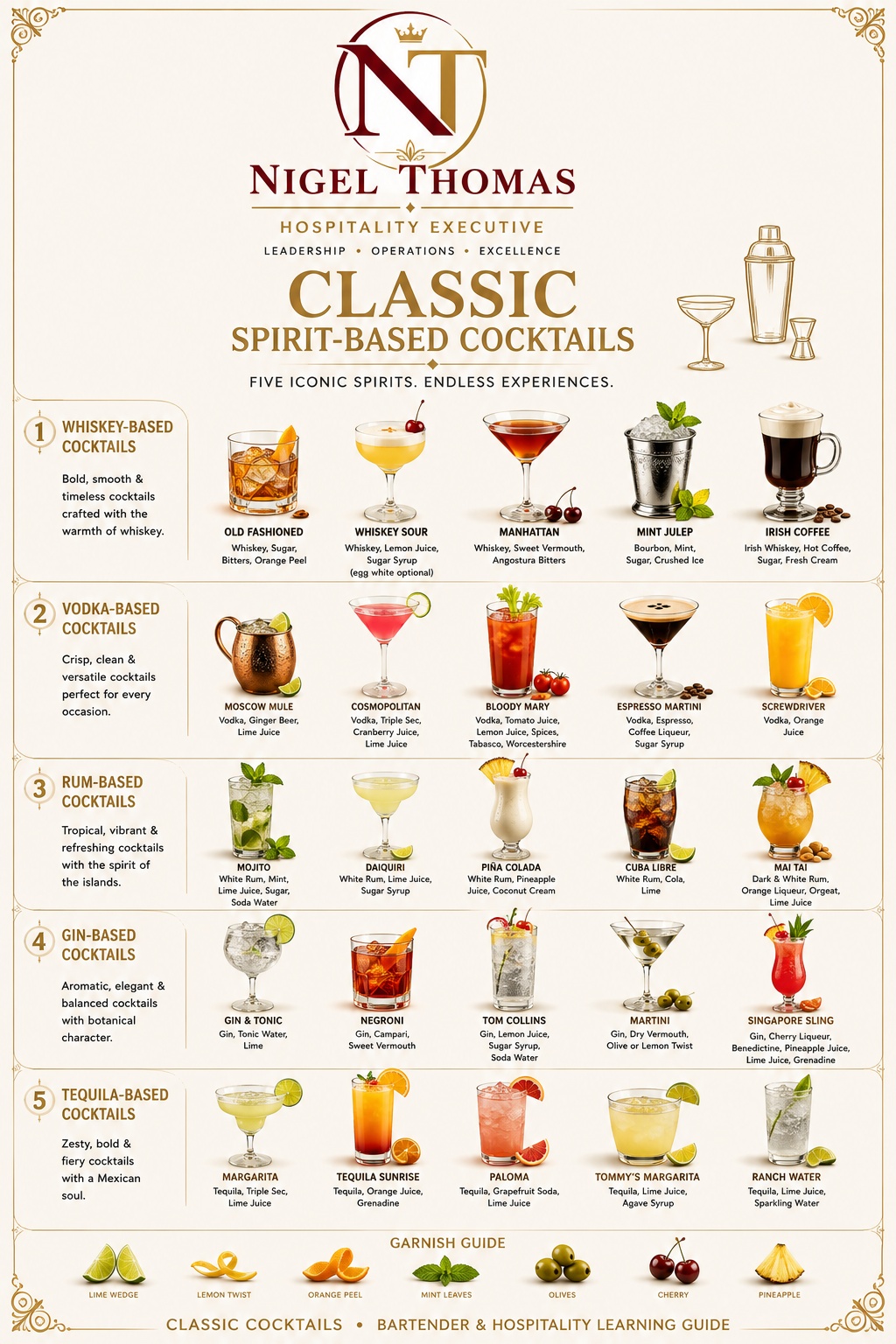
Ask a new bartender to name five whiskey cocktails and most can get to two before stalling. Ask a server to explain the difference between a Collins and a Fizz, or why a Negroni is stirred while a Daiquiri is shaken, and the room usually goes quiet. Classic cocktails are treated as trivia in a lot of training programs, when in reality they are the single fastest way to make a bar team look competent - or expose them as undertrained - in the first sixty seconds of a guest interaction.
This guide covers twenty-five cocktails across the five spirit families that make up the overwhelming majority of any cocktail menu: whiskey, vodka, rum, gin and tequila. For each drink you get the core ingredients, the correct glassware, the garnish, and the service context that actually matters on a working floor - not just a recipe card, but the reasoning a trained bartender carries in their head. It closes with a garnish reference, a method-matching framework that ties back to bar technique fundamentals, a staff training approach, and answers to the questions that come up most often behind a real bar.
"A guest doesn't remember that you made a good Old Fashioned. They remember that you didn't have to think about it."
01 Why Five Spirit Families Is the Right Mental Model
Every spirit-based cocktail menu, no matter how creative or how large, is built on the same five base spirits: whiskey, vodka, rum, gin and tequila. Organising cocktail knowledge around spirit family rather than around individual drink names is what separates a bartender who has memorised twenty-five recipes from one who actually understands the category. Once a team understands what whiskey, gin, rum, vodka and tequila each bring to a glass - warmth and oak, neutrality and cleanliness, tropical sweetness, herbal complexity, and agave heat, respectively - they can improvise substitutions, explain flavour profiles to guests, and recommend confidently instead of defaulting to whatever is easiest to describe.
This is also why the five sections below are structured the same way every time: a short character description of the spirit family, followed by five cocktails that best represent what that spirit does in a glass. The same underlying skeleton - spirit, modifier, sweetener, garnish - appears again and again once you see it, and that repetition is exactly what makes this material trainable in a single shift rather than over months.
02 Whiskey-Based Cocktails
Whiskey cocktails are bold, smooth and timeless, built around the warmth of aged grain spirit. They range from the almost unadorned Old Fashioned to the layered, dessert-adjacent Irish Coffee, and they are disproportionately popular with guests who describe themselves as "not really cocktail people" - which makes them a critical category to have covered properly.
1. Old Fashioned
Whiskey, sugar, bitters and an orange peel, built directly over a large ice cube in a rocks glass. This is the drink every serious bartending program starts with because it has almost nowhere to hide - poor quality whiskey, over-diluted ice, or a badly expressed orange peel show up immediately in the glass. Service tip: use one large cube rather than several small ones to control dilution, and express the orange peel oils over the surface before dropping it in rather than skipping this step.
2. Whiskey Sour
Whiskey, lemon juice and sugar syrup, shaken and served up or over ice, with egg white as an optional addition for texture and a silky foam cap. The egg white version needs a dry shake (no ice) first to emulsify, followed by a second shake with ice - skipping the dry shake is the single most common execution error with this drink. Garnish with a cherry and, if using egg white, a few drops of bitters on the foam.
3. Manhattan
Whiskey, sweet vermouth and Angostura bitters, stirred with ice and strained into a chilled coupe or martini glass. Like all spirit-forward, no-juice cocktails, this is stirred rather than shaken - shaking would introduce unwanted dilution and air bubbles that dull the drink's clarity and texture. Traditionally garnished with a cherry, occasionally a lemon twist for a drier presentation.
4. Mint Julep
Bourbon, fresh mint and sugar, built over crushed ice, traditionally in a chilled silver or pewter julep cup that frosts on the outside. The crushed ice is not cosmetic - it dilutes quickly and keeps the drink ice-cold throughout service, which is the entire point of a drink designed for hot weather and long porches. Garnish generously with a mint sprig, and encourage guests to bruise it gently before drinking to release the aromatics.
5. Irish Coffee
Irish whiskey, hot coffee and sugar, topped with lightly whipped fresh cream floated over the back of a spoon so it sits on top rather than mixing in. This is the one cocktail on this list served hot, and the float technique - pouring slowly over an inverted spoon just above the surface - is worth demonstrating in training rather than just describing, since it is genuinely difficult to get right from a written description alone.
03 Vodka-Based Cocktails
Vodka cocktails are crisp, clean and versatile, and precisely because vodka itself is largely flavourless, these drinks live or die on the quality of everything else in the glass - the ginger beer, the tomato juice, the espresso. Vodka is the spirit family most often ordered by guests who want the effect of a cocktail without a dominant spirit character, which makes ingredient quality even more important here than in categories where the base spirit does more of the work.
6. Moscow Mule
Vodka, ginger beer and lime juice, traditionally served in a copper mug, which genuinely does keep the drink colder for longer due to copper's thermal conductivity - this is one of the rare cases where the signature glassware has a real functional purpose rather than being purely decorative. Garnish with a lime wedge.
7. Cosmopolitan
Vodka, triple sec, cranberry juice and lime juice, shaken hard and strained into a chilled martini glass. The Cosmopolitan's pink colour and citrus twist garnish made it one of the most recognisable cocktails of its era, and it remains a reliable order for guests who want something vodka-based that reads as more sophisticated than a straight mixer drink.
8. Bloody Mary
Vodka, tomato juice, lemon juice and a seasoning stack of spices, Tabasco and Worcestershire sauce, built over ice in a highball glass. This is the most customisable cocktail on this entire list - guests routinely have strong opinions about spice level, garnish load, and whether celery belongs in the glass at all - so a good bartender treats the base recipe as a starting point and asks rather than assumes. Garnish traditionally includes a celery stalk and a cherry tomato.
9. Espresso Martini
Vodka, fresh espresso, coffee liqueur and sugar syrup, shaken hard to build the characteristic three-coffee-bean foam cap and strained into a chilled martini glass. Hard, sustained shaking matters more here than in almost any other cocktail on this list, because the foam is a visible, expected part of the presentation - a flat-topped Espresso Martini reads as under-executed even if the flavour is fine. Garnish with three coffee beans on the foam.
10. Screwdriver
Vodka and orange juice, built over ice in a highball glass. The simplicity of this drink means quality of the orange juice is the entire differentiator - freshly squeezed versus carton-from-concentrate is the difference between a drink that tastes considered and one that tastes like an afterthought. Garnish with an orange slice.
04 Rum-Based Cocktails
Rum cocktails are tropical, vibrant and refreshing, carrying the spirit of the islands regardless of where they're actually served. This category spans the driest, most technically demanding classics through to the sweetest, most indulgent frozen drinks, which makes it one of the widest-ranging spirit families on a typical menu.
11. Mojito
White rum, fresh mint, lime juice, sugar and soda water, built in a highball glass with the mint gently muddled - not pulverised - to release oils without turning the drink bitter or filling it with shredded leaf fragments. Overworking the mint is the most common execution fault with this drink. Top with soda water and garnish with a mint sprig.
12. Daiquiri
White rum, lime juice and sugar syrup, shaken and strained into a chilled coupe. The classic Daiquiri bears almost no resemblance to the blended, artificially flavoured "daiquiris" served at many casual venues, and it's worth training staff on the distinction - this version is dry, sharp and genuinely elegant, not a frozen slushy.
13. Piña Colada
White rum, pineapple juice and coconut cream, blended with ice until smooth and served in a hurricane glass or a hollowed pineapple for presentation. This is one of only two drinks on this entire list made using the blending method rather than shaking, stirring or building, and it needs a genuinely powerful blender to avoid a watery, poorly integrated result. Garnish with a pineapple wedge and a cherry.
14. Cuba Libre
White rum, cola and lime juice, built over ice in a highball glass. Frequently confused with a plain "rum and coke," the defining difference is the lime juice, which cuts the cola's sweetness and gives the drink genuine balance rather than one-dimensional sweetness. Garnish with a lime wedge.
15. Mai Tai
Dark and white rum blended together, with orange liqueur, orgeat (almond syrup) and lime juice, built or shaken over crushed ice. The dual-rum structure - a lighter rum for brightness, a darker rum for depth - is what separates a proper Mai Tai from the generic "tropical rum punch" it's often reduced to on casual menus. Garnish with mint and a cherry, classically finished with a spent lime shell.
05 Gin-Based Cocktails
Gin cocktails are aromatic, elegant and balanced, carrying real botanical character from the juniper, citrus peel and spice that go into the spirit itself. Because gin already brings so much flavour complexity to the glass, gin cocktails tend to have fewer ingredients than other categories - the spirit is doing more of the work, so the supporting cast needs to be more restrained.
16. Gin & Tonic
Gin and tonic water over ice, garnished with lime, built directly in a large wine glass or highball. This is arguably the single most order-frequent cocktail on any bar menu worldwide, and its apparent simplicity is exactly why quality tonic water and correct ice-to-liquid ratio matter so much - there is nowhere for a poor execution to hide in a two-ingredient drink.
17. Negroni
Gin, Campari and sweet vermouth in equal parts, stirred with ice and served over a large cube in a rocks glass. The Negroni's bitter, spirit-forward profile makes it a genuine acquired taste, and staff should be prepared to describe it honestly to guests who haven't had one before - "bitter and boozy, an aperitivo classic" sets expectations far better than letting a guest discover the bitterness by surprise. Garnish with an orange peel, expressed over the drink.
18. Tom Collins
Gin, lemon juice, sugar syrup and soda water, built in a tall Collins glass over ice. This is the gin family's answer to the whiskey Sour and the vodka Screwdriver - a citrus-and-soda long drink designed for warm weather, easy drinking and broad appeal. Garnish with an olive or a lemon twist depending on the house style.
19. Martini
Gin and dry vermouth, stirred with ice and strained into a chilled martini glass. Few cocktails carry as much personal customisation as the Martini - guests will specify gin-to-vermouth ratio, "wet" versus "dry," shaken versus stirred, and olive versus twist, and a well-trained bartender treats each of these as a real question rather than a default. Garnish with olives or a lemon twist per the guest's preference.
20. Singapore Sling
Gin, cherry liqueur, Bénédictine, pineapple juice, lime juice and grenadine, shaken or built and served in a hurricane glass. This is the most ingredient-dense cocktail on the entire list, and it rewards a bartender who actually measures rather than free-pours, since the balance between six components is far more fragile than in a simpler build. Garnish with a cherry and a pineapple wedge.
06 Tequila-Based Cocktails
Tequila cocktails are zesty, bold and fiery, carrying real Mexican character from the agave spirit at their base. This category has grown enormously in popularity over the last decade as guest perception of tequila has shifted away from "shot spirit" and toward a genuinely respected sipping and mixing spirit, and staff who can speak to that shift confidently tend to upsell this category well.
21. Margarita
Tequila, triple sec and lime juice, shaken and served over ice or up, traditionally in a salt-rimmed glass. The salt rim is functional as well as decorative - it balances the drink's acidity - and staff should always ask whether a guest wants it, rather than assuming everyone does. Garnish with a lime wheel.
22. Tequila Sunrise
Tequila, orange juice and grenadine, built by layering the grenadine at the bottom so it rises through the drink and creates the signature sunrise gradient - poured slowly down the side of the glass or over the back of a bar spoon, never stirred in. This is one of the few cocktails on this list where the visual presentation is genuinely part of the technique, not just decoration. Garnish with an orange slice.
23. Paloma
Tequila, grapefruit soda and lime juice, built over ice in a highball glass. Enormously popular throughout Mexico and increasingly on international menus, the Paloma's grapefruit brightness makes it a strong recommendation for guests who find a Margarita too sweet or too salty. Garnish with a lime wedge.
24. Tommy's Margarita
Tequila, lime juice and agave syrup, shaken and served over ice - a variation on the classic Margarita that replaces the triple sec with agave nectar, producing a cleaner, more purely agave-forward profile. This is a good drink to know for guests who ask for "a better Margarita" or who are curious about small variations on a classic they already know.
25. Ranch Water
Tequila, lime juice and sparkling mineral water, built over ice in a highball glass. The newest cocktail on this list by a wide margin, Ranch Water has grown rapidly in popularity as a lighter, lower-sugar alternative within the tequila category, and it's worth having on hand as a recommendation for guests actively avoiding sweeter mixed drinks.
07 Garnish Guide - Quick Reference
Garnish is not decoration, it's a detail that completes the drink - the same principle covered in more depth in our pasta sauce pairing guide applies equally behind the bar: the finishing touch changes how a guest experiences the whole drink, not just how it looks in a photo.
| Garnish | Used With | Prep Note |
|---|---|---|
| Lime Wedge | Moscow Mule, Cuba Libre, Margarita, Paloma, Ranch Water | Cut fresh, same-day where possible |
| Lemon Twist | Manhattan, Tom Collins | Peel fresh, express oils over the drink |
| Orange Peel | Old Fashioned, Negroni | Thin peel, express and rub the rim |
| Mint Leaves | Mint Julep, Mojito, Mai Tai | Slap gently before garnishing to release aroma |
| Olives | Martini, Tom Collins (house style) | Keep chilled in brine, skewer fresh per order |
| Cherry | Whiskey Sour, Manhattan, Piña Colada, Mai Tai, Singapore Sling | Keep submerged in syrup |
| Pineapple | Piña Colada, Singapore Sling | Fresh wedge or wheel, cut same-day |
08 Matching Cocktails to Method
Every cocktail on this list is built using one of the core bar techniques covered in our methods of making cocktails guide, and matching drink to method correctly is not optional stylistic preference - it changes texture, dilution and clarity in ways guests genuinely notice, even when they can't articulate why.
Stirred, Not Shaken
Manhattan, Negroni and Martini are all spirit-forward with no juice or dairy - stirring chills and dilutes without clouding the drink or introducing unwanted air. Shaking these would be a genuine technical error, not just a stylistic choice.
Shaken, Not Stirred
Whiskey Sour, Cosmopolitan, Espresso Martini, Daiquiri and Margarita all contain juice, syrup or dairy that needs vigorous integration - shaking is what creates the texture and, in the Espresso Martini's case, the signature foam cap.
The remaining drinks on this list are built directly in the serving glass (Gin & Tonic, Moscow Mule, Screwdriver, Cuba Libre, Bloody Mary), blended (Piña Colada), or layered for visual effect (Tequila Sunrise) - and training staff to recognise which bucket a new or unfamiliar cocktail falls into is a far more transferable skill than memorising recipes one at a time.
09 Training Framework for Bar Teams
This is a genuinely high-return training topic precisely because guests interact with a bar team's cocktail knowledge constantly, not occasionally. A few practical steps that work well when standardising this material across a team:
- Group training by spirit family, not by individual drink - it builds transferable understanding rather than rote memorisation
- Have new staff physically build, shake and stir each core drink during onboarding rather than only reading recipe cards
- Brief staff specifically on the three most customisable drinks - Bloody Mary, Martini and Margarita - since these draw the most guest-specific requests
- Pair method training with the garnish guide so staff understand technique and presentation together, not as separate topics
- Reinforce standard pour sizes from your house measurement standards so consistency holds across shifts and bartenders
- Keep a copy of the bartender's quick reference at the station for fast lookups during service, not just as an onboarding document
10 Frequently Asked Questions
Why are some cocktails stirred and others shaken?
Stirring is reserved for drinks made entirely of spirits and modifiers with no juice, dairy or egg - it chills and dilutes gently while preserving clarity. Shaking is used whenever a drink contains juice, syrup, dairy or egg white, since the technique's vigorous agitation is needed to properly integrate those ingredients and, in some cases, build texture or foam.
What is the single most important garnish mistake to avoid?
Treating garnish as purely decorative rather than functional. A salt rim on a Margarita balances acidity, an expressed citrus peel over an Old Fashioned adds aromatic oils that change the nose of the drink before the first sip, and a properly muddled mint sprig in a Mojito releases oils that a bruised or torn leaf simply doesn't. Skipping or rushing garnish technique measurably changes the drink, not just its appearance.
Should bartenders customise classic recipes for guest preference?
Yes, within reason - the Martini and Bloody Mary in particular are cocktails where guests routinely have strong, specific preferences, and a good bartender treats the base recipe as a starting point for a conversation rather than a fixed rule. The discipline is in knowing which drinks tolerate customisation gracefully (Martini, Bloody Mary, Margarita) versus which ones lose their identity if altered too far (Old Fashioned, Negroni, Manhattan).
Is it necessary to know all twenty-five cocktails to run a bar well?
Not every venue needs all twenty-five in active rotation, but every bar team benefits from understanding all five spirit families and at least the signature drink from each - Old Fashioned, Moscow Mule, Mojito, Martini and Margarita cover an enormous share of real-world guest requests on their own, and they anchor the rest of the category conceptually even when a menu is smaller.
Twenty-five cocktails, five spirit families, one underlying framework - none of it is trivia once a guest is standing at your bar asking what you'd recommend. Building this into onboarding costs a single structured session and pays back every time a bartender upsells with confidence or gets a classic order exactly right on the first attempt.
Nigel A. Thomas, F&B and Hospitality Operations Professional | India · Middle East · USA

Nigel A. Thomas
30+ years in F&B and hospitality operations across India, the Middle East, and the USA. Founder of JobLynk.live, India's careers platform for hospitality and maritime professionals. Writing about operations, food safety, and the business of hospitality from the inside out.