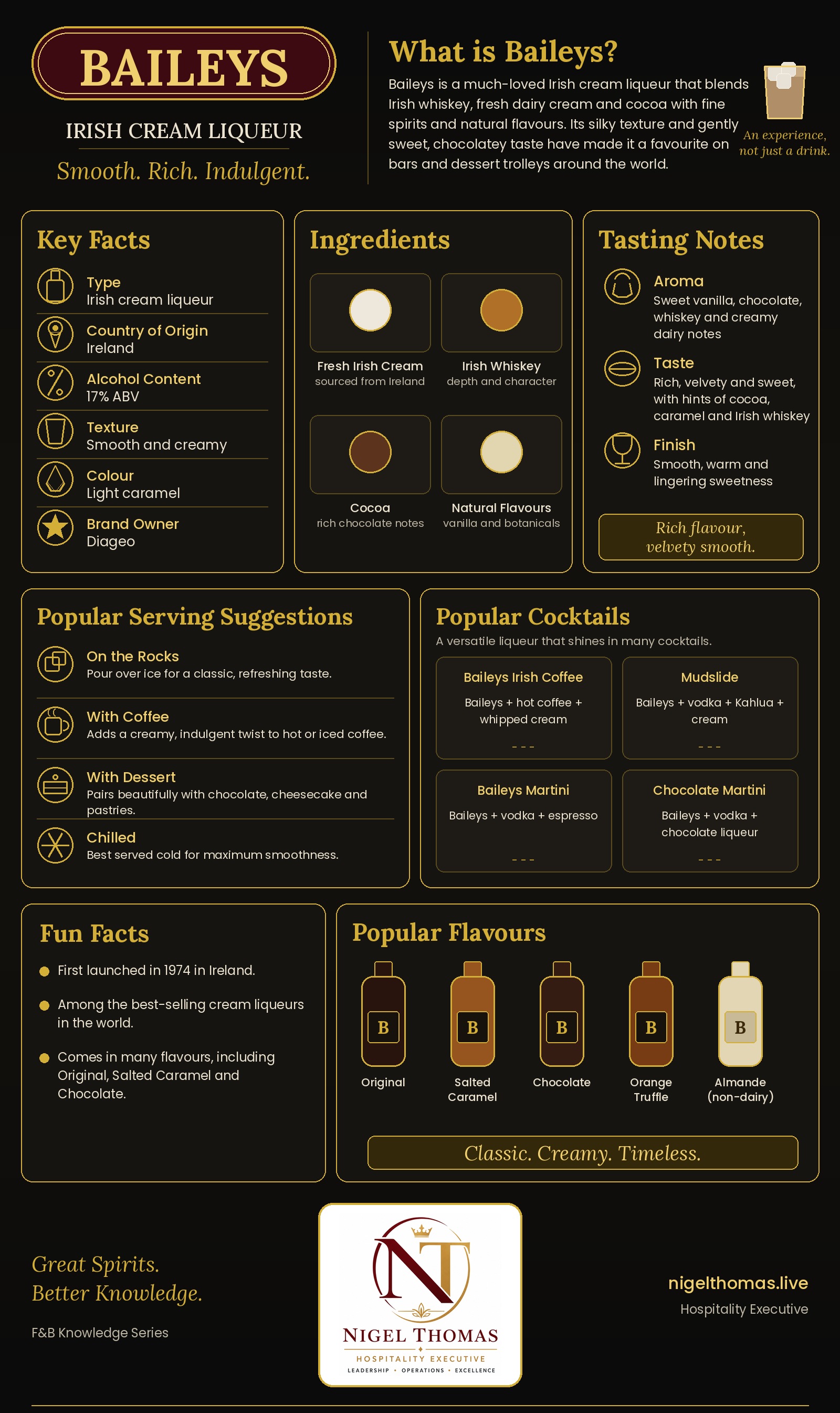
Few bottles on a back bar are as instantly recognisable as Baileys. It sits on dessert trolleys in five-star hotels, behind neighbourhood bars, in home kitchens at Christmas and in the coffee station of nearly every restaurant that takes its after-dinner service seriously. Yet many people who pour it every day could not say what is actually inside the bottle, how it differs from other cream liqueurs, or how to get the most from it on a menu. This guide covers all of it, from the basics to practical service tips for working bar and F&B teams.
What Is Baileys?
Baileys is an Irish cream liqueur. In plain terms, it is a blend of Irish whiskey, fresh dairy cream, cocoa and natural flavourings, sweetened and stabilised so that cream and spirit stay together in one smooth, pourable liquid. It carries 17% alcohol by volume, which places it well below a standard whiskey or vodka and gives it the gentle warmth that makes it easy to sip on its own.
The result is a drink that tastes like a liquid dessert: velvety on the palate, sweet without being sharp, with vanilla, chocolate and caramel notes riding over a soft whiskey backbone. It is poured over ice, stirred into coffee, shaken into cocktails, drizzled over ice cream and baked into cakes. That versatility is the main reason it has stayed on bar menus for fifty years.
Today the brand is owned by Diageo, one of the largest spirits companies in the world, and is sold in well over a hundred countries. It is consistently counted among the best-selling cream liqueurs anywhere.
A Short History of Baileys
Baileys was launched in 1974 in Ireland. It was developed in Dublin by a small team at Gilbeys of Ireland, part of International Distillers & Vintners, a company that later became part of Diageo. The idea was ambitious for its time: combine two products Ireland is famous for, whiskey and dairy cream, in a single bottle that would stay stable on a shelf.
The technical challenge was the heart of the project. Cream and alcohol do not naturally stay together; left alone, a spirit tends to curdle cream and the mixture separates. Solving that problem through careful blending, homogenisation and the use of an emulsifier is what turned a clever idea into a product that could be bottled, shipped across the world and stored for months. The launch was an immediate success, and cream liqueur became a category of its own.
Over the following decades Baileys expanded from a simple Original into a family of flavours, and more recently into a non-dairy option. It also moved from being seen mainly as a Christmas drink to a year-round ingredient used in coffee, desserts and cocktails.
What Goes Into the Bottle
Four building blocks define the character of Baileys. Understanding them helps you explain the product to guests and use it intelligently in a recipe.
Fresh Irish Cream
Dairy cream from Irish farms gives Baileys its body, richness and silky texture. It is the reason the drink feels thick and luxurious rather than thin and syrupy, and it is also why the product contains milk, which matters for allergen declarations on any menu.
Irish Whiskey
Irish whiskey provides depth and character. It is triple-distilled in the Irish tradition, which tends to produce a light, smooth spirit rather than a heavy, smoky one. That softness suits cream well, adding warmth and a faint grain and oak note without overpowering the sweetness.
Cocoa
Cocoa adds the chocolate notes that most drinkers pick up first. It is subtle rather than bitter, giving the liqueur its familiar cafe-au-lait colour and a rounded finish.
Natural Flavours
Vanilla and other botanical flavourings round off the profile, lifting the aroma and tying the cream, cocoa and whiskey together. Sugar and an emulsifier complete the recipe; the emulsifier is what keeps cream and spirit blended instead of separating.
Baileys at a Glance
| Type | Irish cream liqueur |
|---|---|
| Country of origin | Ireland |
| Alcohol content | 17% ABV |
| Texture | Smooth and creamy |
| Colour | Light caramel |
| Brand owner | Diageo |
| First launched | 1974 |
Tasting Notes: Aroma, Taste and Finish
When you teach guests or junior bartenders how to taste, a simple three-step structure works well. Baileys is an ideal product to practise on because its profile is clear and approachable.
Aroma. Lean in and the first impression is sweet vanilla, followed by chocolate, a hint of whiskey and the soft, round smell of fresh dairy cream.
Taste. On the palate it is rich, velvety and sweet, with cocoa and caramel in the middle and a whiskey note that appears towards the back. It is not a sharp or burning drink; the cream cushions the alcohol completely.
Finish. The finish is smooth and warm, with a lingering sweetness that fades slowly. That long, gentle finish is exactly why it works so well at the end of a meal.
How to Serve Baileys
One of the strengths of Baileys is that there is no complicated ritual. Four simple serves cover almost every occasion.
On the Rocks
The classic. Fill a short glass with good-quality ice and pour. The ice chills the liqueur, adds slight dilution and keeps the texture refreshing. A typical house pour is 30 to 60 ml depending on your venue’s standard measure.
With Coffee
Add a measure to a cup of hot coffee for a creamy, indulgent twist, or pour it over iced coffee in warm weather. Baileys works equally well with filter coffee, americano and espresso. Many restaurants use it to create a simple signature after-dinner coffee.
With Dessert
Baileys pairs beautifully with chocolate, cheesecake, tiramisu, brownies and pastries. It can also be served alongside the dessert, poured over vanilla ice cream like a sauce, or used in the dessert itself.
Chilled
For maximum smoothness, serve it cold. Storing the bottle in a cool place and serving over plenty of ice, or stirring briefly with ice and straining, gives a silkier, more refreshing drink.
Popular Baileys Cocktails
These four drinks show the range of the liqueur, from warm and comforting to cold and dessert-like. The measures below are a sensible starting point; adjust them to match your own bar specifications.
Baileys Irish Coffee
Baileys + hot coffee + whipped cream. Pour 30 to 45 ml of Baileys into a heatproof glass, add freshly brewed hot coffee, and finish with a cap of lightly whipped cream. Dust with cocoa or a little grated chocolate if you want extra presentation.
Mudslide
Baileys + vodka + Kahlúa + cream. Combine 30 ml each of Baileys, vodka and coffee liqueur with a splash of cream. Shake hard with ice and strain into a glass drizzled with chocolate sauce, or blend with ice for a frozen version that doubles as a dessert.
Baileys Martini
Baileys + vodka + espresso. Shake roughly 45 ml Baileys, 30 ml vodka and a shot of fresh espresso vigorously with ice and strain into a chilled martini glass. Shaking creates the fine foam on top, so do not rush this step.
Chocolate Martini
Baileys + vodka + chocolate liqueur. Shake 45 ml Baileys, 30 to 45 ml vodka and 15 to 30 ml chocolate liqueur with ice, then strain into a chilled glass rimmed or swirled with chocolate syrup.
A technique note: cream liqueurs and strongly acidic ingredients do not mix well. Citrus juice and some fruit purees can cause curdling, so keep Baileys away from them unless you are following a tested recipe.
The Baileys Flavour Range
The Original is the benchmark, but the range has grown to suit different tastes.
- Original: the classic cream, whiskey and cocoa blend that started it all.
- Salted Caramel: a buttery, sweet-and-salty twist that is popular in coffee and over ice cream.
- Chocolate: a deeper cocoa profile for dessert drinks and hot chocolate.
- Orange Truffle: chocolate with a bright orange lift, often seen as a seasonal favourite.
- Almande (non-dairy): an almond-based version with no dairy, aimed at guests who avoid milk products.
Availability of individual flavours varies by country and season, so check what your distributor can supply before you plan a menu around one.
Pairing Baileys With Food
Because Baileys is sweet and creamy, think of it as a dessert partner. It suits chocolate dishes such as brownies, mousse and molten cakes; creamy desserts such as cheesecake, panna cotta and tiramisu; coffee-flavoured sweets; and ice cream, especially vanilla, coffee and caramel flavours. It also works inside cooking: a spoonful in a chocolate sauce, a coffee cream or a bread-and-butter pudding adds depth without making the dish taste alcoholic.
For a simple dessert upgrade, serve a small scoop of vanilla ice cream in a glass and pour a measure of Baileys over it at the table. It takes seconds, looks elegant and increases the value of the plate.
Storage, Shelf Life and Handling
Baileys contains real cream, so storage matters more than it does for a bottle of whiskey. Keep it in a cool place away from heat and direct sunlight. It does not need to be refrigerated, but you can chill it if you prefer a cold pour. Always check the label on your bottle for the best-before information; the brand generally advises that unopened bottles keep for around two years and that opened bottles are best enjoyed within about six months.
Two habits protect quality. First, close the bottle tightly after every service. Second, shake it gently before pouring, because a little settling can occur over time. If the liqueur smells sour, looks lumpy or tastes off, discard it.
Tips for Bar and F&B Professionals
For hospitality teams, Baileys is more than a product to pour; it is a menu tool.
Position it at the end of the meal
Offer Baileys with coffee or dessert as part of the final-course conversation. A simple line from the server such as “Would you like a Baileys with your coffee tonight?” lifts average spend with almost no extra effort.
Build two or three signature serves
A Baileys coffee, a chilled dessert cocktail and a frozen Mudslide-style drink cover hot, cold and indulgent options without crowding the menu. Train every team member to prepare them to the same standard.
Control the pour
Use a jigger for every measure. Cream liqueurs are easy to over-pour because they look innocent, and over-pouring quietly damages your cost percentage. Standardise the measure in your bar manual and price the serve accordingly.
Declare allergens clearly
Baileys Original contains milk. Make sure menus, servers and bartenders can answer allergen questions confidently, and know which flavours or alternatives are suitable for dairy-free guests.
Rotate stock
Cream-based products have a shorter shelf life than most spirits. Use first-in, first-out, date opened bottles and avoid keeping a half-empty bottle on the back bar for months.
Serve responsibly
At 17% ABV, Baileys is easy to drink quickly. Train staff to treat it like any other alcoholic drink, particularly when it is used in sweet cocktails that mask the strength.
Fun Facts About Baileys
- Baileys was first launched in 1974 in Ireland.
- It is one of the best-selling cream liqueurs in the world.
- It combines Irish whiskey and Irish dairy cream, two of Ireland’s best-known products, in one bottle.
- The brand now spans several flavours, including Original, Salted Caramel, Chocolate and a plant-based Almande.
- It is as comfortable in a kitchen as on a bar, appearing in cakes, sauces, ice cream and coffee.
Frequently Asked Questions
Is Baileys a whiskey?
No. It contains Irish whiskey, but it is a cream liqueur, a different category with a much lower alcohol content and a sweet, creamy flavour.
How strong is Baileys?
Baileys Original is 17% ABV.
Does Baileys need to be refrigerated?
No, it can be stored in a cool place away from sunlight, though many people like to serve it chilled.
Can Baileys go off?
Yes. Because it contains cream, it has a limited shelf life, especially once opened. Follow the guidance on the label and discard it if it smells or tastes wrong.
Is there a dairy-free Baileys?
Yes. Baileys Almande is an almond-based, non-dairy alternative. Always check the current label for ingredients and allergens.
What can I mix with Baileys?
Coffee, hot chocolate, vodka, coffee liqueur, espresso and ice cream are all reliable partners. Avoid citrus and other acidic mixers.
Final Thoughts
Baileys has lasted half a century because it does one thing exceptionally well: it turns a handful of simple, high-quality ingredients into a drink that is instantly comforting. For guests it is an easy, familiar indulgence. For hospitality professionals it is a flexible, profitable product that fits coffee service, dessert menus and cocktail lists alike. Pour it with care, store it properly, price it sensibly and train your team to recommend it, and it will keep earning its place on your bar.
Use the infographic below for quick reference, staff training boards or sharing with your team.