Walk into any hotel kitchen and pasta is one of the busiest items on the line. It appears on the lunch buffet as a salad, at dinner as a classic Italian course, in room service as a late-night comfort dish, and in the staff canteen as the meal that feeds everyone. Yet cooks, servers and even managers often use shape names loosely. A guest orders penne arrabbiata and receives rigatoni. A banquet is costed on spaghetti yields when the menu actually calls for baked shells. Knowing your pasta is a small skill that pays off in better flavour, tighter portion control and fewer mistakes at the pass.
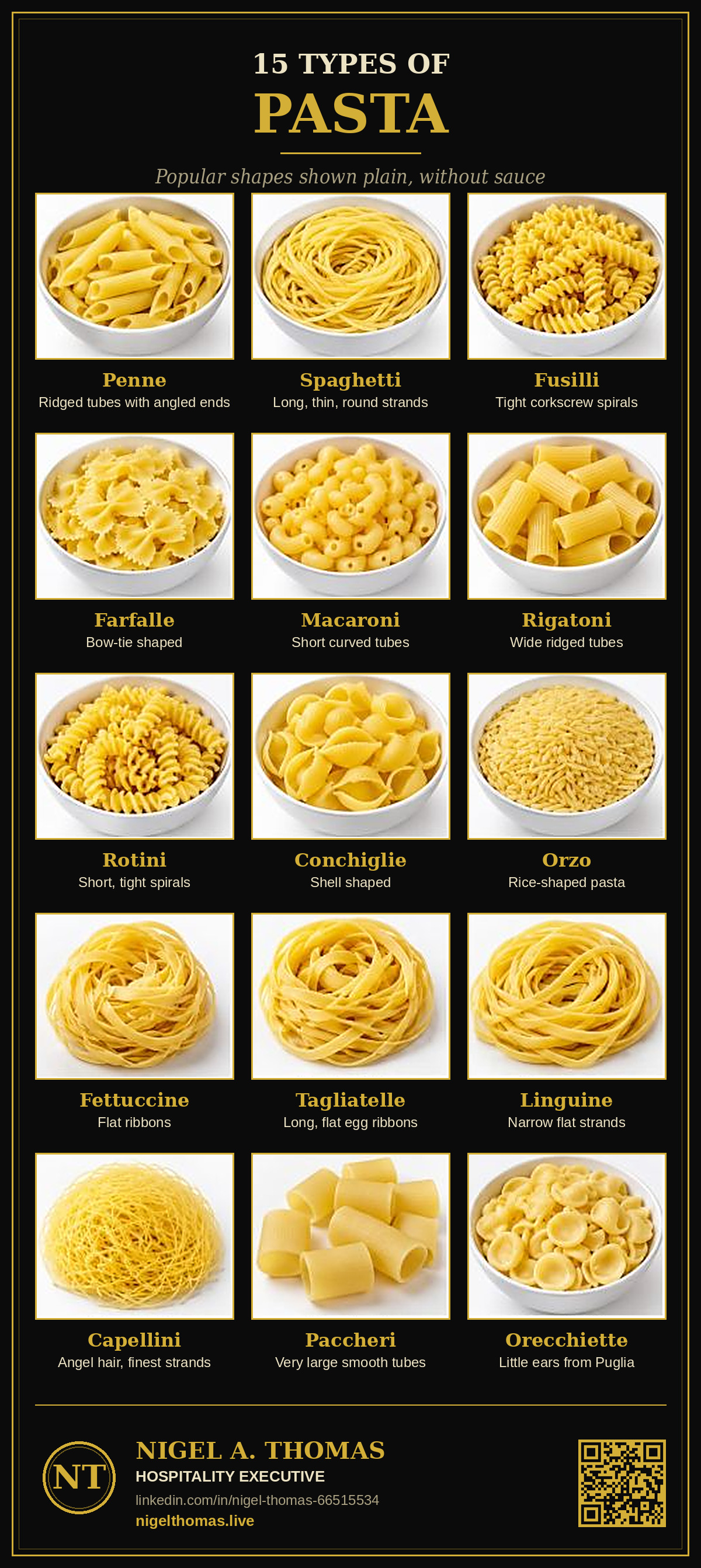
This guide walks through fifteen of the most common pasta shapes, shown plain and without sauce on the poster at the bottom of the page so that you can learn to recognise each one by shape alone. For every shape you will find what its name means, where it comes from, which sauces suit it and one practical kitchen tip. After the shapes come sections on cooking pasta properly, matching shape to sauce, portioning and costing, and handling cooked pasta safely in a hotel or restaurant kitchen.
What Is Pasta?
Pasta is a simple dough of wheat and water, or wheat and eggs, that is shaped and then either cooked fresh or dried for storage. The word is Italian for paste or dough, and the idea is far older than any single country claims. Wheat doughs boiled in water appear in many food cultures, but Italy turned the craft into a system of hundreds of shapes, each with its own name, region and traditional sauce.
Two basic doughs matter in a professional kitchen. Dried pasta, often called pasta secca, is made from durum wheat semolina and water. Durum is a hard wheat with high protein, which gives the cooked pasta its firm bite and golden colour. The dough is pushed through shaped dies, called extrusion, and then dried slowly. Pasta pushed through bronze dies has a rougher, chalkier surface that grips sauce better than the smooth surface from Teflon-coated dies. Fresh pasta, or pasta fresca, is usually made from soft wheat flour and eggs, rolled into sheets and cut or shaped by hand or machine. It cooks in two to four minutes and has a softer, silkier texture.
Neither type is better. They are different tools. Dried pasta is dependable, stores for a long time and suits olive oil, tomato and chunky sauces. Fresh egg pasta suits delicate cream, butter and slow-cooked meat sauces. A good menu uses both, and a good cook knows which one the dish is asking for.
The Main Pasta Families
It helps to sort the shapes into families before learning individual names, because shapes in the same family behave in a similar way on the plate and in the pot.
- Long round strands: spaghetti and capellini. These carry light, smooth sauces that coat each strand.
- Long flat ribbons: fettuccine, tagliatelle and linguine. Their surface area suits cream, butter, ragù and seafood.
- Short tubes: penne, rigatoni, macaroni and paccheri. Their hollow centres trap sauce and they hold up well to baking.
- Spirals and twists: fusilli and rotini. The grooves hold pesto, olive oil dressings and chunky vegetables.
- Fancy and cupped shapes: farfalle, conchiglie and orecchiette. These catch peas, crumbled sausage, cheese and vegetables in their hollows.
- Small shapes: orzo and similar pastas. These belong in soups, salads and pilaf-style dishes.
15 Pasta Shapes You Should Know
1. Penne
Penne takes its name from the Latin word for feather or pen, because each piece is cut at a diagonal like a quill nib. It comes smooth (penne lisce) or ridged (penne rigate). The ridged version is the better choice for most sauces because the lines hold on to the sauce. The angled ends also scoop sauce into the tube. Penne is one of the most forgiving shapes on a busy line because it does not clump easily and reheats well.
Kitchen tip: For baked dishes, take penne out of the water a minute early so that it finishes cooking in the oven instead of turning soft.
2. Spaghetti
Spaghetti is the most recognised pasta in the world. The name comes from spago, the Italian word for string. It is long, round and about two millimetres thick, and it is strongly linked with southern Italy, where dried pasta production grew into a major industry. Spaghetti works best with sauces that are smooth or finely chopped, so that they can cling to the strands, such as garlic and chilli oil, egg-and-cheese carbonara or a well-reduced tomato sauce.
Kitchen tip: Never break spaghetti to fit the pot. Push it gently into the water as the ends soften and it will fold in by itself.
3. Fusilli
Fusilli is a corkscrew shape. Traditionally it was made by winding a strip of dough around a spindle, which is where the name comes from, and today most fusilli is extruded by machine. The tight spiral creates a lot of surface area and many small channels, so thick pesto, roasted vegetable sauces and creamy dressings stay on the pasta instead of sliding to the bottom of the plate. It also holds its shape well when served cold.
Kitchen tip: Fusilli can hide water in its coils. Drain it well and shake the colander before saucing, or the plate will turn watery.
4. Farfalle
Farfalle is the pasta that looks like a bow tie or a butterfly, with a pinched centre and frilled edges. It is associated with northern Italy, particularly Lombardy and Emilia-Romagna. The pinched middle is thicker than the wings, so the centre can stay firm while the edges soften. Many cooks consider that a pleasant contrast, but if the centre is hard, the pasta has simply not been cooked long enough. Farfalle looks attractive on a plate and suits lighter cream, smoked salmon, peas and chicken dishes.
Kitchen tip: Taste a farfalle from the pinched centre, not the wing, when checking whether it is done.
5. Macaroni
Macaroni is a short tube, usually curved, and is known around the world as the pasta of macaroni and cheese. In Italy the word covers a broad range of tube pastas, but in international kitchens it normally means the small curved elbow shape. Its hollow centre holds cheese sauce well and it softens evenly when baked. Macaroni is also a staple of soups and of school and staff meals because it is cheap, filling and easy to cook in large batches.
Kitchen tip: A cheese sauce thickens as it cools. Make it slightly looser than you want, because the macaroni will absorb sauce while it waits for service.
6. Rigatoni
Rigatoni is a wide, short tube with deep ridges along its length and square-cut ends. It is a favourite in Rome and southern Italy. The ridges grip thick sauces, and the wide tube fills with sauce, so each forkful is generous. Rigatoni can handle meat ragù, sausage, roasted vegetables and baked cheese sauces that would overwhelm thinner shapes. It is also sturdy enough for banquet service, where pasta may sit for a few minutes before it reaches the guest.
Kitchen tip: For banquets, choose rigatoni over delicate shapes, because it tolerates holding time better.
7. Rotini
Rotini is often confused with fusilli. The two are closely related, and in some markets the names are used interchangeably, but rotini is usually shorter and more tightly wound. The tight twist makes it excellent for cold dishes. A vinaigrette or a creamy dressing slides into the grooves and flavours the whole piece, and the shape stays firm after chilling. It is also a good choice for children's menus and for family-style buffets, since it is easy to scoop and eat.
Kitchen tip: For pasta salad, cook it to just past al dente, rinse in cold water and toss with a little oil so that the spirals do not stick.
8. Conchiglie
Conchiglie are shell-shaped pasta in a range of sizes. Small shells, conchigliette, are used in soups and salads. Medium shells are served with sauces that settle into the curve, such as peas in cream or crumbled sausage. Jumbo shells, conchiglioni, are cooked, filled with ricotta and spinach or minced meat, and baked in tomato sauce. The shell shape is the ideal combination of a pocket and a handle: each piece carries a small portion of sauce to the mouth.
Kitchen tip: For stuffed shells, undercook them slightly, drain them upside down on a tray and let them cool before filling so that they do not tear.
9. Orzo
Orzo is a small, rice-shaped pasta. In Italian the word means barley, and it is sometimes called risoni, meaning large rice. It cooks quickly, usually in eight to ten minutes, and is useful in places where a normal pasta shape would feel too large: broth, minestrone, summer salads with feta and herbs, or a baked side dish that looks like risotto. Because orzo releases starch, cooking it slowly in stock like a risotto gives a creamy result without needing much cream.
Kitchen tip: Stir orzo often during cooking. The small grains settle and stick to the bottom of the pot quickly.
10. Fettuccine
Fettuccine is a flat ribbon about six to seven millimetres wide, traditionally made with egg, and associated with Rome and central Italy. It is wider than linguine and a little narrower than pappardelle. The broad flat surface carries rich sauces of butter, cream and cheese beautifully, which is why fettuccine Alfredo became famous around the world. It also suits mushroom, chicken and lemon dishes, and it is sold both fresh and dried, often folded into nests.
Kitchen tip: Toss fettuccine with its sauce in the pan over low heat and add a little pasta water. Cream sauces tighten fast and the water keeps them silky.
11. Tagliatelle
Tagliatelle comes from Emilia-Romagna, and particularly from Bologna, where it is the classic partner of slow-cooked meat ragù. It looks similar to fettuccine and the two are often confused, but tagliatelle is traditionally cut from fresh egg dough, and its texture is rougher and more porous, which helps it take up the sauce. Mushrooms, butter and sage, and seasonal truffle also suit it well. Tagliatelle is usually sold in nests of long ribbons that unfold in the water.
Kitchen tip: Lower the nests into the boiling water and wait for them to loosen before stirring, or the ribbons will tear.
12. Linguine
Linguine is a flat, narrow strand that sits between spaghetti and fettuccine. It is linked with Liguria, on the northwest coast of Italy, where it is traditionally served with pesto. Elsewhere it is best known as the partner of seafood: clams, mussels, prawns and crab. The slight flatness gives it more surface than spaghetti, so oil-based and light sauces cling better, yet it still twirls neatly on a fork. It is a favourite on hotel menus because it looks elegant with seafood.
Kitchen tip: Finish linguine with seafood in the pan for the last minute, so that the pasta takes on the flavour of the shellfish liquor.
13. Capellini
Capellini is among the thinnest long pastas, and its even finer cousin is called capelli d'angelo, or angel hair. It cooks in just two to four minutes, which makes it the fastest dried long pasta on the menu, but it also overcooks more easily than any other. Because it is so delicate, it needs a light sauce: fresh tomato and basil, garlic and olive oil, or a squeeze of lemon with herbs. Heavy sauces will flatten it. Capellini is often twirled into nests for plated starters.
Kitchen tip: Cook capellini to order only, and have the sauce ready first. A minute too long turns it to paste.
14. Paccheri
Paccheri is a very large, smooth tube from the Campania region around Naples. The name is linked to a Neapolitan word for a slap, supposedly because of the sound the wide tubes make when they are tossed in a pan. The large opening makes paccheri ideal for stuffing with ricotta or fish and for rich sauces with big pieces of seafood or meat that can slip inside. It is a plated-dish pasta that looks impressive and suits fine-dining menus.
Kitchen tip: Paccheri can collapse or split in the pot. Keep the water at a steady boil and stir gently, and do not overcook them.
15. Orecchiette
Orecchiette is the signature pasta of Puglia, in the heel of Italy, and takes its name from its resemblance to a small ear. Traditionally it is shaped by hand: a small piece of dough is dragged across a board with the thumb and turned over to make a shallow cup. That cup catches small ingredients such as peas, crumbled sausage and chopped greens, and the slightly thick edge gives a pleasant chew. The classic pairing is cime di rapa, a bitter turnip green, with garlic, anchovy and chilli.
Kitchen tip: Because orecchiette have thick and thin parts, the cooking time varies. Taste them rather than trusting the timer.
Quick Reference Table
| Shape | Family | Best sauce style |
|---|---|---|
| Penne | Short tube | Tomato, spicy, baked |
| Spaghetti | Long strand | Oil-based, egg and cheese, smooth tomato |
| Fusilli | Spiral | Pesto, chunky vegetable |
| Farfalle | Fancy shape | Light cream, salmon, peas |
| Macaroni | Short tube | Cheese sauce, baked, soup |
| Rigatoni | Short tube | Meat ragù, sausage, baked |
| Rotini | Spiral | Cold salads, vinaigrette |
| Conchiglie | Shell | Ricotta, cheese, stuffed and baked |
| Orzo | Small shape | Soup, salad, pilaf-style |
| Fettuccine | Flat ribbon | Cream, butter, mushroom |
| Tagliatelle | Flat ribbon | Slow-cooked ragù, butter and sage |
| Linguine | Narrow flat strand | Seafood, pesto, oil and chilli |
| Capellini | Thin strand | Light tomato, herbs, lemon |
| Paccheri | Large tube | Seafood ragù, stuffed |
| Orecchiette | Small cup | Greens and sausage, tomato |
How to Cook Pasta Properly
Good pasta is mostly about water, salt and timing. The method below works for dried pasta in almost any kitchen, from a home stove to a banquet kettle.
- Use plenty of water. A common rule is one litre of water for every 100 grams of dry pasta. A big pot keeps the temperature up when the pasta goes in and gives the pieces room to move, which prevents sticking.
- Salt the water well. Around ten grams of salt per litre is a standard guide. Pasta absorbs water as it cooks, so this is the only chance to season it from the inside.
- Add the pasta to boiling water and stir during the first minute or two, when the starch on the surface is sticky. Keep the water at a lively boil.
- Skip the oil in the water. Oil floats on top and does not stop sticking, and it can leave a film on the pasta that stops sauce clinging.
- Cook to al dente. The Italian phrase means "to the tooth": the pasta is tender but still has a slight firmness in the very centre. Start tasting two minutes before the time printed on the packet.
- Save a cup of pasta water before draining. The starchy water loosens a sauce and helps it bind to the pasta.
- Finish in the sauce. Move the drained pasta into the pan with the sauce for the last minute, toss with a splash of the cooking water, and serve at once.
Matching Shape to Sauce
Italian cooks do not pair shapes and sauces at random. The logic follows a few simple principles that any menu planner can use.
Thin sauces for thin pasta. Delicate strands such as capellini and thin spaghetti are easily overwhelmed. They need oil, fresh tomato, garlic or light seafood sauces that coat each strand without weighing it down.
Rich sauces for broad pasta. Wide flat ribbons like fettuccine and tagliatelle have enough surface to carry cream, butter and heavy ragù. Slow-cooked meat sauces cling to the rough surface of fresh egg pasta in a way that they never do on smooth dried strands.
Chunky sauces for shapes with hollows. Tubes, shells and cups such as rigatoni, conchiglie and orecchiette are designed to trap pieces. Sausage, peas, diced vegetables and cheese sit inside the shape instead of falling away. Smooth tomato sauce is also fine, but these shapes show off their best qualities with texture.
Grooves for oil and pesto. Spirals like fusilli and rotini have channels that hold thinner, oily sauces and herb pastes, as well as vinaigrettes in cold dishes.
Small shapes for soups and salads. Orzo and other small pastas behave like a grain. They belong in broth, in salads with vegetables and herbs, and in side dishes where a large shape would feel clumsy.
Portioning and Costing Pasta
For a hotel or restaurant, pasta is attractive because it is relatively inexpensive and consistent, but a lack of portion control quietly erodes margin. A few numbers help.
- Main course portion: about 80 to 100 grams of dry pasta per person, depending on how much sauce and protein is on the plate.
- Starter portion: about 50 to 60 grams of dry pasta per person.
- Fresh egg pasta: about 110 to 130 grams per person for a main, since fresh pasta contains moisture and eggs.
- Yield: dried pasta roughly doubles in weight when cooked, usually reaching two to two and a quarter times its dry weight. One kilogram of dry pasta therefore gives about 2 to 2.25 kilograms of cooked pasta, and this is the number to use for batch cooking and costing.
When costing a pasta dish, do not stop at the pasta itself. The real cost sits in the sauce: seafood, cheese, cream, truffle oil and cuts of meat cost many times more than the dry pasta. This is why a simple dish like spaghetti aglio e olio has a very high margin, while linguine with prawns needs careful pricing. Weigh portions on a scale during training, use a standard ladle or spoon for the sauce, and record cooked pasta weights on your recipe cards so that every cook serves the same plate.
Storage and Food Safety
Dried pasta is a low-risk product, but a few habits keep it in good condition and protect guests.
- Store dry pasta in a cool, dry place, off the floor, in sealed containers or the original sealed packs. Use first in, first out and label opened packs with the date.
- Keep fresh pasta cold at 5 degrees Celsius (41 degrees Fahrenheit) or below, and respect the use-by date. Fresh pasta contains egg.
- Cool cooked pasta quickly if it will not be served at once. A common standard is to bring food from about 57 degrees Celsius (135 degrees Fahrenheit) down to 21 degrees Celsius (70 degrees Fahrenheit) within two hours, and then to 5 degrees Celsius (41 degrees Fahrenheit) within a further four hours. Spread the pasta in shallow trays, toss it with a little oil and chill it. Follow your own hotel's HACCP plan for the exact limits.
- Reheat to at least 74 degrees Celsius (165 degrees Fahrenheit) at the centre, either in boiling water for a few seconds or in the sauce, and do not reheat the same batch repeatedly.
- Label and date every container of cooked pasta, and discard it once it passes the time limit in your SOP.
Allergens. Pasta contains wheat and gluten, and fresh pasta also contains egg. Cooking gluten-free pasta in water that has been used for wheat pasta contaminates it. Use a separate pot, a separate colander and clean utensils, and tell the service team clearly which dishes are safe for guests with coeliac disease or an egg allergy.
Common Questions
What is the difference between fettuccine and tagliatelle? Both are flat ribbons of similar width. Fettuccine is linked with Rome and central Italy and is often served with cream and butter. Tagliatelle is linked with Bologna and Emilia-Romagna and is the classic partner of meat ragù. In practice many cooks use them interchangeably, but a traditional menu keeps them separate.
Are fusilli and rotini the same? They are very close relatives. Both are spirals, but rotini is typically shorter and more tightly wound. In many shops the two names are used for the same product, so check the shape rather than the label.
Is fresh pasta better than dried? Not necessarily. Fresh pasta is softer and cooks faster, and it suits delicate sauces. Dried semolina pasta holds its texture better and suits robust sauces, baking and banquet service. Each has a place on a menu.
Why does my pasta stick together? The usual reasons are too little water, water that is not boiling when the pasta goes in, or leaving the pasta without stirring in the first minute. Oil in the water does not fix it.
How do I know when pasta is al dente? Bite a piece. It should be tender all the way through, with a tiny firm point at the very centre. If you see a thick white core, it needs more time. If it feels completely soft, it has gone too far.
Final Thoughts
Pasta looks simple, but there is real craft in knowing fifteen shapes, understanding why each one suits certain sauces, and cooking it with care. A cook who can match capellini to a light tomato sauce, tagliatelle to a patient ragù and paccheri to a seafood stew will always plate better food than one who treats all pasta the same. For managers, the same knowledge supports better menu writing, more accurate costing and safer handling. Use the poster below as a quick teaching aid for your team, print it for the kitchen wall, and learn the shapes one section at a time.