Prosecco: Italy’s Sparkling Charm
Fresh · Fruity · Elegant · Everyday Celebration
What Is Prosecco?
Prosecco is a fresh, fruity Italian sparkling wine from the north-east of Italy. It is light in body, gently aromatic, and usually carries between 10.5 and 12 percent alcohol, which makes it one of the easiest sparkling wines to serve and to enjoy. Where Champagne is often associated with toasty depth and long ageing, Prosecco is all about freshness: green apple, ripe pear, white peach, honeysuckle and a squeeze of citrus, finished with soft, lively bubbles.
For anyone working in hotels, restaurants, bars or banqueting, Prosecco is a daily workhorse. It is the wine that opens brunch, the welcome drink at weddings, the base of the Spritz and the Bellini, and the by-the-glass sparkling that guests order without needing a long explanation. It is also one of the best-selling sparkling wines in the world, with production well over half a billion bottles a year. Understanding it properly, beyond the label, is a genuine advantage for a floor manager, sommelier, bartender or F&B trainer.
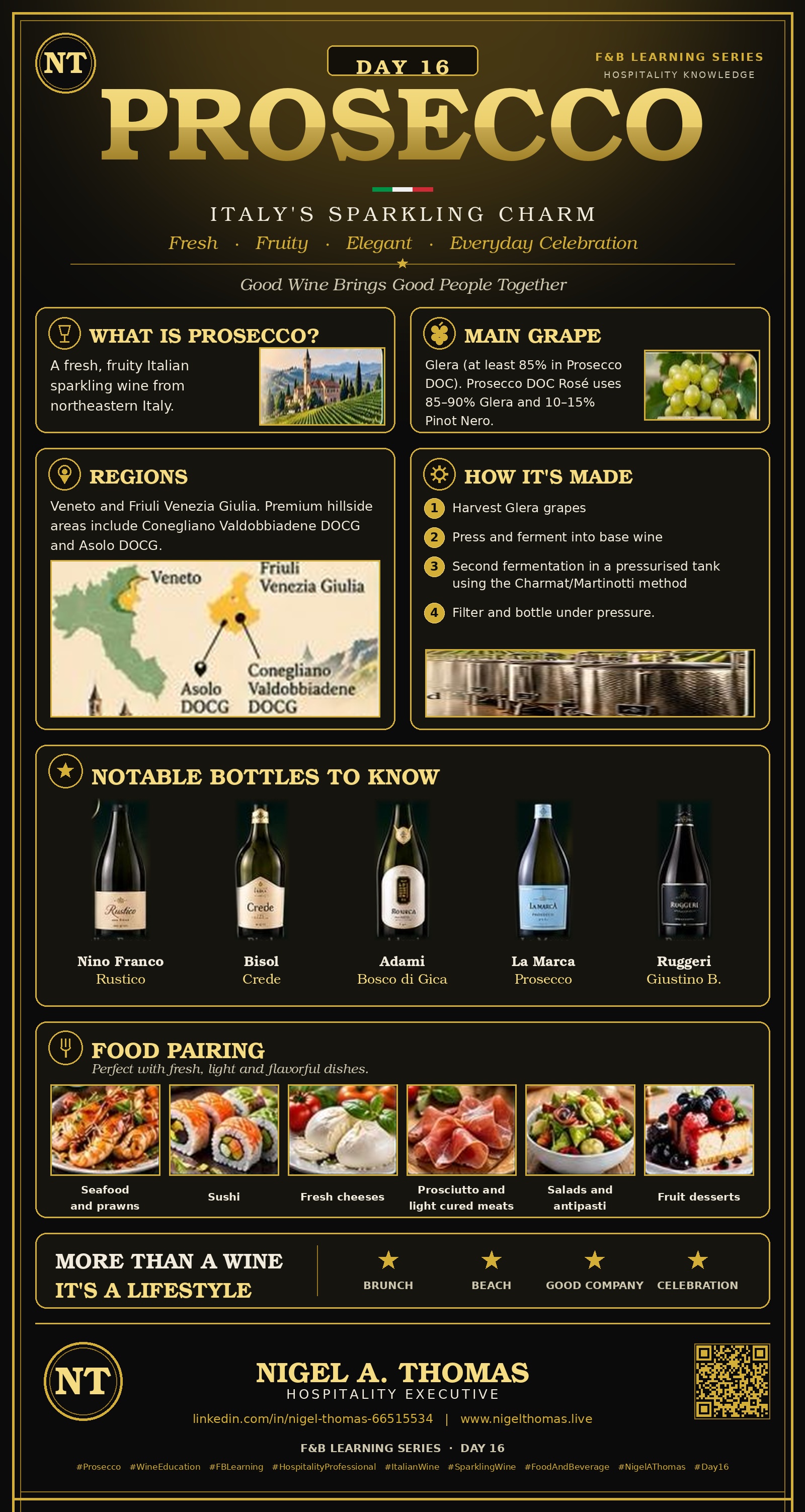
This guide is Day 16 of my F&B Learning Series. It expands on the one-page infographic at the bottom of this article, covering where Prosecco comes from, how it is made, the Glera grape, the difference between the quality levels, the notable bottles to know, how to serve it, and how to pair it with food. Everything here is written from a hospitality operations point of view, with service and training notes you can use on the floor.
A Short History: From a Village Name to a Protected Wine
The name Prosecco is linked to a village near Trieste in north-eastern Italy, and for a long time it was also the name of the grape itself. Wines made from this variety have been grown in the Veneto and Friuli hills for centuries, and the sparkling style developed gradually as producers learned to capture and keep the natural bubbles of fermentation.
The turning point came in 2009. To protect the wine from imitation and to tie it firmly to its home territory, Italy reorganised the appellation. The grape was officially renamed Glera, and the name Prosecco became a protected designation of origin rather than a grape variety. The area was defined across nine provinces in the Veneto and Friuli Venezia Giulia regions, and two premium hillside zones were promoted to the highest Italian quality tier, DOCG. That reorganisation is the reason a bottle of Prosecco today carries a clear geographical guarantee, and why the label matters so much when you are choosing a wine for your menu.
A second milestone came with the introduction of Prosecco Rosé under the DOC rules, which allowed a pink version to be made with a small share of Pinot Nero. We will look at that in the grape section below.
Where Prosecco Comes From: The Regions
Prosecco comes from north-eastern Italy, and the production zone is spread across two regions: the Veneto and Friuli Venezia Giulia. The Prosecco DOC covers a large area that includes the provinces of Belluno, Padua, Pordenone, Gorizia, Treviso, Trieste, Udine, Venice and Vicenza. This is the zone that supplies the great majority of the Prosecco found on restaurant lists and supermarket shelves, and it is where the plains and gentler slopes allow efficient, high-volume production.
The premium wines come from the hills. Two hillside areas are classified DOCG, the top tier of Italian wine law, and these are the names to look for on the poster:
- Conegliano Valdobbiadene DOCG: the historic heartland, in the hills of the province of Treviso between the towns of Conegliano and Valdobbiadene. The steep, narrow vineyard terraces are harvested largely by hand, and the landscape is a UNESCO World Heritage site. Wines from here are labelled Prosecco Superiore.
- Asolo DOCG: a smaller zone of rolling hills around the town of Asolo, producing Asolo Prosecco, often a little softer and more floral in character.
Inside Conegliano Valdobbiadene there are further distinctions worth knowing. Some wines are labelled Rive, which indicates they come from a specific steep sub-zone or village, harvested by hand. At the very top sits Superiore di Cartizze, a tiny and highly prized hillside near Valdobbiadene often described as the grand cru of Prosecco. These labels are useful talking points when you are helping a guest trade up from a standard glass to something special.
A simple rule for staff: if the label says Prosecco DOC, think of it as the everyday, approachable style from the wider area. If it says Conegliano Valdobbiadene or Asolo, it is from the premium hillside zones and usually offers more finesse, more aroma and a higher price.
The Main Grape: Glera
The heart of Prosecco is the Glera grape, a white variety with high natural acidity and delicate aromas. By law, Prosecco DOC must contain at least 85 percent Glera. The remaining share, up to 15 percent, may come from other permitted local or international varieties, which can add structure or complexity depending on the producer's style.
Glera gives the wine its signature profile. On the nose you will find green apple, pear, white peach, acacia and citrus blossom. On the palate it is light, clean and slightly floral, with a soft, creamy mousse rather than the sharp, tight bubbles of some other sparkling wines. Because it is a naturally aromatic and not a heavy grape, Prosecco is made to be enjoyed young, usually within a year or two of release.
Prosecco Rosé follows a distinct recipe. The Prosecco DOC Rosé uses between 85 and 90 percent Glera, with 10 to 15 percent Pinot Nero, the red grape that gives the wine its pale pink colour and a hint of red berry fruit. It is a good option for celebrations, hen parties, brunch menus and any occasion where a pink sparkling wine will photograph well and taste fresh.
How Prosecco Is Made: The Charmat-Martinotti Method
What makes Prosecco different from Champagne is not only the grape but the way the bubbles are created. Champagne is made by the traditional method, where the second fermentation happens inside each individual bottle. Prosecco is normally made by the Charmat-Martinotti method, also called the tank method, where the second fermentation happens in a large pressurised stainless steel tank. The name honours the Italian Federico Martinotti and the Frenchman Eugène Charmat, who developed and refined the tank process.
The steps shown on the infographic are simple, and worth teaching to your team in this order:
- Harvest the Glera grapes at the right level of ripeness, preserving their acidity and aromas.
- Press the grapes gently and ferment the juice into a dry, still base wine.
- Add yeast and sugar to the base wine in a sealed, pressurised tank. The second fermentation happens here, and the carbon dioxide produced stays dissolved in the wine, creating the bubbles.
- Chill, filter and bottle the wine under pressure so the bubbles are kept in the bottle.
The advantages of this approach are freshness and fruitiness. Because the wine spends only a short time with the yeast and does not undergo long ageing, the primary fruit and floral aromas are preserved instead of being replaced by bread, biscuit and brioche notes. It is also faster and more economical than the traditional method, which is why Prosecco can offer such good value.
A smaller number of producers make a style called col fondo, which means with the sediment. These wines are refermented in the bottle and not disgorged, so they are slightly cloudy and rustic. They are a niche product, but they are a fun talking point for wine lists with a craft or natural focus.
Understanding the Label: Spumante, Frizzante and Sweetness Levels
Prosecco is made in different levels of fizz. Spumante is the fully sparkling version, with bubbles that last in the glass and a firmly pressurised bottle, and it is what most guests mean when they ask for Prosecco. Frizzante is lightly sparkling, with a softer, gentler fizz, and is often closed with a string-tied cork or a crown cap. Tranquillo is the still version and is rarely seen outside Italy.
Sweetness is shown on the label, and this is where many guests and even new staff get confused. The common levels for Prosecco are:
- Brut: the driest style commonly sold, crisp and clean, and a good all-round choice for aperitifs and food.
- Extra Dry: despite the name, this is slightly sweeter than Brut. It is the most traditional and widely poured style, with a touch of softness that many guests prefer.
- Dry: noticeably sweeter again, with more generous fruit, suitable for desserts and brunch.
A useful training point: Extra Dry does not mean very dry. If a guest asks for a dry sparkling wine, a Brut is usually the better recommendation. Getting this right avoids a lot of returned glasses.
Vintage Prosecco is also possible. When a year appears on the bottle, it is called Millesimato, and the wine must come from a single harvest. Millesimato bottles tend to be a little more expressive and are well suited to a premium by-the-glass or bottle service.
Notable Bottles to Know
The infographic highlights five bottles that are useful reference points for staff training and for building a Prosecco list. They show the range of the category, from everyday, approachable wines to premium hillside bottlings. As always, check the exact label and vintage you are buying, since producers release several cuvées.
- Nino Franco Rustico: a well-regarded Valdobbiadene Prosecco from a historic family estate, known for its fresh, dry, elegant style and its reliability. A good benchmark for a premium by-the-glass pour.
- Bisol Crede: from the Bisol family of Valdobbiadene, a dry, refined bottling that shows the finesse of the hillside zone and works well with seafood and light starters.
- Adami Bosco di Gica: a classic Valdobbiadene Superiore from the Adami family, floral and crisp, and popular on aperitif and antipasti menus.
- La Marca Prosecco: an approachable, widely distributed Prosecco DOC with its recognisable pale blue label. It is easy to sell, easy to explain and very consistent, making it a popular choice for banquets and house sparkling.
- Ruggeri Giustino B.: a premium Valdobbiadene bottling from the Ruggeri family, positioned as a flagship wine for special occasions and fine dining.
For a small hotel or restaurant list, a sensible structure is one value Prosecco DOC for volume service, one Conegliano Valdobbiadene DOCG for a premium option, and one rosé or Millesimato for celebrations. This gives guests a clear choice and gives your team a simple upselling ladder.
Serving Prosecco Like a Professional
Good Prosecco can be spoiled by poor service, and good service is one of the easiest ways to show professionalism. These are the points I teach my teams:
- Chill the bottle to roughly 6 to 8 degrees Celsius. Too warm and the wine foams and tastes flabby, too cold and the aromas disappear.
- Present the bottle label-first to the host and confirm the wine before opening.
- Remove the foil and loosen the cage while holding your thumb over the cork. Never point the bottle at a guest.
- Hold the cork firmly and slowly turn the bottle, not the cork, tilting it at about 45 degrees. Aim for a soft sigh, not a loud pop.
- Pour in two stages: a small pour to let the foam settle, then top up to about two thirds of the glass.
- Serve in a tulip-shaped or white wine glass when possible. A wider bowl lets the aromas open up, while a narrow flute keeps the bubbles lively for longer. Avoid the old coupe, which loses fizz quickly.
- Wrap the bottle in a napkin, return it to an ice bucket with water and ice, and refill glasses before they are empty.
Store unopened bottles lying down or standing in a cool, dark place, and remember that Prosecco is made to be consumed young. For open bottles, a proper sparkling wine stopper will keep it acceptable for a day, but it will never be as good as freshly opened.
Prosecco Cocktails and Classic Serves
Prosecco's bright, fruity character and modest alcohol content have made it the base for some of the world's most popular aperitif drinks. Understanding the classic recipes lets your bar team sell more and serve consistently.
- Spritz: the classic Italian aperitif, built over ice in a wine glass with Prosecco, an Italian bitter liqueur such as Aperol and a splash of soda water, garnished with a slice of orange. The popular standard proportions are about six parts Prosecco, four parts bitter liqueur and two parts soda.
- Bellini: invented at Harry's Bar in Venice, made with white peach purée topped with chilled Prosecco. It is simple but needs ripe fruit or a very good purée.
- Mimosa-style brunch drinks: Prosecco with fresh orange or other fruit juice, served well chilled.
- Prosecco with fruit: a few fresh berries or a slice of peach in a flute is an easy, elegant welcome drink.
Because Prosecco is lighter than Champagne and more affordable, it is the sensible choice for cocktails. Save the finest bottles for drinking on their own.
Food Pairing: Perfect With Fresh, Light and Flavorful Dishes
The infographic highlights six food pairings, and they all share the same logic: Prosecco loves fresh, light and slightly salty dishes. Its acidity cuts through richness, its bubbles refresh the palate and its fruitiness softens spice.
- Seafood and prawns: grilled prawns, fried calamari, oysters and shellfish. The acidity and bubbles work like a squeeze of lemon. Choose a Brut.
- Sushi: the clean, delicate flavours of raw fish and rice are well matched by a dry Prosecco, and it handles soy and pickled ginger better than most still wines.
- Fresh cheeses: burrata, mozzarella, ricotta and fresh goat cheese. The creaminess is balanced by the freshness of the wine.
- Prosciutto and light cured meats: the classic salty and sweet combination of Italian cured ham with a glass of Prosecco is hard to beat as an aperitivo board.
- Salads and antipasti: marinated vegetables, olives, grilled courgette and herb-driven salads all sit comfortably with Prosecco.
- Fruit desserts: berry tarts, fruit salads and light cheesecakes pair well with an Extra Dry or Dry style, where the touch of sweetness matches the dessert.
As a rule, match the sweetness of the wine to the dish. Brut with savoury food, Extra Dry or Dry with sweet dishes and brunch. Avoid pairing Prosecco with very heavy, rich or heavily spiced dishes, where the delicate fruit will be overwhelmed.
Prosecco, Champagne and Cava: What Is the Difference?
Guests often ask how Prosecco compares with other sparkling wines, and a short, confident answer builds trust. Champagne comes from France, is made from Chardonnay, Pinot Noir and Pinot Meunier using the traditional method with long ageing on the lees, and tends to show toasty, yeasty complexity. Cava comes from Spain, mostly from Catalonia, and is also made by the traditional method, with a drier, earthier profile. Prosecco comes from Italy, is made primarily from Glera in a tank, and is lighter, fruitier and fresher.
None of these is better than the others. They are different tools for different occasions. Prosecco is the easy aperitif and the party wine, Champagne is the special occasion celebration, and Cava is the drier, value-driven alternative. Position them clearly on your list, and your team will have an easier time selling each one.
Training Tips for F&B Teams
If you are building a training session around this topic, a few simple exercises make the knowledge stick. Run a short tasting with three wines: one Prosecco DOC Brut, one Conegliano Valdobbiadene DOCG, and one Extra Dry. Ask staff to write down aroma, sweetness and finish, then compare notes. Practise the opening and pouring routine until it is silent and smooth. Role-play the sweetness conversation, so that every team member can explain Brut versus Extra Dry in one sentence.
A short script that works well on the floor: Prosecco is a light, fresh Italian sparkling wine, made mainly from the Glera grape. The Brut is crisp and dry, the Extra Dry is slightly softer, and both go beautifully with seafood, fresh cheese and cured meats. This gives guests information, not jargon, and gives you a natural opportunity to suggest the premium bottle.
Finally, remember what the poster says: more than a wine, it is a lifestyle. Brunch, beach, good company and celebration are the moments when Prosecco is ordered. Think of the guest experience, and every glass becomes part of a good memory.
Key Takeaways
- Prosecco is a fresh, fruity sparkling wine from north-eastern Italy, made mainly in the Veneto and Friuli Venezia Giulia.
- The main grape is Glera, with at least 85 percent required in Prosecco DOC. Prosecco DOC Rosé adds 10 to 15 percent Pinot Nero.
- It is usually made by the Charmat-Martinotti tank method, which preserves fresh fruit and floral aromas.
- Conegliano Valdobbiadene DOCG and Asolo DOCG are the premium hillside zones. Cartizze is the most prized hillside.
- Brut is the driest, Extra Dry is slightly sweeter, Dry is sweeter again.
- Serve well chilled, open quietly, pour in two stages, and pair with seafood, sushi, fresh cheeses, cured meats, salads and fruit desserts.
Frequently Asked Questions
Is Prosecco the same as Champagne?
No. Champagne is French and is made by the traditional method with a second fermentation in the bottle. Prosecco is Italian, made mainly from Glera, usually by the tank method, and is lighter and fruitier.
What grape is Prosecco made from?
Prosecco is made mainly from the Glera grape, with at least 85 percent required in Prosecco DOC.
What does Extra Dry mean on a Prosecco label?
Extra Dry is slightly sweeter than Brut. If a guest wants a drier wine, recommend Brut.
How should Prosecco be served?
Well chilled at about 6 to 8 degrees Celsius, in a tulip or white wine glass, poured in two stages.
What food goes with Prosecco?
Seafood and prawns, sushi, fresh cheeses, prosciutto and light cured meats, salads and antipasti, and fruit desserts.