F&B Operations: Mastering 5 Outlets, 5 Profitability Models
In the world of Food & Beverage management, a common mistake made by even seasoned operators is treating every revenue center the same. A restaurant is not a bar. A banquet is not room service. While they all fall under the umbrella of F&B operations, each outlet possesses its own distinct operational DNA, financial cadence, and set of profitability levers. When management applies a "one-size-fits-all" approach, they inevitably starve high-margin outlets of the attention they need while over-allocating resources to underperforming ones.
To run a truly profitable F&B division—whether in a luxury hotel, a resort, or a large-scale commercial catering operation—you must understand that success is not just about selling food and drink. It is about managing five distinct business models under one roof. Each model requires a tailored approach to revenue generation, cost control, and key performance indicators (KPIs).
In this comprehensive guide, we will break down the five core F&B outlet models. We will explore how to align your management strategy with the specific profit drivers of each, ensuring that every decision made on the floor contributes to the total F&B profitability of your establishment. For a deeper dive into the financial mechanics that underpin these models, you can refer to our F&B Cost Control Blueprint.
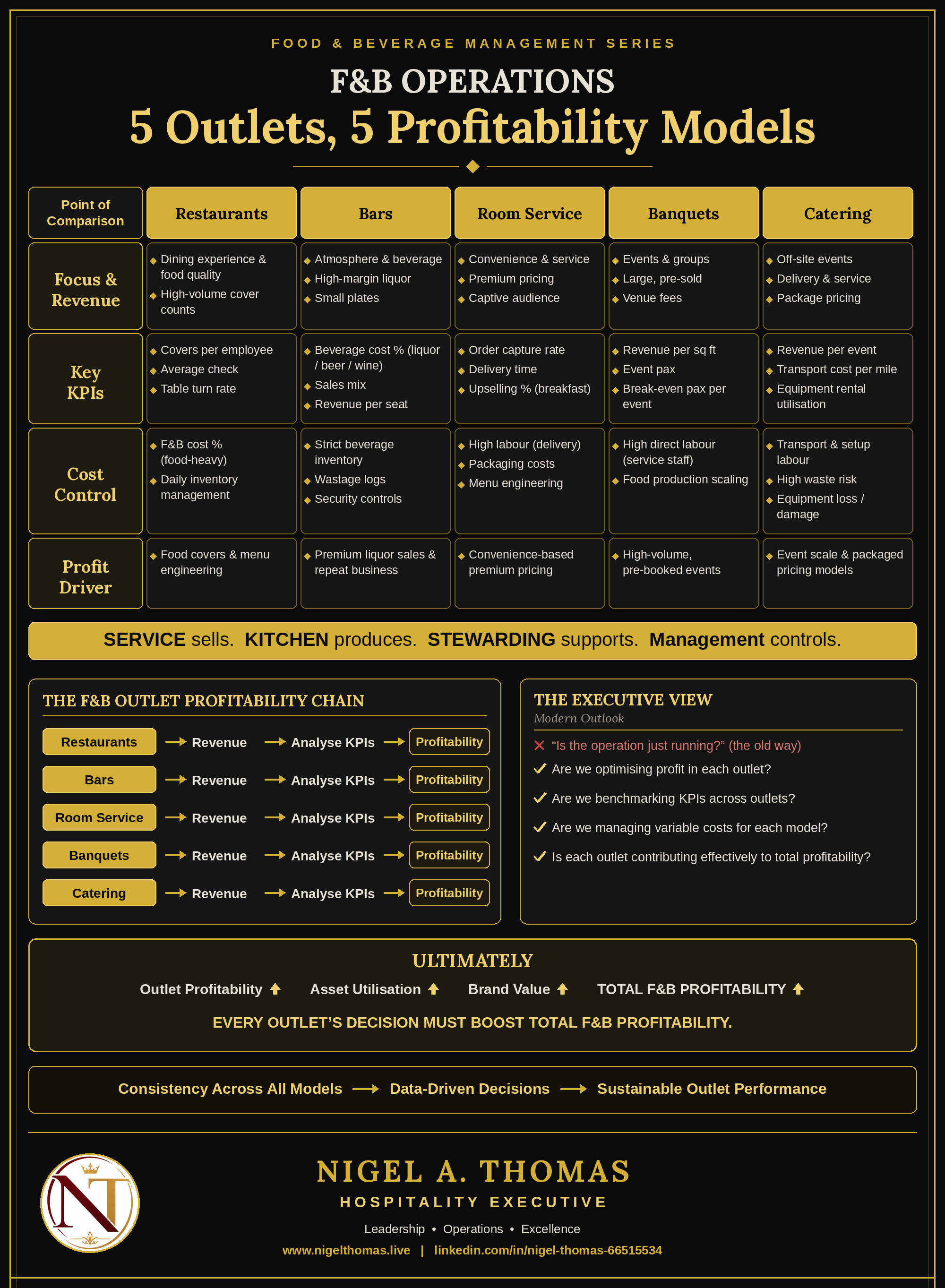
1. The Restaurant Model: The Engine of Footfall
The restaurant is the traditional heart of F&B operations. Whether it is a fine-dining establishment, a casual bistro, or a hotel coffee shop, the restaurant model is driven by volume, consistency, and the guest experience. It is a model of high turnover and meticulous portion control.
Focus & Revenue
At its core, the restaurant model relies on a compelling dining experience and consistent food quality. Revenue is driven by high-volume cover counts. You are playing a volume game; therefore, every empty seat is a lost revenue opportunity. The goal is to maximize the number of guests served during peak hours without compromising the quality of the food or service.
Key KPIs to Track
To measure the health of a restaurant, you must track metrics that reflect efficiency and spending behavior:
- Covers per employee: This measures labor efficiency. If your covers per employee are dropping, your labor cost is likely rising disproportionately to your revenue.
- Average check: This tracks the average spend per guest. Increasing this through upselling and strategic menu design is one of the fastest ways to boost profitability.
- Table turn rate: The number of times a table is occupied by different parties in a service period. A slow turn rate indicates bottlenecks in service or kitchen production.
For a deeper understanding of how to align your front-of-house and back-of-house teams to improve these KPIs, read our guide on the FOH & BOH Hierarchy.
Cost Control in the Restaurant
Restaurants are food-heavy operations. Therefore, F&B cost percentage is heavily weighted toward food cost. You must implement strict daily inventory management for high-value proteins and perishables. Daily inventory management prevents theft, reduces spoilage, and ensures that your theoretical food cost aligns with your actual food cost.
The Profit Driver
The ultimate profit driver for a restaurant is food covers and menu engineering. You can serve 500 people a day, but if they are all ordering your lowest-margin items, you will not be profitable. Menu engineering—strategically placing high-margin items in prime menu real estate and training staff to upsell—is the difference between a busy restaurant and a profitable one. For a complete guide on this, see our Food Cost Control Complete Guide.
2. The Bar Model: High Margins, High Energy
The bar is often the most profitable outlet in an F&B operation, but it is also the one most susceptible to shrinkage and inconsistency. The bar model is driven by atmosphere, speed, and the art of the pour. Unlike the restaurant, which relies on food volume, the bar relies on the high-margin nature of liquor.
Focus & Revenue
Revenue here is driven by atmosphere and beverage quality. A bar with a great vibe can charge premium prices. The model thrives on high-margin liquor (spirits and cocktails) and small plates. Small plates are crucial because they encourage guests to stay longer, ordering more drinks, without the high food cost and kitchen labor associated with full meals.
Key KPIs to Track
- Beverage cost % (liquor / beer / wine): This must be tracked separately for each category. A 20% cost on beer is vastly different from a 20% cost on wine.
- Sales mix: Understanding what your guests are drinking. If 80% of your sales are draft beer, your cocktail program is underperforming.
- Revenue per seat: How much revenue does each bar stool generate? This is a critical metric for space utilization.
Cost Control in the Bar
Cost control in the bar is heavily reliant on strict beverage inventory and waste logs. Over-pouring, spillage, and free drinks are the silent killers of bar profitability. You must implement security controls, such as POS systems that require a manager's swipe for voids and comps, and conduct regular blind inventory counts to calculate shrinkage.
The Profit Driver
The profit driver for a bar is premium liquor sales and repeat business. A bar that becomes a "local" or a destination for a specific clientele generates consistent, high-margin revenue. Training bartenders to upsell premium spirits and creating a signature cocktail menu that cannot be easily replicated elsewhere drives both margin and brand loyalty. For more on this, read our Bartender's Quick Reference.
3. Room Service: The Convenience Premium
Room Service (In-Room Dining) is a unique beast. It is often viewed as a loss leader or a necessary service standard in hotels, but when managed correctly, it can be a highly profitable, convenience-based model. The key is understanding that guests are not just paying for food; they are paying for the privilege of not leaving their room.
Focus & Revenue
The focus is on convenience and service. Room service has a captive audience—hotel guests who are tired, jet-lagged, or working late. Because of this captive audience, room service can command premium pricing. You are selling convenience, and the menu pricing must reflect that.
Key KPIs to Track
- Order capture rate: What percentage of hotel guests are ordering room service? If this is low, your marketing or menu visibility is failing.
- Delivery time: The time from order placement to delivery at the door. This is the single biggest factor in guest satisfaction for room service.
- Upselling % (breakfast): Room service breakfast is a prime opportunity to upsell fresh juices, specialty coffees, and side items.
Cost Control in Room Service
Labor is the biggest cost challenge in room service. Delivering one club sandwich to the 14th floor takes a dedicated server, a tray, and time. High labor (delivery) and packaging costs must be carefully managed. You must also implement strict menu engineering to ensure that the items on the room service menu are easy to execute, travel well, and carry a high enough margin to cover the delivery labor.
The Profit Driver
The profit driver is convenience-based premium pricing. By positioning room service as a luxury experience—complete with proper tray setups, flowers, and a seamless ordering process—you can justify the premium pricing. Focus on high-margin, low-labor items (like cheese boards, sandwiches, and bottled beverages) to maximize profitability. For a complete guide on managing hotel operations, see our Hotel Management Financial Model.
4. Banquets: The Volume & Logistics Game
Banqueting is the B2B side of F&B operations. It is a high-volume, low-margin (on a per-plate basis) game that relies on meticulous logistics and production scaling. A banquet for 500 people is not just a large dinner; it is a military operation that requires precise timing and coordination.
Focus & Revenue
The focus is on events and groups. Revenue is driven by large, pre-sold events. Unlike a la carte dining, banquet revenue is confirmed weeks or months in advance. Venue fees can also be a significant revenue stream, especially for conferences and weddings.
Key KPIs to Track
- Revenue per sq ft: Banquet spaces are prime real estate. You must maximize the revenue generated per square foot of your ballroom or meeting space.
- Event pax: The number of guests per event. This drives all your production and labor calculations.
- Break-even pax per event: The number of guests you must serve just to cover your fixed costs for opening the room and staffing the event.
Cost Control in Banquets
Cost control in banquets is about scaling. High direct labor (service staff) is required for large events. You must be ruthless in your scheduling, using part-time staff for large events and cutting staff the moment the dessert course is cleared. Food production scaling is also critical; you must accurately predict how much food to prepare without massive overproduction, which leads to waste.
The Profit Driver
The profit driver is high-volume, pre-booked events. Because the revenue is locked in, your ability to profit is entirely dependent on your execution efficiency. A well-run banquet with tight labor control and precise food production can yield excellent profits. However, a poorly run banquet with overcooked food and excessive labor can wipe out the profit of the entire event. For those in catering and events, our Cloud Kitchen & Catering Operations Guide offers invaluable insights.
5. Catering: The Off-Site Frontier
Off-site catering is the most complex of the five models. You are taking your kitchen, your service staff, and your standards out of your controlled environment and into an unfamiliar space. It is a model of high risk and high reward.
Focus & Revenue
The focus is on off-site events, delivery, and service. Revenue is driven by package pricing. Unlike a restaurant where guests order à la carte, catering clients buy packages (e.g., "Silver Package," "Gold Package"). This simplifies pricing but requires you to meticulously calculate the cost of every item in that package.
Key KPIs to Track
- Revenue per event: The total top-line revenue generated by a single catering job.
- Transport cost per mile: Logistics is a major expense. You must track the cost of fuel, vehicle maintenance, and driver time.
- Equipment rental utilisation: If you are renting chafing dishes, linens, and serving pieces, you must track how often that equipment is used to ensure a return on your investment.
Cost Control in Catering
Cost control starts with transport and setup labor. You must optimize your delivery routes and setup crews. High waste risk is inherent in off-site catering—if you drop a tray of food, you cannot simply walk back to the kitchen to remake it. Equipment loss and damage are also significant costs that must be tracked and billed to the client if necessary.
The Profit Driver
The profit driver is event scale and packaged pricing models. Large-scale events allow you to buy ingredients in bulk, reducing your food cost percentage. Packaged pricing protects your margins by bundling low-cost items (like starches and salads) with high-cost items (like premium proteins), ensuring a healthy overall margin. For more on pricing strategies, see our Smart Menu Pricing Formula.
The F&B Outlet Profitability Chain
Understanding each model individually is only half the battle. The true magic happens when you integrate them into a cohesive F&B operation. The profitability chain for every outlet follows the same fundamental flow: Revenue → Analyse KPIs → Profitability.
Whether it is the Restaurant, Bars, Room Service, Banquets, or Catering, the process is identical. You generate revenue, you analyze the KPIs specific to that outlet, and you make adjustments to drive profitability. The mistake operators make is stopping at revenue generation. They see a busy restaurant and assume it is profitable, without analyzing the covers per employee or the table turn rate.
The old way of managing F&B outlets asked: "Is the operation just running?"
The modern, executive view asks:
- Are we optimising profit in each outlet?
- Are we benchmarking KPIs across outlets?
- Are we managing variable costs for each model?
- Is each outlet contributing effectively to total profitability?
Strategic Integration: The Whole is Greater than the Sum of its Parts
To achieve total F&B profitability, you must break down the silos between your outlets. A guest checking in for a banquet should be encouraged to visit the bar for a pre-dinner drink. A room service guest should receive a flyer for the restaurant's weekend brunch. A restaurant guest should be informed about the catering services for their upcoming office party.
Cross-selling between outlets is the single most effective way to increase total F&B revenue without increasing your fixed costs. However, this requires a unified management approach. Your POS system must be integrated, your marketing must be cohesive, and your staff must be trained to promote the entire F&B operation, not just their specific outlet.
Furthermore, you must benchmark KPIs across outlets. If your bar is achieving a 15% beverage cost but your restaurant is achieving a 25% beverage cost, you need to investigate why. Is it a pricing issue? A theft issue? A lack of training? Benchmarking allows you to identify best practices and apply them across the board. For a complete set of metrics, refer to our Financial KPIs Poster and Restaurant Financial KPIs.
Ultimately: Consistency Across All Models
Whether you are running a burger joint or a 5-star hotel banquet hall, the ultimate goal is sustainable outlet performance. This is achieved through consistency. Consistency in your data-driven decisions. Consistency in your cost controls. Consistency in your guest experience.
Every outlet's decision must boost total F&B profitability. When you change a menu item in the restaurant, it should not negatively impact the bar's sales mix. When you adjust the price of a banquet package, it should not erode the perceived value of the catering service. Every decision is interconnected.
By understanding the unique profit drivers of Restaurants, Bars, Room Service, Banquets, and Catering, and by applying the right KPIs and cost controls to each, you transform your F&B operation from a collection of independent restaurants into a highly profitable, cohesive business unit.
Final Thoughts
Managing F&B operations is a complex, dynamic challenge. It requires a blend of culinary knowledge, financial acumen, and leadership skill. By treating your five outlets as five distinct profitability models—each with its own rules, metrics, and drivers—you equip yourself with the tools to optimize performance at every level.
Embrace the data. Analyze your KPIs. Control your costs. And never forget that in the end, Service sells, Kitchen produces, Stewarding supports, and Management controls. When all four pillars work in harmony across all five models, total F&B profitability is not just an objective—it is an inevitability.
About the Author
Nigel Thomas is a hospitality executive and trainer with over 30 years of global experience across luxury hotels, resorts, cruise lines, and food and beverage operations in India, the Middle East, and the United States. He specializes in operational excellence, team training, and career mentoring for hospitality professionals.
← Back to Blog