Where Restaurant Profit Is Actually Won or Lost

In more than three decades of running kitchens, food and beverage divisions, and full hotel operations across India, the Middle East and the United States, I've seen the same pattern play out again and again: the properties that protect margin aren't the ones with the fanciest menus or the busiest dining rooms. They're the ones where cost control is a daily discipline, not a monthly surprise.
This isn't about squeezing quality out of the plate. It's about building a small number of repeatable habits into the rhythm of the kitchen so that profit takes care of itself. Below is the framework I bring into every property I work with, whether I'm opening a resort, tightening a struggling F&B division, or training a new generation of supervisors.
The Real Cost Equation
Chasing higher sales is the instinct most operators reach for first when margins tighten. In my experience it's rarely the fastest lever. Tightening cost control by a couple of percentage points on an existing sales base almost always moves the profit needle faster and with far less risk than trying to grow revenue in a soft market. Cost discipline is the lever you control every single day; sales growth depends on factors well outside the kitchen.
Five Habits That Separate Profitable Kitchens From the Rest
Over the years I've distilled cost control down to five habits. None of them are exotic. What separates the properties that hold their margin is that these five things happen every day, on every shift, without exception.
Portion Discipline
Calibrated scales, ladles and scoops on every station. If a recipe calls for 180g, every chef on every shift plates 180g — not "about that much."
True Recipe Costing
Every dish is costed to the gram before it goes on the menu, and re-costed whenever a key ingredient price moves. Menu pricing follows the numbers, not a hunch.
Waste Visibility
A logged waste record — trim, spoilage, returns, over-production — reviewed weekly. What isn't written down gets repeated.
Supplier Accountability
Vendors are scored on consistency and reliability, not just the lowest quote. A cheap delivery that arrives short or late costs more than it saves.
Inventory Rhythm
Daily checks on high-value items, full stock counts on a fixed weekly and monthly cycle, and every variance investigated the same day it's found.
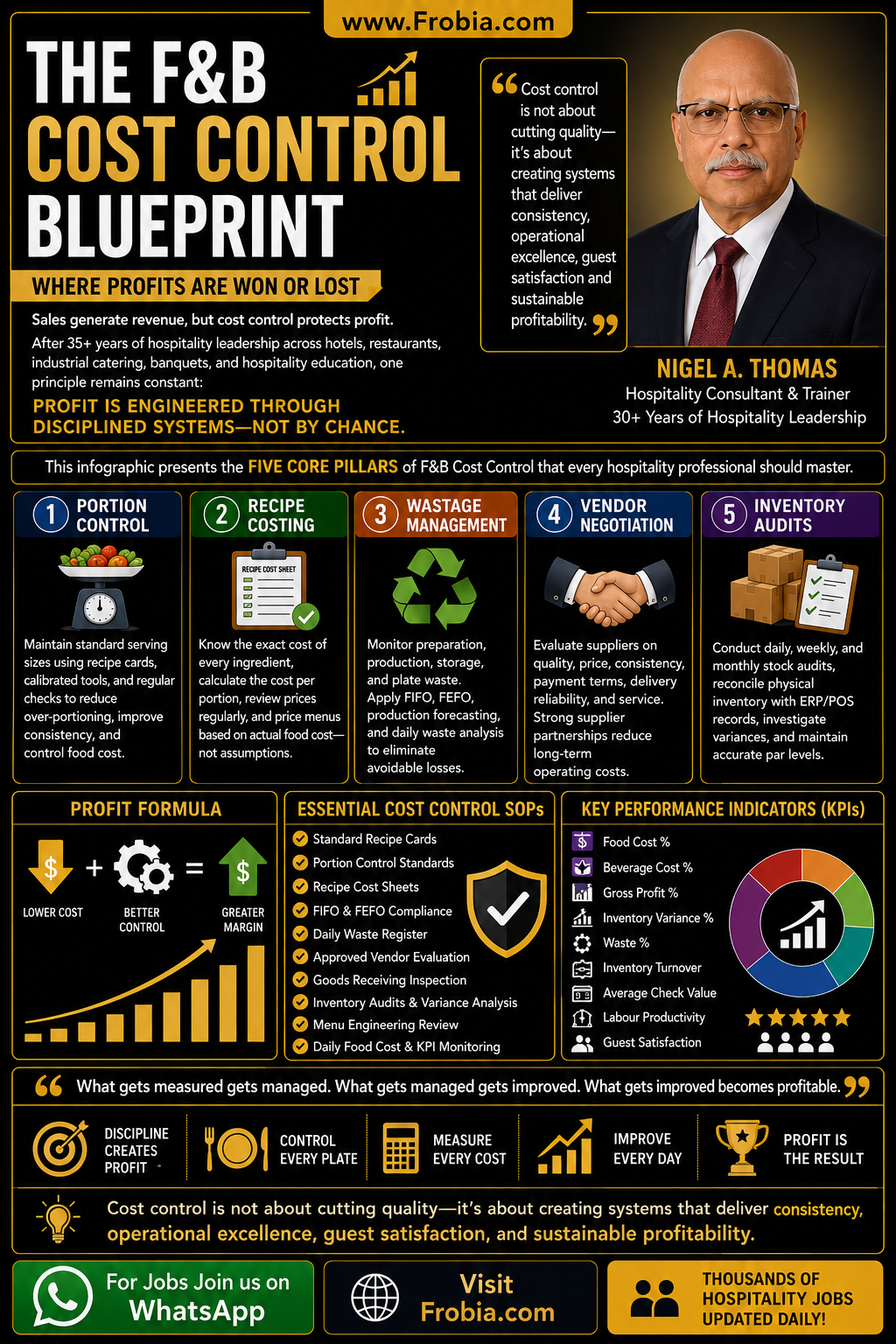
The five-habit blueprint for protecting F&B margin — the same framework I bring into every property.
1. Portion Discipline
Portion drift is invisible on any single plate and enormous across a month of service. A kitchen that lets portion sizes float by even 15-20 grams per dish, across thousands of covers, is quietly giving away real money — and usually has no idea it's happening because nothing about the food looks wrong to the guest.
- Calibrated scales at every relevant station, checked periodically.
- Recipe cards posted and followed — not memorized loosely.
- Standard scoops, ladles and portioning tools, never "eyeballed" amounts.
- New hires shadowed on plating before they run a station solo.
- Spot checks built into the supervisor's daily walk-through.
I've walked into properties where a single burger patty was consistently 25g over spec. Across a busy quarter, that one gap alone was worth several months of a line cook's salary. Nobody had noticed because each plate, on its own, looked completely normal.
2. True Recipe Costing
A menu priced on gut feel is a menu that's slowly losing money on someone's favourite dish without anyone realizing it. Every recipe needs a real cost sheet: exact quantities, current supplier pricing, yield after trim and cooking loss, and a clear cost-per-portion figure that gets revisited whenever a core ingredient's price shifts.
A recipe cost sheet worth having includes:
- Ingredient list with exact weights, not approximate measures.
- Current unit cost for each ingredient.
- Yield percentage after trimming, cooking loss and prep waste.
- Cost per portion and resulting food cost percentage at current menu price.
- A trigger to re-cost when any core ingredient moves more than a set threshold.
This single document does more to protect margin than almost anything else on this list, because it turns pricing decisions from a guess into arithmetic.
3. Waste Visibility
Waste is the cost that hides best, because it never shows up as a single dramatic loss — it shows up as a thousand small ones. Trim waste, over-production for a quiet Tuesday, a buffet that ran too generous, a delivery that sat too long before rotation. None of it feels significant in the moment.
What tends to drive waste in practice:
- Over-producing for anticipated business that doesn't show up.
- Inconsistent trimming technique across the brigade.
- Stock not rotated on a strict first-in, first-out basis.
- Buffet and banquet over-catering "just to be safe."
- Staff meals drawn from premium stock instead of a planned menu.
A simple daily waste log, reviewed weekly with the team rather than filed away, turns this from an invisible leak into a coaching conversation. The goal was never to eliminate waste to zero — it's to know exactly where it's coming from.
4. Supplier Accountability
The lowest quote on a supplier list is rarely the lowest actual cost. A vendor who delivers late, short, or inconsistent forces the kitchen into last-minute substitutions and emergency purchases — both of which cost far more than the few rupees or dollars saved on the original quote.
- Score suppliers on consistency and delivery reliability, not price alone.
- Inspect every delivery against the purchase order before it's accepted.
- Reject short or damaged deliveries at the door, not after they're in storage.
- Keep at least one backup vendor for every high-volume ingredient.
- Review supplier performance formally, not just when something goes wrong.
Strong supplier relationships pay off most during a supply shock — a bad harvest, a shipping delay, a sudden price spike. The properties that had already built trust with two or three reliable vendors weathered those moments; the ones chasing the cheapest quote each week scrambled.
5. Inventory Rhythm
Inventory control isn't one big stock count at month-end — it's a rhythm. High-value items get checked daily. Full counts happen on a fixed weekly and monthly cycle. And every variance, no matter how small, gets investigated the same day it surfaces rather than written off as "normal shrinkage."
A working inventory rhythm looks like:
- Daily spot checks on premium proteins, seafood and other high-value stock.
- Full physical counts reconciled against system records weekly.
- A formal monthly stocktake tied to the P&L close.
- Any variance above a set threshold investigated before the next order is placed.
- Clear, dated labelling on everything in dry, chilled and frozen storage.
The Metrics I Watch Every Week
None of the five habits above mean much without a short list of numbers to track them against. This is the set I keep in front of every operations team I lead:
That last one belongs on the list deliberately. Every cost decision in this framework gets weighed against guest experience — the goal was never to cut corners, it's to remove the waste that guests never see or benefit from in the first place.
The Bottom Line
None of these five habits is complicated on its own. What makes the difference is consistency — doing all five, every day, without exception, until they become how the kitchen simply operates rather than a checklist someone has to remember to run through.
If you're building or tightening a food and beverage operation and want a second set of eyes on where the margin is leaking, I work with hotels, resorts and restaurant groups on exactly this — from a one-time operational audit through to full pre-opening setup. Reach out through the contact page, or connect with me on LinkedIn.