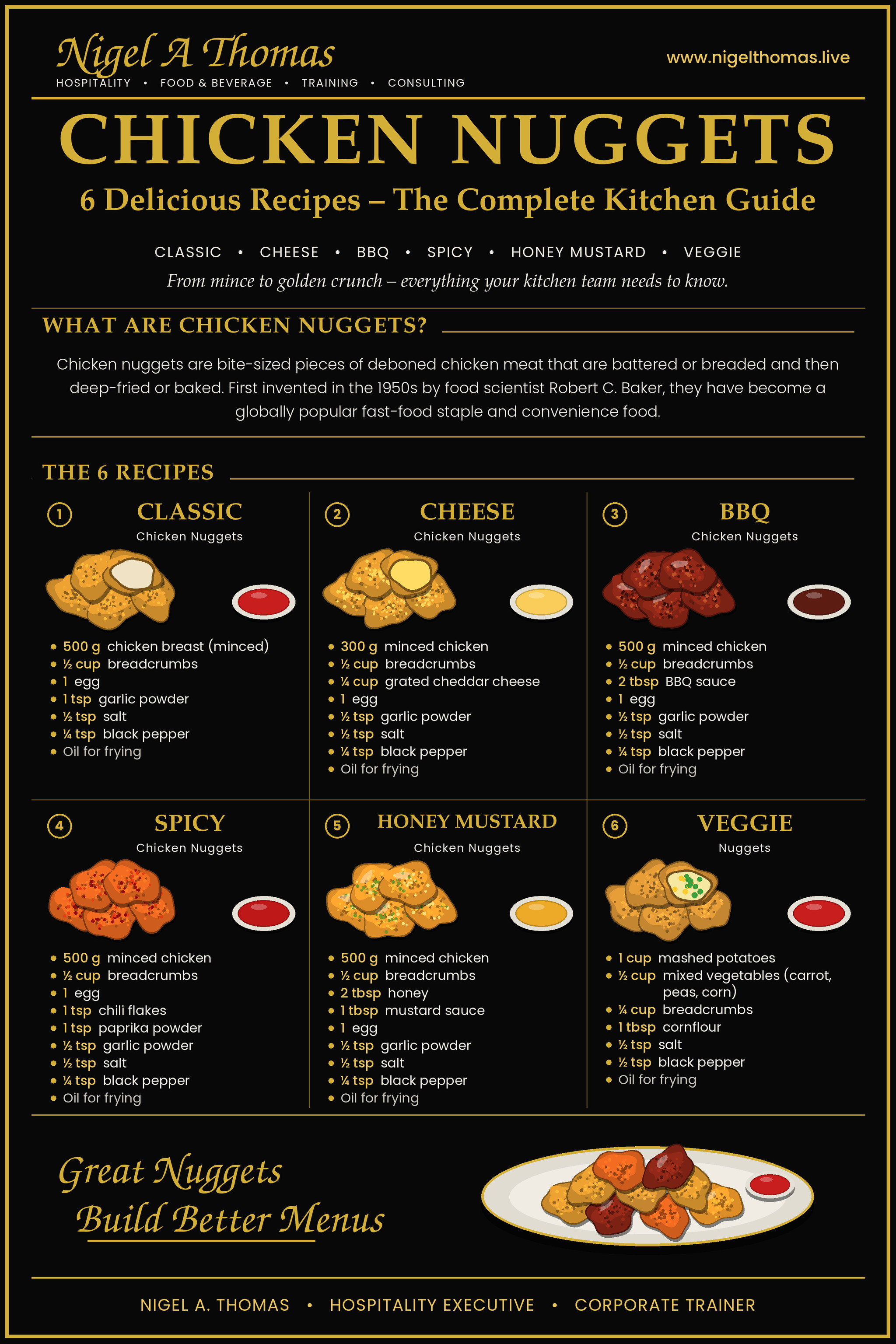
Few dishes travel as easily as the chicken nugget. It sits on the children's menu of a five-star resort, on the late-night room service card, in the snack bar of a cruise ship, and behind the counter of every quick-service restaurant in the world. It is simple to make, easy to portion, quick to cook and almost impossible to dislike. That combination is exactly why a chef or F&B manager should know how to make it properly rather than simply open a frozen bag.
This guide gives you six complete chicken nugget recipes: Classic, Cheese, BBQ, Spicy, Honey Mustard and Veggie. Each one uses everyday ingredients and a short ingredient list. Below you will find the exact quantities, a clear method for each, practical kitchen tips, food safety rules, holding and storage guidance, and a few ideas for putting nuggets on a menu with a sensible food cost. A downloadable black-and-gold infographic poster is at the bottom of the page, ready to print for your kitchen wall or training room.
What Are Chicken Nuggets?
Chicken nuggets are bite-sized pieces of deboned chicken meat that are battered or breaded and then deep-fried or baked. They were first invented in the 1950s by food scientist Robert C. Baker, and they have since become a globally popular fast-food staple and convenience food.
The idea behind the nugget is practical. Instead of cooking a whole breast or thigh, which cooks unevenly and takes time, the meat is minced or finely chopped, seasoned, bound together and shaped into small, even pieces. Small and even is the secret of the dish. Every piece is the same thickness, so every piece cooks in the same time, which is exactly what a busy kitchen needs. It also means trimmings and less glamorous cuts can be put to good use, and the seasoning can be controlled precisely rather than left to chance.
The six recipes in this guide share one foundation. Five are built on minced chicken, a little breadcrumb, egg and simple dry seasoning of garlic powder, salt and black pepper. The sixth, the Veggie nugget, swaps the chicken for mashed potato and mixed vegetables so that vegetarian guests are not left out. The difference between each recipe is one or two ingredients, which makes the set very easy to teach and easy to run from one mise en place.
The Six Recipes at a Glance
Use this table as a quick reference. All six recipes finish with oil for frying.
| Recipe | Main ingredients | Seasoning and extras |
|---|---|---|
| Classic | 500 g chicken breast (minced), ½ cup breadcrumbs, 1 egg | 1 tsp garlic powder, ½ tsp salt, ¼ tsp black pepper |
| Cheese | 300 g minced chicken, ½ cup breadcrumbs, 1 egg, ¼ cup grated cheddar cheese | ½ tsp garlic powder, ½ tsp salt, ¼ tsp black pepper |
| BBQ | 500 g minced chicken, ½ cup breadcrumbs, 1 egg, 2 tbsp BBQ sauce | ½ tsp garlic powder, ½ tsp salt, ¼ tsp black pepper |
| Spicy | 500 g minced chicken, ½ cup breadcrumbs, 1 egg | 1 tsp chili flakes, 1 tsp paprika powder, ½ tsp garlic powder, ½ tsp salt, ¼ tsp black pepper |
| Honey Mustard | 500 g minced chicken, ½ cup breadcrumbs, 1 egg, 2 tbsp honey, 1 tbsp mustard sauce | ½ tsp garlic powder, ½ tsp salt, ¼ tsp black pepper |
| Veggie | 1 cup mashed potatoes, ½ cup mixed vegetables (carrot, peas, corn), ¼ cup breadcrumbs | 1 tbsp cornflour, ½ tsp salt, ½ tsp black pepper |
The Master Method
All six recipes follow the same sequence. Learn it once and you can make any of them. The individual recipes below list only what changes.
- Prepare the meat. Use chicken breast, or boneless thigh if you prefer a juicier nugget, and mince it finely. A grinder gives the most even result. If you chop by hand or use a food processor, pulse in short bursts and stop while a little texture remains. Over-processing turns the meat into a paste and the nuggets become rubbery. Keep the meat cold throughout.
- Mix. Put the minced chicken, egg, breadcrumbs and all the dry seasonings in a bowl. Mix with your hands, or with a gloved hand in a commercial kitchen, until the mixture holds together and feels slightly tacky. Mix only until combined.
- Rest. Cover the bowl and chill the mixture for 15 to 30 minutes. A cold, rested mixture is far easier to shape and holds its form in the oil.
- Shape. Portion with a spoon or a small scoop, about 25 g each for a classic bite-sized nugget. Flatten each portion gently into a rounded piece about 1.5 cm thick. Damp hands stop the mixture sticking.
- Coat (optional). The breadcrumbs in each recipe are mixed into the meat as a binder. For an extra-crunchy exterior, roll the shaped pieces in a little additional dry breadcrumb just before cooking.
- Cook. Heat oil in a deep pan or fryer and fry in small batches without crowding, turning once, until deep golden. Drain on a rack or absorbent paper and season lightly while hot.
- Check. Confirm that the centre of the thickest nugget has reached at least 74°C (165°F) with a probe thermometer before service.
A word on yield: 500 g of minced chicken with the other ingredients makes roughly 20 to 24 nuggets of about 25 g. Scale up by multiplying every ingredient by the same factor, and keep your seasoning proportional.
The Six Recipes
1Classic Chicken Nuggets
The one every other recipe is measured against. Mild, savoury and golden, with the clean flavour of chicken and garlic. This is the recipe to master first, and it is the best one for teaching new commis and trainees because there is nothing to hide behind.
Ingredients
- 500 g chicken breast (minced)
- ½ cup breadcrumbs
- 1 egg
- 1 tsp garlic powder
- ½ tsp salt
- ¼ tsp black pepper
- Oil for frying
Method
- Combine the minced chicken breast, breadcrumbs, egg, garlic powder, salt and black pepper in a bowl.
- Mix until the mixture just holds together, then chill for 15 to 30 minutes.
- Shape into small, even, flattened nuggets.
- Fry in hot oil in small batches until golden brown on both sides and cooked through.
- Drain well and serve hot with ketchup.
Chef's note: breast meat is lean and can dry out if overcooked, so watch the clock. If the mixture feels too dry to bind, add a teaspoon of cold water or a little more egg white rather than extra breadcrumbs. Serve with ketchup, a squeeze of lemon and a few fresh salad leaves for a simple, classic plate.
2Cheese Chicken Nuggets
Soft, savoury and a little indulgent. The cheddar melts inside the nugget as it fries, so each bite is rich and slightly stretchy. This one is a reliable favourite with children and a strong seller as a shared starter.
Ingredients
- 300 g minced chicken
- ½ cup breadcrumbs
- ¼ cup grated cheddar cheese
- 1 egg
- ½ tsp garlic powder
- ½ tsp salt
- ¼ tsp black pepper
- Oil for frying
Method
- Mix the minced chicken, breadcrumbs, grated cheddar, egg, garlic powder, salt and pepper until evenly combined.
- Chill the mixture for 20 minutes so the cheese firms up and the mixture becomes easier to handle.
- Shape into small rounded nuggets, pressing the edges together so no cheese is exposed.
- Fry in medium-hot oil, not too hot, so the outside does not darken before the cheese has melted and the centre has cooked.
- Drain and serve while the cheese is soft, with a warm cheese sauce or ketchup.
Chef's note: grate the cheese fresh and fairly fine. Pre-shredded cheese often carries anti-caking starch that changes how it melts. Because cheese is salty, taste the cheddar before you finalise the salt. A mature cheddar gives the strongest flavour in a small quantity, which helps your food cost.
3BBQ Chicken Nuggets
Sweet, smoky and sticky, with a deep reddish-brown glaze. The barbecue sauce goes into the mixture for flavour all the way through, and a little more brushed on at the end gives the glossy finish you see on a good wing or nugget.
Ingredients
- 500 g minced chicken
- ½ cup breadcrumbs
- 2 tbsp BBQ sauce
- 1 egg
- ½ tsp garlic powder
- ½ tsp salt
- ¼ tsp black pepper
- Oil for frying
Method
- Mix the chicken, breadcrumbs, BBQ sauce, egg, garlic powder, salt and pepper until the mixture is evenly coloured.
- Chill for 15 to 30 minutes, then shape into flattened nuggets.
- Fry in hot oil in small batches until deep golden brown. The sauce darkens the surface, so judge doneness by time and a probe thermometer, not by colour alone.
- Drain, then toss or brush with a little extra BBQ sauce while the nuggets are still hot.
- Serve with more BBQ sauce for dipping.
Chef's note: sugar in barbecue sauce browns quickly. If the nuggets are colouring too fast, lower the oil temperature slightly or finish them in a hot oven. Choose a sauce with a thick, smooth texture so it clings to the mixture instead of making it wet.
4Spicy Chicken Nuggets
A bold, warming nugget with visible flecks of chili and a rusty orange colour from the paprika. The heat is moderate and builds slowly, so it suits adult guests, bar snack menus and anyone who wants more than a mild bite.
Ingredients
- 500 g minced chicken
- ½ cup breadcrumbs
- 1 egg
- 1 tsp chili flakes
- 1 tsp paprika powder
- ½ tsp garlic powder
- ½ tsp salt
- ¼ tsp black pepper
- Oil for frying
Method
- Mix the chicken with the breadcrumbs, egg, chili flakes, paprika, garlic powder, salt and pepper.
- Chill for 15 to 30 minutes so the spices bloom into the meat.
- Shape into nuggets and fry in hot oil, turning once, until crisp and deep golden.
- Drain and serve straight away with a chili dipping sauce, a yoghurt dip or chilled mayonnaise to cool the heat.
Chef's note: chili flakes vary a great deal in strength between suppliers, so test a small piece before you cook the whole batch and adjust next time. Paprika adds colour and gentle sweetness more than heat. If you serve children and adults from the same kitchen, make a Classic batch and a Spicy batch separately and label them clearly.
5Honey Mustard Chicken Nuggets
Sweet, tangy and glossy. Honey and mustard are a classic pairing: the honey rounds off the sharpness of the mustard, and together they make a nugget that tastes more grown-up than the Classic without being spicy.
Ingredients
- 500 g minced chicken
- ½ cup breadcrumbs
- 2 tbsp honey
- 1 tbsp mustard sauce
- 1 egg
- ½ tsp garlic powder
- ½ tsp salt
- ¼ tsp black pepper
- Oil for frying
Method
- Whisk the honey and mustard sauce together in a small bowl. Set aside a spoonful for glazing.
- Mix the rest into the chicken with the breadcrumbs, egg, garlic powder, salt and pepper.
- Chill, then shape into flattened nuggets.
- Fry in medium-hot oil, a touch cooler than for the Classic, because honey caramelises and burns quickly.
- Brush the hot nuggets with the reserved honey mustard and serve with extra dipping sauce.
Chef's note: gentle heat is the key. If the oil is too hot the surface will turn dark and bitter before the middle is cooked. A pinch of chopped parsley over the finished nuggets adds colour and freshness for plating.
6Veggie Nuggets
A soft, golden, crisp-edged nugget made from mashed potato and mixed vegetables, with no meat and no egg. The cut surface shows bright flecks of carrot, peas and corn, which makes it appealing on the plate, especially for children who are reluctant to eat vegetables.
Ingredients
- 1 cup mashed potatoes
- ½ cup mixed vegetables (carrot, peas, corn)
- ¼ cup breadcrumbs
- 1 tbsp cornflour
- ½ tsp salt
- ½ tsp black pepper
- Oil for frying
Method
- Cook the carrot, peas and corn until just tender, drain very well and let them cool. Dice the carrot small.
- Mix the mashed potato, vegetables, breadcrumbs, cornflour, salt and pepper into a firm, even dough.
- Chill for at least 30 minutes. This step matters more here than in the chicken recipes, because the mixture is softer.
- Shape into small flattened nuggets with damp hands.
- Fry in hot oil until golden and crisp, turning gently, and serve hot with ketchup.
Chef's note: moisture is the enemy. Dry mashed potato, well-drained vegetables and cornflour are what hold these nuggets together. If the mixture is sticky, add a little more breadcrumb. Because this recipe contains no meat or egg, it can suit vegetarian and egg-free guests, but always check every ingredient label and keep it separate from chicken during cooking, using fresh oil and clean utensils.
Frying Versus Baking
Nuggets can be deep-fried or baked, and the choice depends on your kitchen and your guest. Deep-frying gives the crispest crust and the fastest cooking, usually a few minutes per batch, and it is the standard method for a service line. Shallow frying in a pan works well at home or for small batches, as long as you turn the pieces and keep the oil at a steady temperature.
Baking is lighter and easier to manage in volume. Place the shaped nuggets on a lined tray, brush or spray lightly with oil, and bake in a hot oven, turning once, until golden and cooked through. The crust will be less crisp, so a light dusting of dry breadcrumbs before baking helps. Baking also suits the Cheese and Veggie recipes, which are more delicate in the fryer.
Whichever method you choose, never crowd the pan, tray or basket. Overcrowding drops the temperature, steams the surface and gives pale, greasy nuggets. Cook in batches and keep finished batches on a rack in a warm oven while you continue.
Food Safety
Minced poultry demands respect. Grinding spreads any surface bacteria through the whole mixture, so there is no safe “rare” for a nugget. Follow these rules every time:
- Keep it cold. Store raw chicken at or below 5°C (41°F) and mince it just before use. Return the mixture to the chill between steps.
- Cook to 74°C (165°F). Probe the thickest nugget in each batch. Do not judge by colour alone, particularly with the dark BBQ and Honey Mustard versions.
- Prevent cross-contamination. Use separate boards, knives, bowls and gloves for raw chicken, and wash hands thoroughly after handling it. Never use the same tongs for raw and cooked nuggets.
- Protect your guests with allergies. The recipes contain egg (except Veggie), breadcrumbs, which contain gluten, and cheese. Mustard sauce and some BBQ sauces are also allergens or contain them. Declare these clearly on the menu and in your allergen matrix.
- Manage the oil. Filter the oil regularly, replace it when it darkens or smells, and keep a dedicated fryer for allergen-free or vegetarian items where possible.
Sauces and Service
A nugget is only half the plate. The sauce gives contrast and lets the guest personalise the dish. A simple set of dips covers every recipe in this guide:
- Ketchup for the Classic and Veggie.
- Warm cheese sauce or mild cheddar dip for the Cheese nuggets.
- BBQ sauce for the BBQ nuggets, served slightly warm.
- Chili sauce or yoghurt dip for the Spicy nuggets, one for heat and one to cool it.
- Honey mustard dip, with a little more honey and mustard than you used in the mix, for the Honey Mustard nuggets.
For plating, a bed of crisp lettuce gives height and a fresh colour against the golden nuggets. Serve in a small bowl, paper cone or on a plain white plate, with the dip in a ramekin on the side. A sprinkle of chopped herbs or a wedge of lemon lifts the presentation at almost no cost. For a sampler platter, offer three or four flavours together, such as Classic, BBQ, Spicy and Honey Mustard, with matching dips. It sells well as a shared starter, a bar snack or a children's mixed plate.
Holding, Cooling and Storage
Good planning means you can prepare in advance and still serve a fresh product.
- Prepare ahead. Shaped, uncooked nuggets can be kept on a lined tray, covered, in the refrigerator for a short period before cooking. For longer storage, freeze them on the tray until solid, then pack in labelled, dated containers. Cook from frozen, allowing a little extra time, and always check the centre temperature.
- Hot holding. Hold cooked nuggets at 57°C (135°F) or above, the ServSafe standard, on a rack under a heat lamp or in a warm cabinet. Quality drops quickly, so hold for only a short time and cook small batches often.
- Cooling leftovers. If cooked nuggets must be stored, cool them quickly in shallow trays, refrigerate promptly, label with the date, and use within the shelf life your food safety plan allows. Reheat to at least 74°C (165°F) before serving.
- Labelling. Every container needs a product name, preparation date, use-by date and the initials of the cook. Follow first in, first out.
On the Menu: Costing and Training
Chicken nuggets are one of the most forgiving items on a menu for margin. The ingredient list is short, the portions are controlled, and the cost of the dry seasonings per portion is very small. Chicken is the main cost, so the cleanest way to protect your margin is to buy well, trim and mince efficiently, and keep waste low.
To cost a recipe, price each ingredient per gram or per spoon, add them up for the whole batch, and divide by the number of portions. Add oil loss as a small percentage, because some oil is absorbed and some is discarded. Then compare the cost per portion to your menu price. Remember to cost the dips and garnish as part of the dish.
The set of six also works well as a menu engineering tool. A single base mixture can be split after mixing, with a spoonful of BBQ sauce in one part, chili and paprika in another, and honey and mustard in a third. This lets a small kitchen offer variety without extra prep or extra stock. The Veggie nugget adds a vegetarian option with a very low food cost, and it keeps your menu inclusive.
For training, the chicken nugget is an ideal first project. It teaches mincing and binding, portion control, shaping, safe handling of raw poultry, oil management, temperature control and plating, all in one short exercise. Have trainees make the Classic first, then ask them to adapt it into one of the other five and explain what they changed and why.
Troubleshooting
| Problem | Likely cause | Fix |
|---|---|---|
| Nuggets fall apart in the oil | Mixture too wet or not chilled; oil too cool | Chill longer, add a little breadcrumb, and heat the oil properly before frying |
| Dry, tough texture | Over-mixing, over-processing, or overcooking | Mix gently, leave some texture in the meat, and pull as soon as the centre reaches temperature |
| Dark outside, raw inside | Oil too hot, especially with BBQ and Honey Mustard | Lower the heat, make the pieces thinner, or finish in the oven |
| Pale and greasy | Oil too cool or pan overcrowded | Fry in small batches and let the oil recover between them |
| Veggie nuggets are soft | Too much moisture in the potato or vegetables | Dry the mash, drain the vegetables, and add breadcrumb or cornflour |
Frequently Asked Questions
Can I use chicken thigh instead of breast?
Yes. Boneless, skinless thigh gives a juicier, more flavourful nugget and is more forgiving if you slightly overcook it. Mince it the same way and use the same quantities.
Can I make the nuggets without egg?
You can replace the egg with a spoonful of mashed potato or a little cornflour mixed with water, similar to the Veggie recipe. The texture will be slightly softer, so chill the mixture well before shaping.
How do I make them crunchier?
Roll the shaped nuggets in a thin layer of dry breadcrumbs before frying, keep the oil at a steady temperature, and drain on a wire rack instead of paper so steam does not soften the crust.
Can I freeze them?
Yes. Freeze shaped, uncooked nuggets on a tray, then pack them. Cooked nuggets also freeze, but the texture is best from raw. Always cook or reheat until the centre reaches 74°C (165°F).
Which recipe should I start with?
Start with the Classic. Once you can make it consistently, the other four chicken versions are simple variations, and the Veggie nugget teaches a different binding technique.
Chicken nuggets reward care. A well-minced, well-seasoned, well-fried nugget is a small piece of food that tells a guest, and an inspector, a great deal about the standards of the kitchen behind it. Print the poster below, put it on the wall and cook all six.