6 Salmon Recipes for Hotel & Restaurant Kitchens
Ask any hotel chef which protein can carry a menu from room service to a banquet to a fine dining special, and salmon is usually near the top of the answer. It is rich, forgiving, visually striking and familiar to almost every guest who walks through the door. Over three decades in luxury hotels, resorts and on cruise ships, I have seen salmon served in more ways than I can count: poached for a buffet, cured for a breakfast, grilled for a poolside lunch and pan-roasted for a six-course tasting menu. The fish never goes out of style because it adapts so well to the cook.
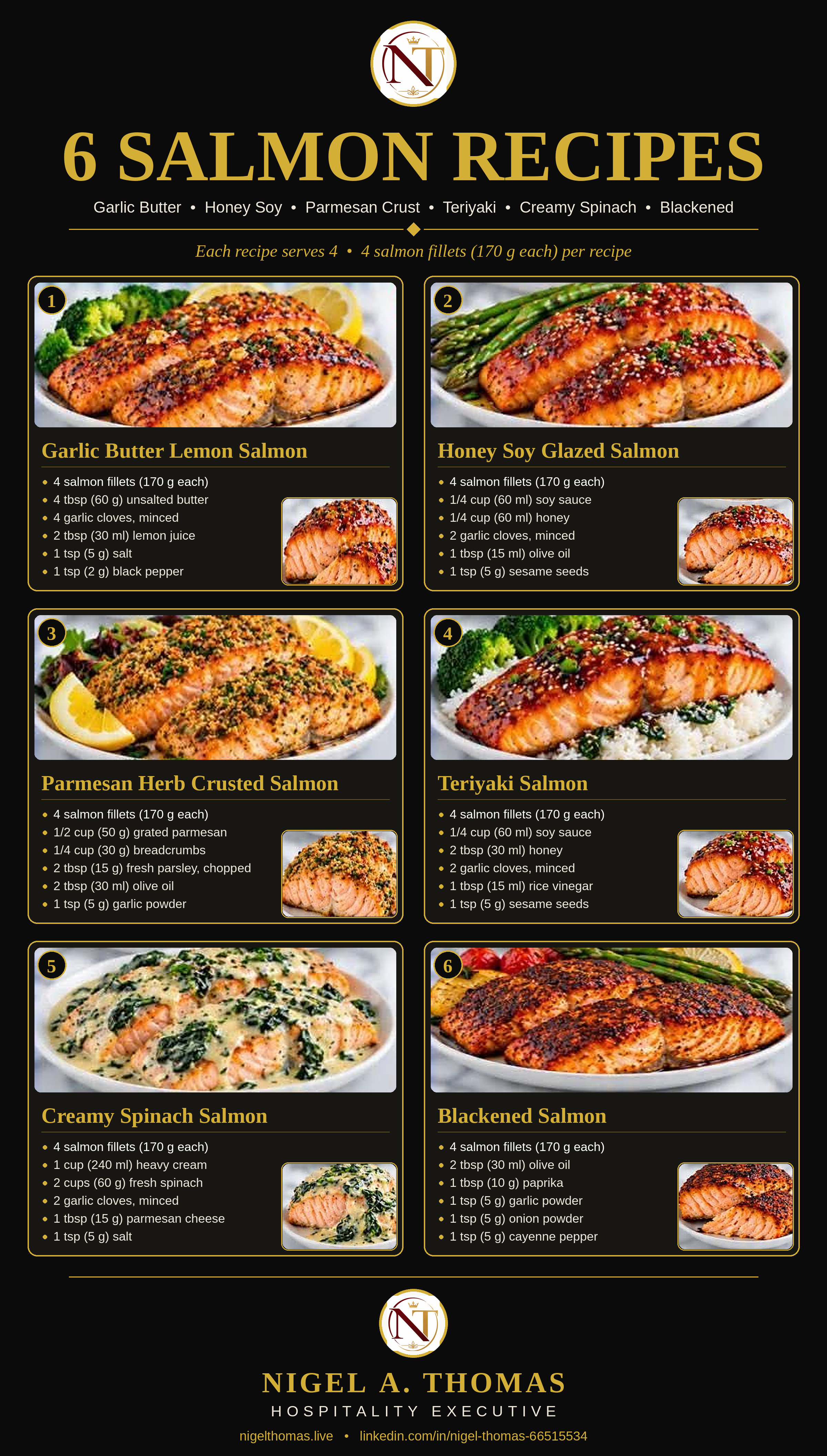
This guide covers six salmon recipes that work equally well in a home kitchen and in a professional line: Garlic Butter Lemon Salmon, Honey Soy Glazed Salmon, Parmesan Herb Crusted Salmon, Teriyaki Salmon, Creamy Spinach Salmon and Blackened Salmon. Each recipe uses four 170 g (6 oz) fillets, which is a generous but realistic single portion. Every recipe has exact quantities, a clear method, practical chef notes and ideas for service. Before the recipes, we look at how to buy, receive and prepare salmon properly, because the best recipe in the world cannot rescue poor fish. After them, we cover cooking temperatures, allergens, costing, storage and the mistakes I see most often.
A free infographic poster with all six recipes is available at the bottom of this page. You can print it and pin it in your kitchen or share it with your team.
Why Salmon Deserves a Place on Every Menu
Salmon sits in a sweet spot that few proteins reach. It has enough natural fat to stay moist under heat that would dry out a leaner fish, so it tolerates the small timing errors that happen in a busy service. Its flavour is distinctive but not aggressive, which means it accepts a buttery sauce, a sweet glaze, a spiced crust or a cream sauce without losing its identity. And it looks good on the plate: the pink-orange flesh against green vegetables, white rice or a pale sauce does half the selling before the guest takes a bite.
From a business point of view, salmon gives you three advantages. First, the fillet is a uniform, easy-to-portion product. A 170 g cut is simple to specify, simple to cost and simple to repeat, which keeps quality consistent across cooks and across shifts. Second, the preparation is front-loaded. Glazes, crusts and spice blends can all be prepared during mise en place, so the final cooking on the line takes only minutes. Third, guests perceive salmon as a healthy, premium choice, which supports a healthy price point without needing exotic ingredients.
The six recipes in this guide also show how a single fish can cover very different menu slots. Garlic butter and lemon is the classic comfort option. Honey soy and teriyaki bring a sweet-savoury Asian profile. The parmesan herb crust adds texture and a baked, golden finish. The creamy spinach version is the indulgent dinner dish. Blackened salmon brings heat and smoke. Put together, they let you build a salmon section of a menu with real variety while buying only one main item.
Buying and Receiving Salmon the Right Way
Good cooking starts at the receiving dock. When salmon arrives at a hotel or restaurant, check it before you sign for it. The flesh should look bright and moist, with a firm texture that springs back when pressed gently with a clean gloved finger. The smell should be clean and fresh, like cold seawater, never sharp or sour. Whole fillets should show tight, well-defined flake lines. Dull colour, gaping flesh, a sticky film or a strong odour are all reasons to reject the delivery.
Temperature matters as much as appearance. Fresh fish should be received at 0 to 4°C (32 to 40°F), ideally on ice, and moved into refrigeration immediately. Frozen salmon should arrive solidly frozen with no signs of thawing and refreezing, such as large ice crystals inside the packaging or liquid pooled at the bottom of the box. Record temperatures on your receiving log. In a HACCP-based operation, the receiving check is your first critical control point for fish, and a short entry in the log protects you if a question is ever raised later.
Fresh versus frozen
Many guests, and some cooks, assume fresh is always better than frozen. In reality, high-quality salmon that was frozen soon after harvest and thawed carefully can be excellent, and often more consistent than fresh fish that has travelled for days. Frozen salmon is also valuable for cost control and for reducing waste, since you only thaw what you need. The key is how you thaw it: slowly, under refrigeration, in its packaging or on a draining tray, and never at room temperature or under warm water. Allow a full day for fillets to thaw in a cold room, then pat them dry before use.
Skin-on or skinless, farmed or wild
All six recipes work with skin-on or skinless fillets. Skin-on fillets are more forgiving in a pan because the skin protects the flesh from direct heat, and crisp skin is a texture many guests love. Skinless fillets suit the parmesan crust, the creamy spinach and the glazed baked dishes, where the skin would soften under a topping or sauce anyway. Farmed salmon tends to be fattier, milder and more consistent in size, which makes portion control easy. Wild salmon is leaner, with a deeper flavour and colour, and needs slightly more care so that it does not dry out. Choose according to your menu price, your guests and your supplier reliability, and specify it clearly in your purchase specifications so that deliveries are consistent.
Preparing Salmon: Mise en Place for Consistent Results
Preparation is where professional kitchens separate themselves from average ones. Use the following routine for every recipe in this guide and the results will be far more consistent.
- Portion accurately. Weigh fillets to 170 g (6 oz). Cut from the thick centre of the fillet where possible so portions are even in thickness, which makes cooking times predictable. Keep thinner tail pieces for another use, such as a salmon cake or a pasta special.
- Check for pin bones. Run a clean fingertip along the centre line of each fillet. Remove any pin bones with clean tweezers, pulling in the direction they lie. A guest finding a bone is a service failure that no sauce can fix.
- Pat completely dry. Moisture on the surface prevents browning and causes steaming instead of searing. Use clean paper towels and dry both sides. This single step improves crispness more than almost any other.
- Bring toward cool room temperature briefly. Taking the fish out of the refrigerator 10 minutes before cooking helps it cook evenly, but never leave raw fish out for longer than that. In a commercial kitchen, keep portions on a tray over ice until the cook is ready.
- Season at the right moment. Salt draws moisture out over time. For searing and baking, season just before the fish goes into the heat. For marinades, keep the time short so the salt and acid do not change the texture.
- Prepare sauces, glazes and crusts in advance. Measure and mix everything in labelled containers. Separate any glaze that will be used as a finishing sauce before it ever touches raw fish.
The Six Salmon Recipes
All quantities below are for four portions, using four 170 g salmon fillets. Oven temperatures assume a conventional oven; reduce by about 20°C (25°F) in a fan oven. Cooking times are guides, because the thickness of the fillet and the heat of your pan or oven make a real difference. Use a probe thermometer in the thickest part of the fillet whenever you can.
1. Garlic Butter Lemon Salmon
Ingredients (serves 4)
- 4 salmon fillets (170 g each)
- 4 tbsp (60 g) unsalted butter
- 4 garlic cloves, minced
- 2 tbsp (30 ml) lemon juice
- 1 tsp (5 g) salt
- 1 tsp (2 g) black pepper
Method
- Pat the fillets dry and season both sides with the salt and black pepper.
- Melt a little of the butter in a heavy pan over medium-high heat. Place the fillets in, presentation side down, and sear for 3 to 4 minutes until golden.
- Turn the fillets and lower the heat. Add the rest of the butter and the garlic.
- Baste the fish continuously with the foaming garlic butter for 3 to 4 minutes, until just cooked through.
- Take the pan off the heat, add the lemon juice, spoon the sauce over and serve at once.
Chef’s notes. This is the dish most guests will recognise, and the simplicity is its strength. The risk is burnt garlic: if the garlic turns dark brown, it turns bitter, so add it only once the heat is lowered and keep the butter moving. Add the lemon juice off the heat so that it brightens the sauce rather than splitting it. For a baked version, place the seasoned fillets on a tray, spoon over the melted garlic butter and bake at 200°C (400°F) for 12 to 15 minutes, finishing with lemon.
Serve with: steamed broccoli, roasted baby potatoes or buttered rice, with lemon wedges on the side. It also works beautifully as a hotel room service dish because it holds well for a short transport time and the sauce is already on the plate.
2. Honey Soy Glazed Salmon
Ingredients (serves 4)
- 4 salmon fillets (170 g each)
- 1/4 cup (60 ml) soy sauce
- 1/4 cup (60 ml) honey
- 2 garlic cloves, minced
- 1 tbsp (15 ml) olive oil
- 1 tsp (5 g) sesame seeds
Method
- Whisk the soy sauce, honey, garlic and olive oil together. Pour off about a third into a clean container and keep it aside for finishing.
- Place the fillets in the remaining glaze and marinate in the refrigerator for 15 to 30 minutes, turning once.
- Lift the fillets onto a lined tray and bake at 200°C (400°F) for 12 to 15 minutes.
- Brush with some of the marinade halfway through to build a lacquered surface.
- Finish with the reserved glaze, scatter over the sesame seeds and rest for 2 minutes before serving.
Chef’s notes. A glaze containing honey will caramelise quickly and can burn if the oven is too hot or the fish sits too close to the element. If the edges darken before the centre is cooked, cover loosely with foil. The reserved glaze matters for food safety: any marinade that has touched raw fish must not be used as a finishing sauce unless it has been boiled first. Setting aside a clean portion at the start avoids the problem entirely. Do not marinate for much longer than 30 minutes, because the salt in soy sauce will begin to firm the surface of the flesh.
Serve with: steamed asparagus, jasmine rice or stir-fried greens. The sweet and savoury balance also pairs well with a crisp cucumber salad.
3. Parmesan Herb Crusted Salmon
Ingredients (serves 4)
- 4 salmon fillets (170 g each)
- 1/2 cup (50 g) grated parmesan
- 1/4 cup (30 g) breadcrumbs
- 2 tbsp (15 g) fresh parsley, chopped
- 2 tbsp (30 ml) olive oil
- 1 tsp (5 g) garlic powder
Method
- Mix the parmesan, breadcrumbs, parsley and garlic powder in a bowl. Add the olive oil and stir until the mixture clumps like damp sand.
- Pat the fillets dry, place on a lined tray and season lightly with black pepper.
- Press the crust firmly onto the top of each fillet in an even layer.
- Bake at 200°C (400°F) for 12 to 15 minutes, until the crust is golden and the fish flakes at the thickest point.
- If the top needs more colour, place under a hot grill for 1 to 2 minutes, watching closely.
Chef’s notes. Parmesan is salty, so this recipe needs little or no added salt on the fish itself. For a crust that stays on, make sure the surface of the salmon is dry, and press rather than sprinkle. Panko crumbs give extra crunch, and a thin brush of Dijon mustard under the crust adds flavour and acts as glue. For banquet service, the crust can be prepared a day ahead and kept refrigerated, so the whole dish is assembled and baked in the final hour.
Serve with: a lemony green salad, roasted vegetables or a light tomato salad. The crunchy top contrasts well with a soft side such as creamy polenta or mashed potato.
4. Teriyaki Salmon
Ingredients (serves 4)
- 4 salmon fillets (170 g each)
- 1/4 cup (60 ml) soy sauce
- 2 tbsp (30 ml) honey
- 2 garlic cloves, minced
- 1 tbsp (15 ml) rice vinegar
- 1 tsp (5 g) sesame seeds
Method
- Combine the soy sauce, honey, garlic and rice vinegar. Set aside a portion for the finishing sauce.
- Marinate the fillets in the remaining mixture for up to 30 minutes in the refrigerator.
- Sear the fillets in a hot, lightly oiled pan for 3 minutes per side, or roast at 200°C (400°F) for 12 minutes.
- Meanwhile, simmer the reserved sauce for 3 to 4 minutes until it thickens and coats the back of a spoon.
- Brush the fillets with the thickened sauce, sprinkle with the sesame seeds and serve over rice.
Chef’s notes. Teriyaki literally refers to a glossy finish, and the thick, shiny sauce is the point of this dish. Reduce the finishing sauce gently, because honey and soy catch quickly on a hot surface. If you want extra body, a small amount of cornstarch stirred into cold water and added at the end will give a classic sticky glaze. Fresh ginger is a welcome addition if your menu allows variation. Slice spring onions finely and add them just before serving for freshness.
Serve with: steamed white rice and broccoli. In a hotel setting, this dish works well as a bento-style lunch or a healthy dinner option and is easy to batch for a staff canteen.
5. Creamy Spinach Salmon
Ingredients (serves 4)
- 4 salmon fillets (170 g each)
- 1 cup (240 ml) heavy cream
- 2 cups (60 g) fresh spinach
- 2 garlic cloves, minced
- 1 tbsp (15 g) parmesan cheese
- 1 tsp (5 g) salt
Method
- Season the fillets with half the salt and sear in a hot pan with a little oil for 3 to 4 minutes per side. Remove and keep warm.
- In the same pan, lower the heat, add the garlic and stir for 30 seconds.
- Pour in the cream and simmer gently for 3 to 4 minutes until it begins to thicken.
- Stir in the parmesan and the remaining salt, then add the spinach and let it wilt for 1 to 2 minutes.
- Return the salmon and any resting juices to the pan and spoon the sauce over for 1 minute to finish cooking.
Chef’s notes. This is a one-pan dish, which makes it efficient on a busy line, but it needs attention to heat. Cream that boils hard can split or turn oily, so keep it at a gentle simmer. Fresh spinach releases water as it wilts, so allow the sauce a moment to tighten again before plating. Sun-dried tomato or a squeeze of lemon makes a good variation and cuts through the richness. Because the fish is returned to the sauce, slightly undercook it in the first stage.
Serve with: buttered pasta, rice or crusty bread to catch the sauce, and asparagus or green beans for colour. It suits a dinner menu in cooler months or an indulgent chef’s special.
6. Blackened Salmon
Ingredients (serves 4)
- 4 salmon fillets (170 g each)
- 2 tbsp (30 ml) olive oil
- 1 tbsp (10 g) paprika
- 1 tsp (5 g) garlic powder
- 1 tsp (5 g) onion powder
- 1 tsp (5 g) cayenne pepper
Method
- Mix the paprika, garlic powder, onion powder and cayenne. Add salt to taste if your blend does not already contain it.
- Pat the fillets dry, brush with half the olive oil and coat generously with the spice mix on the presentation side.
- Heat a cast iron or heavy pan until very hot and add the remaining oil.
- Place the fillets spice side down and cook for 3 to 4 minutes without moving them, until a dark crust forms.
- Turn and cook for another 3 to 4 minutes, or until the centre reaches your target temperature, then rest for 2 minutes.
Chef’s notes. Blackened does not mean burnt: the dark colour comes from the toasted spices and the hot pan, and the fish should still taste of spice and smoke, not bitterness. This method creates a lot of smoke, so a commercial kitchen needs good extraction and the cook should be briefed on safety, including how to handle a hot, smoking pan. At home, open a window and turn on the extractor. If your guests do not like heat, reduce the cayenne by half and increase the paprika. Smoked paprika is a good upgrade.
Serve with: a cooling element such as lime crema, avocado salsa or mango salsa, alongside grilled vegetables, corn or dirty rice. The heat and the cool contrast make this a popular summer option.
Cooking Temperatures and Doneness
Food safety guidance in many countries sets a safe internal temperature for cooked fish at 63°C (145°F), measured in the thickest part of the fillet. At this temperature the flesh turns opaque and flakes easily with a fork. This is the standard to use in any commercial kitchen unless you have a documented procedure for serving fish cooked to a lower temperature, with the right sourcing and consumer advisories in place. Many chefs prefer salmon slightly under that point, with a moist, just-set centre, and carry out the final stage of cooking by resting. If you serve salmon cooked to a lower temperature, check your local food safety regulations and your own HACCP plan before putting it on the menu.
A simple practical test is to press the thickest part with a fork. It should separate into large moist flakes. If it looks translucent and resists, it needs another minute. If it looks chalky and dry, with white protein beading on the surface, it has gone too far. The white substance is albumin, a protein pushed out by overcooking. A little is normal; a lot tells you the heat was too high or the cooking too long.
Carry-over cooking also matters. A fillet will continue to rise by several degrees after leaving the heat, especially a thick one. Pull it just before the target and let it rest for two minutes on a warm plate or tray. That rest also lets the juices settle so that the fish stays moist when it is cut.
Allergens and Dietary Considerations
Every one of these recipes contains at least one major allergen, and anyone writing a menu has a duty to know them. Salmon itself is fish, which is a major allergen. Beyond that, the recipes include:
- Dairy: garlic butter, parmesan crust and creamy spinach (butter, parmesan, cream).
- Soy: honey soy glazed and teriyaki (soy sauce).
- Gluten: soy sauce usually contains wheat, and breadcrumbs in the parmesan crust contain wheat. Tamari and gluten-free breadcrumbs are practical substitutes.
- Sesame: honey soy glazed and teriyaki (sesame seeds).
- Honey: not suitable for infants under one year, and not suitable for vegans.
Always follow your local allergen labelling rules and keep an allergen matrix for the kitchen and the service team. A guest with an allergy needs a confident, accurate answer, not a guess. Prevent cross-contact with separate boards, utensils and pans when preparing allergen-free requests, and communicate clearly between the kitchen and the floor. Blackened salmon is naturally the simplest to adapt for dairy-free and soy-free requests, provided the spice blend has no hidden additives.
Costing and Menu Positioning
Salmon is a significant cost line, so a professional kitchen costs every dish. Start with the purchase price per kilogram and adjust for yield. Trimming, skinning and pin-boning will reduce the weight, so a 170 g portion costs more than 170 g of the raw purchase price suggests. Add the cost of the other ingredients, which in these recipes are modest: butter, honey, soy sauce, herbs and spices contribute a small proportion compared with the fish. Cream and parmesan are the most expensive extras, followed by fresh asparagus and other garnishes.
Divide the total plate cost by your target food cost percentage to find a selling price. As a general guide, many hotels and restaurants aim for a food cost somewhere between 28 and 35 percent on main courses, though this varies by market and concept. Salmon often runs higher, so it is common to offset it by pairing with low-cost starches and vegetables, and by pricing for perceived value. Write the standard recipe card, the portion weight and the plating specification so that every cook produces the same dish every time.
For menu positioning, think about where each recipe works best. Garlic butter lemon is a reliable all-day main. Honey soy and teriyaki appeal to lighter, health-focused menus and room service. The parmesan crust suits banquets because it bakes in large trays with little attention. Creamy spinach is a dinner special with a higher perceived value. Blackened salmon suits casual dining, bar menus and summer terraces. Offering two or three of these, rather than all six at once, keeps the menu focused and the inventory tight.
Storage, Holding and Leftovers
Fresh salmon should be stored at 0 to 4°C (32 to 40°F), on the lowest shelf of the refrigerator and below ready-to-eat foods so that raw juices cannot drip on to anything else. Keep it covered and on a draining tray, and use it within one to two days of receiving unless the supplier has given a different date. Label everything with the date and time, and follow first-in, first-out so older stock is used first.
Cooked salmon should not sit at room temperature. Under most guidelines, hot food must be held at 63°C (145°F) or above, or cooled rapidly and refrigerated. Cool leftovers quickly, store in shallow covered containers at 4°C or below, and use within two days. Reheat to at least 74°C (165°F) before serving. Cooked salmon makes excellent salmon cakes, flaked fish salads, pasta sauces and breakfast hash, which is a practical way of reducing waste and protecting margin.
Marinades, glazes and crusts should be handled with the same care. Prepare them in clean containers, label them with the date, and never reuse a marinade that has contacted raw fish without boiling it. Spice blends can be made in bulk and stored in airtight containers away from heat and light for several weeks, which saves time on busy services.
Final Thoughts
Salmon rewards good habits: careful buying, clean preparation, accurate portioning, controlled heat and a short rest. Once those are in place, the six recipes in this guide give you a full range of styles, from the simple elegance of garlic butter and lemon to the bold smoke of blackened salmon. Whether you are planning a hotel menu, training a kitchen team or cooking dinner for your family, master these foundations and you can adapt them endlessly.
Download the infographic below to keep all six recipes in one place, and explore the related food guides from the blog to keep building your culinary knowledge.