Contents
Introduction What is a Restaurant General Manager? Roles & Responsibilities Financial Management Food Cost Control Labour Cost Management Inventory Control Guest Experience Leadership & Culture Restaurant KPIs Restaurant SOPs Career Growth Frequently Asked QuestionsIntroduction
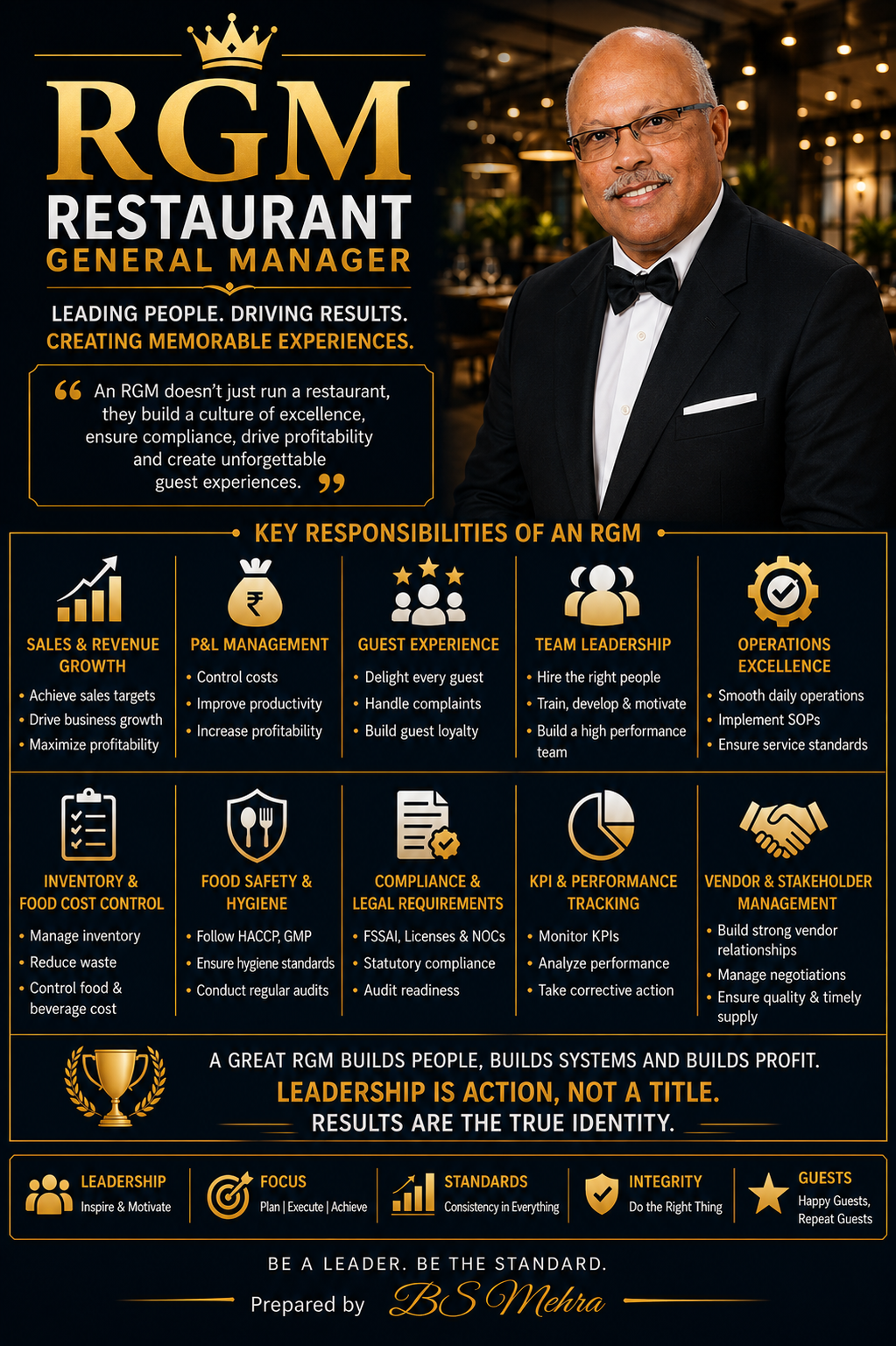
Every successful restaurant has one common factor behind its performance—strong leadership. While guests experience delicious food, friendly service, and a welcoming atmosphere, the Restaurant General Manager (RGM) works behind the scenes to ensure that every department operates efficiently, profitably, and consistently. The RGM is ultimately responsible for bringing together people, processes, finances, and customer service into one seamless operation.
Today's Restaurant General Manager is much more than a supervisor. Modern restaurant leaders manage profitability, recruit and train employees, monitor food safety, maintain inventory accuracy, improve guest satisfaction, analyse financial reports, and create a culture where both employees and customers enjoy returning every day.
Whether managing a quick-service restaurant, casual dining outlet, café, fine-dining restaurant, hotel restaurant, or multi-unit operation, the role requires strong leadership, excellent communication, financial discipline, operational knowledge, and the ability to make sound decisions under pressure.
The Restaurant General Manager is accountable for every aspect of the business— sales growth, profitability, food quality, guest satisfaction, staff performance, legal compliance, hygiene standards, and long-term business sustainability.
What is a Restaurant General Manager?
A Restaurant General Manager is the senior operational leader responsible for the complete day-to-day management of a restaurant. Unlike department supervisors who oversee only one area, the RGM coordinates every operational function to ensure that the restaurant achieves its financial objectives while consistently delivering an outstanding guest experience.
The position requires balancing operational excellence with commercial performance. Every decision—from staffing levels and purchasing to menu engineering and marketing—has a direct impact on guest satisfaction and profitability.
An effective Restaurant General Manager spends equal attention on three critical areas:
- People Leadership
- Operational Excellence
- Financial Performance
The Three Pillars of Restaurant Management
People
Recruit talented employees, develop future leaders, create high-performing teams, motivate staff, reduce employee turnover, conduct regular coaching sessions, and build a positive workplace culture where service excellence becomes a habit rather than an instruction.
Operations
Maintain consistent food quality, service standards, cleanliness, hygiene, HACCP compliance, inventory accuracy, equipment maintenance, opening procedures, closing procedures, and efficient daily operations.
Profitability
Increase sales, manage labour costs, reduce food waste, improve inventory control, control purchasing, optimise menu pricing, analyse P&L statements, and maximise restaurant profitability without compromising guest satisfaction.
Why Restaurant General Managers Are Critical
Restaurants operate in one of the most competitive industries in the world. Rising food costs, increasing labour expenses, changing guest expectations, online reviews, delivery platforms, and regulatory compliance create constant operational challenges.
The Restaurant General Manager serves as the bridge between ownership, employees, suppliers, and customers. Every decision made by the manager directly influences revenue, guest loyalty, employee engagement, and long-term business success.
A professionally managed restaurant consistently demonstrates:
- Higher guest satisfaction scores
- Improved online reviews
- Lower employee turnover
- Reduced food waste
- Better labour productivity
- Improved inventory accuracy
- Higher average guest spend
- Stronger profitability
- Consistent brand standards
- Excellent food safety compliance
The Modern Restaurant General Manager
Technology has transformed restaurant management. Today's Restaurant General Manager is expected to understand POS reporting, inventory management systems, labour scheduling, digital marketing, online ordering platforms, customer relationship management, delivery aggregators, and business analytics. Decisions are increasingly driven by data rather than assumptions.
Successful managers review daily dashboards, monitor Key Performance Indicators (KPIs), analyse trends, and implement corrective actions quickly. They understand that small improvements in food cost, labour efficiency, and guest retention can significantly improve annual profitability.
Great Restaurant General Managers do not simply manage restaurants—they build teams, develop future leaders, create memorable guest experiences, and establish systems that allow the business to perform consistently every single day.
In the following sections, we explore every major responsibility of a Restaurant General Manager, from operational leadership and financial management to food cost control, inventory management, staff development, restaurant KPIs, SOP implementation, and career growth. Whether you are an aspiring manager or an experienced hospitality professional, this guide is designed to serve as a practical reference for achieving operational excellence in today's restaurant industry.
Roles & Responsibilities of a Restaurant General Manager
The Restaurant General Manager (RGM) is responsible for ensuring that every area of the restaurant operates efficiently, profitably, and consistently. While guests may only see the dining experience, the RGM coordinates dozens of operational activities before the first customer arrives and long after the last guest has left.
A successful Restaurant General Manager combines leadership, financial discipline, operational excellence, people management, and customer service into one unified strategy. Every decision influences profitability, employee morale, guest satisfaction, and the restaurant's reputation.
Deliver exceptional guest experiences while protecting profitability through excellent leadership, operational discipline, food safety, cost control, and continuous staff development.
Primary Responsibilities
- Lead the restaurant's daily operations
- Deliver outstanding guest experiences
- Manage financial performance
- Recruit, train and retain employees
- Monitor food quality and presentation
- Control food and beverage costs
- Manage labour scheduling and productivity
- Ensure HACCP and food safety compliance
- Maintain restaurant cleanliness
- Develop supervisors and future managers
- Analyse KPIs and operational reports
- Protect company assets and profitability
The Restaurant General Manager's Daily Routine
Although every restaurant differs, experienced Restaurant General Managers follow structured daily routines that reduce operational surprises and improve consistency.
Before Opening
- Arrive before the first shift.
- Walk through the restaurant.
- Inspect dining areas.
- Inspect kitchen cleanliness.
- Verify refrigeration temperatures.
- Review staffing levels.
- Check reservations.
- Review previous day's sales.
- Inspect stock availability.
- Confirm cash float.
- Meet department supervisors.
- Review VIP bookings.
- Confirm maintenance issues.
- Verify online ordering systems.
- Ensure POS systems are operational.
Experienced managers identify operational problems before guests do. A ten-minute inspection before opening often prevents hours of disruption later in the day.
During Service
Once service begins, priorities change rapidly. The RGM becomes highly visible, supporting both guests and employees while continuously monitoring operational performance.
- Welcome guests.
- Support service staff.
- Resolve guest complaints immediately.
- Monitor food quality.
- Observe ticket times.
- Coordinate kitchen and service teams.
- Monitor labour productivity.
- Approve discounts where necessary.
- Assist during peak periods.
- Monitor hygiene compliance.
- Review delivery operations.
- Support supervisors.
After Service
- Review daily sales.
- Check cash reconciliation.
- Verify inventory movements.
- Review food wastage.
- Record maintenance issues.
- Conduct closing inspection.
- Secure restaurant assets.
- Prepare next-day action plan.
Leadership Responsibilities
Restaurants succeed because of people. High-performing Restaurant General Managers understand that employee engagement directly influences guest satisfaction, productivity, and profitability.
Leadership is not simply giving instructions. It involves coaching, mentoring, recognising achievement, resolving conflict, setting expectations, and creating an environment where employees perform confidently.
Building High Performance Teams
- Lead by example.
- Communicate clearly.
- Recognise outstanding performance.
- Coach continuously.
- Develop future supervisors.
- Conduct regular training.
- Create accountability.
- Celebrate team success.
Communication Skills
Communication connects every department within the restaurant. Managers spend much of their day communicating with guests, chefs, supervisors, suppliers, maintenance contractors, delivery partners, accountants, and owners.
Effective communication reduces mistakes, improves teamwork, speeds service, and creates consistency throughout the operation.
Daily Communication Includes
- Pre-shift briefings
- Kitchen coordination
- Guest interaction
- Supplier discussions
- Staff coaching
- Performance reviews
- Incident reporting
- Management meetings
Decision Making Under Pressure
Restaurant operations rarely follow a perfect schedule. Equipment failures, staff shortages, delayed deliveries, guest complaints, and unexpected demand require managers to make fast, informed decisions.
Successful Restaurant General Managers stay calm, prioritise correctly, communicate clearly, and focus on solutions rather than problems.
Examples of Daily Decisions
- Approving emergency purchases.
- Reassigning employees during busy periods.
- Handling guest recovery.
- Managing stock shortages.
- Approving complimentary meals.
- Adjusting labour deployment.
- Responding to equipment failures.
- Managing unexpected reservations.
The best Restaurant General Managers are proactive rather than reactive. They build systems, train teams, analyse data, and solve small operational issues before they become major business problems.
Financial Management – The Heart of Restaurant Profitability
A Restaurant General Manager is not only responsible for delivering excellent guest experiences but also for protecting the financial health of the business. Every purchasing decision, staffing schedule, menu item, and operational process ultimately affects profitability. Successful managers understand that strong financial discipline allows a restaurant to invest in people, equipment, marketing, and future growth.
Modern Restaurant General Managers regularly analyse financial reports instead of waiting until month-end. Daily monitoring allows managers to identify trends quickly and take corrective action before small problems become major financial losses.
Sales generate revenue, but effective cost control creates profit. High sales with poor cost management rarely produce sustainable business success.
Understanding the Restaurant Profit & Loss Statement (P&L)
The Profit & Loss Statement is the restaurant's financial report card. It measures how much revenue the restaurant generated and where every rupee was spent. Every Restaurant General Manager should understand the key sections of the P&L and review them regularly.
Typical P&L Categories
- Total Food Sales
- Total Beverage Sales
- Other Revenue
- Cost of Goods Sold (COGS)
- Gross Profit
- Labour Cost
- Employee Benefits
- Utilities
- Repairs & Maintenance
- Marketing Expenses
- Cleaning Supplies
- Operating Expenses
- Net Operating Profit
Rather than simply reviewing total sales, experienced managers investigate why numbers change. Understanding the reasons behind increasing food costs or declining profitability helps managers implement practical corrective actions.
Food Cost Control
Food cost is one of the largest controllable expenses in any restaurant. Even small improvements in purchasing, storage, preparation, and portion control can significantly increase annual profits.
Major Causes of High Food Cost
- Over-portioning
- Food waste
- Poor purchasing practices
- Theft
- Incorrect receiving procedures
- Improper storage
- Menu pricing errors
- Recipe inconsistency
- Inventory inaccuracies
- Spoilage
Standard recipes and accurate portion control are among the simplest and most effective ways to maintain consistent food quality while protecting restaurant profitability.
Food Cost Control Checklist
- Use standard recipes.
- Conduct daily stock checks.
- Monitor expiry dates.
- Apply FIFO inventory rotation.
- Control portion sizes.
- Reduce production waste.
- Investigate variances promptly.
- Review supplier pricing regularly.
Beverage Cost Control
Beverage operations often provide higher profit margins than food, but they also require strict controls. Accurate pouring, inventory management, and regular stock reconciliation help reduce losses and improve profitability.
- Measure beverage portions accurately.
- Conduct bottle inventory regularly.
- Monitor complimentary beverages.
- Track breakages.
- Investigate stock variances.
- Review beverage sales mix.
- Maintain secure storage.
Labour Cost Management
Labour is usually the second-largest controllable operating expense. Effective scheduling ensures that restaurants maintain excellent service without unnecessary payroll costs.
Successful managers align staffing levels with forecasted business volumes rather than historical habits. Flexible scheduling improves both productivity and employee morale.
Ways to Optimise Labour Cost
- Forecast sales accurately.
- Prepare weekly schedules.
- Cross-train employees.
- Monitor overtime carefully.
- Match staffing to demand.
- Reduce idle time.
- Measure labour productivity.
- Review labour percentages daily.
Reducing labour cost should never reduce guest satisfaction. The objective is productivity, not simply fewer employees.
Inventory Management
Inventory represents cash sitting on the shelf. Excess inventory increases spoilage, storage costs, and waste, while insufficient inventory disrupts service and disappoints guests. The Restaurant General Manager must maintain the correct balance.
Inventory Best Practices
- Conduct regular physical counts.
- Use inventory management software.
- Separate high-value products.
- Monitor slow-moving stock.
- Apply FIFO principles.
- Maintain accurate receiving records.
- Investigate inventory variances.
- Perform monthly stock audits.
Purchasing & Supplier Management
Reliable suppliers play a vital role in restaurant success. Building long-term relationships while maintaining competitive pricing helps improve quality and operational stability.
- Approve authorised suppliers.
- Compare quotations regularly.
- Review supplier performance.
- Verify deliveries carefully.
- Inspect product quality.
- Monitor price changes.
- Maintain purchase records.
- Negotiate long-term agreements.
Reducing Waste
Waste directly reduces profitability. High-performing Restaurant General Managers monitor every form of waste and encourage employees to treat ingredients, utilities, and equipment as valuable business assets.
Common Sources of Waste
- Food spoilage
- Overproduction
- Incorrect preparation
- Customer plate waste
- Utility overconsumption
- Equipment misuse
- Disposable packaging waste
- Inventory damage
Restaurants that review operational performance every day make small improvements consistently. These incremental gains accumulate into significant annual profit improvements without compromising food quality or guest satisfaction.
Key Financial KPIs Every Restaurant General Manager Should Monitor
- Total Sales Revenue
- Average Guest Check
- Food Cost Percentage
- Beverage Cost Percentage
- Labour Cost Percentage
- Prime Cost
- Gross Profit Margin
- Inventory Turnover
- Waste Percentage
- Guest Satisfaction Score
- Table Turnover Rate
- Net Operating Profit
Financial success is achieved through disciplined execution rather than occasional cost-cutting exercises. Restaurant General Managers who combine accurate reporting, operational excellence, inventory control, labour optimisation, and strong leadership are best positioned to deliver consistent long-term profitability.
Guest Experience – The Ultimate Measure of Restaurant Success
Guests rarely remember every detail of a meal, but they always remember how they were made to feel. Outstanding restaurants consistently deliver memorable experiences through professional service, genuine hospitality, food quality, cleanliness, and attention to detail. The Restaurant General Manager is responsible for creating a guest-focused culture where every employee understands that exceptional service is everyone's responsibility.
Modern guests expect more than good food. They expect quick service, friendly employees, clean surroundings, accurate orders, value for money, and immediate resolution of any concerns. Restaurant General Managers establish systems that consistently deliver these expectations every day.
Great restaurants serve food. Outstanding restaurants create memorable experiences that encourage guests to return and recommend the business to others.
Guest Experience Priorities
- Warm greeting within seconds of arrival.
- Professional appearance of all employees.
- Fast and accurate service.
- Consistent food quality.
- Restaurant cleanliness.
- Comfortable dining environment.
- Prompt complaint resolution.
- Warm farewell and invitation to return.
Managing Guest Complaints
Every restaurant receives complaints. Successful Restaurant General Managers recognise that complaints are opportunities to recover guest confidence and improve future performance. Quick, professional responses often transform dissatisfied guests into loyal advocates.
Five-Step Complaint Resolution Process
- Listen without interrupting.
- Show empathy and acknowledge the concern.
- Investigate the situation quickly.
- Provide a practical solution.
- Follow up to ensure guest satisfaction.
Managers should encourage employees to escalate serious issues promptly rather than allowing small problems to become negative online reviews.
Leadership & Team Development
Restaurants succeed because of people. Equipment, recipes, and technology support the operation, but motivated employees deliver exceptional guest experiences. Restaurant General Managers therefore spend significant time recruiting, training, coaching, motivating, and retaining talented employees.
Characteristics of Effective Restaurant Leaders
- Lead by example.
- Communicate honestly.
- Remain calm under pressure.
- Coach continuously.
- Recognise employee achievements.
- Develop future supervisors.
- Encourage teamwork.
- Promote accountability.
Employees watch what managers do more closely than they listen to what managers say. Professional behaviour from leaders establishes the culture for the entire restaurant.
Recruitment & Employee Retention
Hiring the right people reduces turnover, improves productivity, and enhances guest satisfaction. Restaurant General Managers should recruit for attitude and train for skill whenever possible.
Successful Recruitment Practices
- Prepare clear job descriptions.
- Conduct structured interviews.
- Verify previous employment.
- Assess communication skills.
- Evaluate customer-service attitude.
- Provide effective induction training.
- Assign mentors for new employees.
- Review probation performance.
Training & Continuous Development
Training should not stop after orientation. High-performing restaurants conduct continuous learning through coaching, demonstrations, refresher sessions, cross-training, and regular performance feedback.
Essential Training Topics
- Customer service excellence.
- Food safety and hygiene.
- HACCP procedures.
- POS system operation.
- Cash handling.
- Upselling techniques.
- Fire safety.
- Emergency response.
- Complaint handling.
- Leadership development.
Restaurant Standard Operating Procedures (SOPs)
Standard Operating Procedures create consistency across every shift and every employee. Well-written SOPs reduce errors, improve productivity, strengthen food safety, and ensure that guests receive the same high-quality experience regardless of who is working.
Core Restaurant SOP Categories
- Opening procedures.
- Closing procedures.
- Food preparation.
- Kitchen sanitation.
- Dining room cleaning.
- Cash management.
- Inventory receiving.
- Stock storage.
- Equipment maintenance.
- Guest complaint handling.
- Emergency response.
- Staff appearance standards.
Restaurants that consistently follow documented SOPs experience fewer operational mistakes, better employee confidence, stronger food safety compliance, and higher guest satisfaction.
Food Safety, HACCP & FSSAI Compliance
Food safety is one of the Restaurant General Manager's highest priorities. Managers must ensure compliance with applicable food safety regulations while protecting guests, employees, and the restaurant's reputation.
Food Safety Responsibilities
- Monitor food temperatures.
- Prevent cross-contamination.
- Maintain personal hygiene standards.
- Ensure correct food storage.
- Verify supplier quality.
- Conduct cleaning schedules.
- Maintain pest-control programmes.
- Document corrective actions.
- Train employees regularly.
- Prepare for inspections.
Emergency Preparedness
Restaurant General Managers must prepare employees for emergencies before they occur. Documented procedures reduce confusion and protect guests, employees, and company assets.
- Fire response procedures.
- Medical emergencies.
- Power failures.
- Equipment breakdowns.
- Gas leaks.
- Food contamination incidents.
- Security situations.
- Natural disasters.
Restaurant Key Performance Indicators (KPIs)
Restaurant KPIs provide measurable evidence of operational performance. Rather than relying on assumptions, successful Restaurant General Managers monitor performance using objective data and regular reporting.
Operational KPIs
- Daily Sales Revenue.
- Average Guest Check.
- Guest Satisfaction Score.
- Online Review Rating.
- Table Turnover Rate.
- Food Cost Percentage.
- Beverage Cost Percentage.
- Labour Cost Percentage.
- Prime Cost.
- Waste Percentage.
- Employee Turnover.
- Training Completion Rate.
- Inventory Variance.
- Health Inspection Results.
- Complaint Resolution Time.
The most successful Restaurant General Managers review these KPIs daily, weekly, and monthly to identify opportunities for continuous improvement.
Technology & Digital Restaurant Management
Modern restaurant operations increasingly depend on technology to improve efficiency and support decision-making. Restaurant General Managers should understand how digital systems integrate with everyday operations.
Essential Restaurant Technology
- Point of Sale (POS) Systems.
- Kitchen Display Systems (KDS).
- Inventory Management Software.
- Labour Scheduling Applications.
- Digital Reservations.
- Online Ordering Platforms.
- Customer Relationship Management (CRM).
- Business Intelligence Dashboards.
The modern Restaurant General Manager combines operational expertise with technology, financial knowledge, people leadership, and continuous improvement to build sustainable, profitable restaurant businesses.
Career Path of a Restaurant General Manager
The Restaurant General Manager role is one of the most rewarding leadership positions in the hospitality industry. It combines operational excellence, financial management, customer service, and people leadership. Professionals who consistently deliver results often progress into regional, corporate, or executive management positions.
Typical Career Progression
- Restaurant Trainee
- Captain / Shift Leader
- Restaurant Supervisor
- Assistant Restaurant Manager
- Restaurant Manager
- Restaurant General Manager
- Area Manager
- Regional Operations Manager
- Director of Operations
- Vice President – Operations
The strongest Restaurant General Managers combine operational knowledge with financial discipline, excellent communication, leadership skills, and continuous professional development.
Essential Skills Every Restaurant General Manager Should Develop
- Leadership & Team Building
- Financial Management
- P&L Analysis
- Food Cost Control
- Labour Cost Management
- Inventory Management
- Restaurant Marketing
- Guest Recovery
- Negotiation Skills
- Time Management
- Conflict Resolution
- Decision Making
- Problem Solving
- Business Analytics
- Technology & POS Systems
Restaurant General Manager Interview Questions
Recruiters frequently evaluate operational knowledge, leadership capability, financial awareness, and guest service philosophy during Restaurant General Manager interviews.
- Describe your restaurant leadership style.
- How do you control food costs without affecting quality?
- How would you handle a difficult guest complaint?
- How do you motivate underperforming employees?
- What KPIs do you monitor daily?
- How do you improve labour productivity?
- Describe a successful cost-saving initiative.
- How do you prepare for health inspections?
- How do you train new restaurant employees?
- Why should we hire you as our Restaurant General Manager?
Frequently Asked Questions
What does a Restaurant General Manager do?
A Restaurant General Manager oversees every aspect of restaurant operations including guest service, food quality, financial performance, employee management, food safety, inventory, purchasing, labour scheduling, profitability, and business growth.
Is Restaurant General Manager a senior position?
Yes. The Restaurant General Manager is normally the highest-ranking operational manager within an individual restaurant and reports directly to ownership, corporate leadership, or regional management.
What qualifications are useful?
Hospitality Management, Hotel Management, Food & Beverage Operations, Business Management, professional certifications, and significant operational experience all contribute to career success.
Which KPIs should Restaurant General Managers monitor?
Sales revenue, average guest spend, food cost percentage, beverage cost percentage, labour cost percentage, guest satisfaction scores, inventory variance, waste levels, employee turnover, and profitability.
Can Restaurant General Managers work internationally?
Yes. Experienced Restaurant General Managers are in demand across hotels, restaurants, resorts, cruise lines, contract catering companies, airport hospitality, and international restaurant chains.
Related Hospitality Management Guides
Final Thoughts
Restaurant General Managers play a critical role in shaping both operational success and guest satisfaction. By combining strong leadership, disciplined financial management, excellent food safety practices, and a commitment to continuous improvement, they create restaurants that consistently deliver exceptional experiences while achieving sustainable profitability.
Whether you are preparing for your first management position or refining your leadership skills after years in the industry, the principles outlined in this guide provide a solid foundation for long-term success in restaurant operations.
Hospitality is ultimately about people. Great Restaurant General Managers build capable teams, delight guests, protect the business, and inspire future leaders through consistent professional excellence.