Recipes • F&B Recipe Series • By Nigel A. Thomas, Hospitality Executive
Premium Salad Recipes: 20 Café Signature Salads
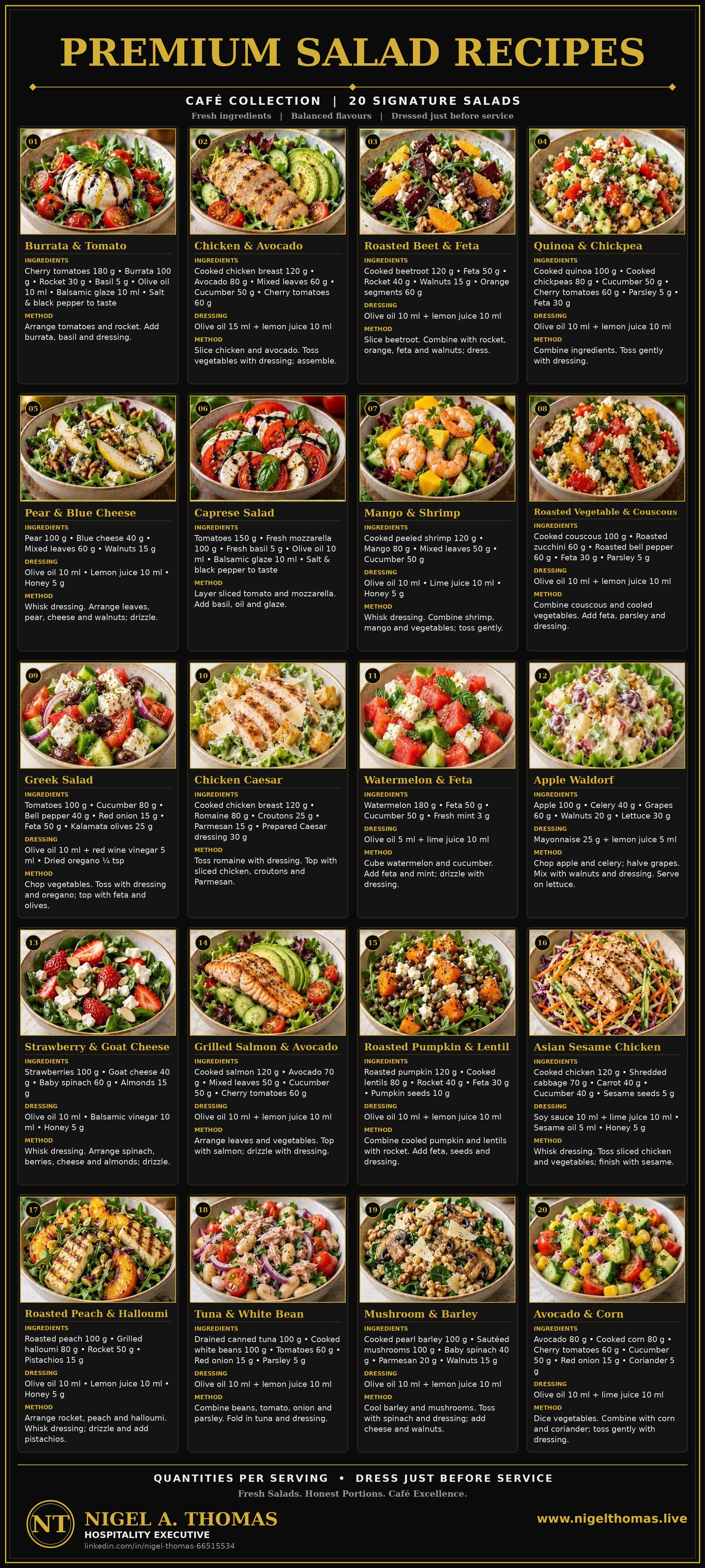
A great salad is not a pile of leaves. In a hotel café or restaurant it is a carefully balanced plate: something fresh, something rich, something crunchy, something sharp and a dressing that ties them together. This guide collects twenty signature salads for the café menu, each with exact per-serving quantities, a dressing and a short method, so a kitchen team can build them identically every time.
The recipes come from the Premium Salad Recipes Café Collection, a five-part series of F&B Tips Guide sheets. Every quantity is for a single serving, which makes the recipes easy to scale up for a banquet or down for a tasting. Every dressing is measured in millilitres, so a cook never has to guess, and every method fits on one line so it can be learned in a single shift. The poster that goes with this article collects all twenty salads on one page for the kitchen wall.
Over thirty years in luxury hotels, resorts, cruise ships and independent restaurants, one lesson comes up again and again. Consistency sells more food than creativity does. A guest who loved the Greek salad on Tuesday expects the same salad on Saturday, and the way to deliver that is a written specification with weights, measures and a method. That is what this page offers.
Why salads deserve a place of honour on the café menu
Salads used to be the afterthought of the menu, a bowl of lettuce and tomato offered to guests who wanted something light. That has changed completely. Guests today ask for fresh, balanced and flexible food, and salads answer all three requests. They suit vegetarians, health-conscious diners, business lunches, poolside service and room-service trays, and a single well-built salad can be a starter, a side dish or a full meal depending on the portion and the protein.
From the operator's side, salads also make commercial sense. Many of the ingredients are shared across several dishes, so a kitchen that stocks feta, rocket, cherry tomatoes, lemons and walnuts can build a dozen different salads without carrying a dozen different inventories. Preparation is largely cold work, which frees the hot line during the lunch rush, and the visual appeal of a well-plated salad supports a premium price. The collection in this guide is deliberately built around that overlap.
Salads are also the easiest place to show seasonality and local sourcing. A café in Mumbai, Mysuru or Hyderabad can replace peaches with mangoes or strawberries with guavas, and still follow the same structure of leaf, fruit, cheese, crunch and dressing. The recipes in this guide are a framework as much as a list.
The five building blocks of a premium salad
Every recipe in this collection follows the same architecture, and understanding it makes it much easier to train staff and to invent new dishes. First comes the base: leaves such as rocket, baby spinach, romaine or mixed leaves, or a cooked grain or pulse such as quinoa, couscous, barley or lentils. The base gives volume and carries the dressing.
Second is the feature ingredient, the thing the guest is really ordering, whether burrata, grilled halloumi, salmon, chicken, shrimp or beetroot. Third comes the supporting cast of vegetables and fruit, such as cucumber, tomatoes, mango, pear or orange, which add colour, moisture and freshness. Fourth is the texture element, typically nuts or seeds like walnuts, almonds, pistachios, pumpkin seeds and sesame, or croutons in the Caesar, which gives the crunch that stops a salad from being monotonous.
Fifth is the dressing. Nearly every salad here is dressed with olive oil and an acid, either lemon or lime juice, balsamic vinegar or red wine vinegar. Sweetness from honey and a savoury note from soy or mayonnaise appear only where the dish needs them. When a new salad is developed, a good test is to ask whether all five blocks are present and whether any of them is missing or doubled. If the salad feels flat, it usually lacks acid or crunch. If it feels heavy, it usually has too much dressing or too many rich ingredients.
Dressings: small quantities, big impact
The quantities on the recipe sheets are precise and small. Most salads use just 10 ml of olive oil and 10 ml of citrus juice, sometimes with 5 g of honey. That is a lighter, brighter, more acidic dressing than many people expect, and it is deliberate. A portion-controlled dressing protects food cost, keeps the calorie count sensible and prevents the soggy, oily plate that guests dislike. It also lets the quality of the main ingredients show.
A few dressings go outside the pattern. The chicken and avocado salad uses 15 ml of oil because lean chicken needs a little more richness. The watermelon salad uses only 5 ml of oil because the fruit is already juicy. The Greek salad uses red wine vinegar and dried oregano. The Waldorf uses 25 g of mayonnaise with lemon. The Asian sesame chicken uses soy sauce, lime, sesame oil and honey. The Caesar uses a prepared dressing at 30 g, which suits a high-volume café where speed and consistency matter.
Whisk dressings in small batches or build them in a squeeze bottle, shake well, and label with the date and time. Never pre-dress a salad in the kitchen unless it is specifically a marinated dish. The instruction printed at the bottom of every sheet, dress just before service, is the single most important rule in the collection. Leaves wilt within minutes of being dressed, nuts lose their crunch and cheese turns soft and watery.
The twenty salads at a glance
The recipes below are grouped by style rather than by their original numbers on the sheets, so a chef can quickly find the type of salad the menu needs. The number beside each name matches the poster, so you can cross-check any recipe against the infographic.
Cheese-led and fruit-led salads
These seven salads depend on one great cheese, a fruit or a ripe tomato, and almost nothing else. They are the quickest to plate and the most sensitive to ingredient quality.
01 Burrata & Tomato
Ingredients (per serving)
Cherry tomatoes 180 g
Burrata 100 g
Rocket 30 g
Basil 5 g
Olive oil 10 ml
Balsamic glaze 10 ml
Salt & black pepper to taste
Method: Arrange tomatoes and rocket. Add burrata, basil and dressing.
The simplest salad on the page is also the least forgiving, because there is nowhere to hide. Cherry tomatoes at 180 g carry the dish, so buy them ripe, keep them out of the chiller until the last hour, and salt them a few minutes before plating so they release their juices. Burrata is best served cool rather than cold, torn open so the creamy centre runs into the rocket. Add basil as whole leaves at the last moment, and finish with oil and balsamic glaze in a thin ribbon, never a pool.
06 Caprese Salad
Ingredients (per serving)
Tomatoes 150 g
Fresh mozzarella 100 g
Fresh basil 5 g
Olive oil 10 ml
Balsamic glaze 10 ml
Salt & black pepper to taste
Method: Layer sliced tomato and mozzarella. Add basil, oil and glaze.
Caprese depends entirely on ingredient quality, and it is the best test of a purchasing specification. Tomatoes should be ripe and room temperature; fridge-cold tomatoes lose most of their flavour. Fresh mozzarella should be drained and patted dry so it does not water down the plate. Layer the slices in overlapping rows rather than a pile, tuck basil between them, and finish with oil and glaze. Salt and black pepper go on last and are to taste, so tell the team to season at the pass.
05 Pear & Blue Cheese
Ingredients (per serving)
Pear 100 g
Blue cheese 40 g
Mixed leaves 60 g
Walnuts 15 g
Dressing: Olive oil 10 ml, Lemon juice 10 ml, Honey 5 g
Method: Whisk dressing. Arrange leaves, pear, cheese and walnuts; drizzle.
This is the classic sweet, salty and creamy trio. Choose a pear that is ripe but still firm, so the slices keep their shape, and slice them to order or hold them briefly in the lemon juice from the dressing. Blue cheese at 40 g is a deliberate, modest portion; its strength means more would dominate. Walnuts add bitterness and crunch that finish the picture. Honey in the dressing is only 5 g, just enough to soften the lemon and tie the cheese to the fruit.
Method: Whisk dressing. Arrange spinach, berries, cheese and almonds; drizzle.
Berries, spinach and goat cheese show how a salad can be sweet, tangy and fresh at once. Hull and quarter the strawberries only when needed, since cut berries soften quickly. Baby spinach should be dry and cold, because wet leaves dilute the balsamic dressing. Goat cheese is crumbled over the top instead of mixed in, so it stays in distinct white pieces against the red and green. Almonds can be flaked and lightly toasted for aroma. The dressing is balanced with honey to round off the balsamic.
11 Watermelon & Feta
Ingredients (per serving)
Watermelon 180 g
Feta 50 g
Cucumber 50 g
Fresh mint 3 g
Dressing: Olive oil 5 ml + lime juice 10 ml
Method: Cube watermelon and cucumber. Add feta and mint; drizzle with dressing.
Watermelon and feta is the most refreshing salad in this collection and one of the best sellers in hot weather. Pick a sweet, dense watermelon, cube it neatly, and drain it on a cloth because excess water ruins the dressing. The 5 ml of oil and 10 ml of lime juice is a very light dressing, which is right for the fruit. Mint should be torn at the last moment. Because watermelon releases liquid quickly, assemble this salad as late as possible and serve it very cold.
17 Roasted Peach & Halloumi
Ingredients (per serving)
Roasted peach 100 g
Grilled halloumi 80 g
Rocket 50 g
Pistachios 15 g
Dressing: Olive oil 10 ml, Lemon juice 10 ml, Honey 5 g
Method: Arrange rocket, peach and halloumi. Whisk dressing; drizzle and add pistachios.
Halloumi can be grilled until golden because it holds its shape under heat, and that caramelised crust is the point of the dish. Roast or grill the peaches until they just soften and mark, then cool them slightly. Rocket brings pepper and bitterness, pistachios bring crunch and colour, and the lemon and honey dressing lifts everything. Halloumi is best served warm, so grill it to order and add it last. This is a seasonal favourite for summer menus and works beautifully as a shared starter.
12 Apple Waldorf
Ingredients (per serving)
Apple 100 g
Celery 40 g
Grapes 60 g
Walnuts 20 g
Lettuce 30 g
Dressing: Mayonnaise 25 g + lemon juice 5 ml
Method: Chop apple and celery; halve grapes. Mix with walnuts and dressing. Serve on lettuce.
The Waldorf is a historic salad and still a smart one: apple, celery, grapes and walnuts in a creamy dressing, served on lettuce. Cut the apple just before mixing, or toss it in the lemon juice at once, to stop browning. Halve the grapes so they release some of their juice into the mayonnaise. Celery gives the crunch, and walnuts add richness and texture. At 25 g of mayonnaise it is a light coating, not a heavy one, and the 5 ml of lemon juice cuts through the richness.
Protein salads
Protein salads are the lunch mains of a café menu. They carry the highest food cost and the highest price, and they reward careful cooking and clean plating.
02 Chicken & Avocado
Ingredients (per serving)
Cooked chicken breast 120 g
Avocado 80 g
Mixed leaves 60 g
Cucumber 50 g
Cherry tomatoes 60 g
Dressing: Olive oil 15 ml + lemon juice 10 ml
Method: Slice chicken and avocado. Toss vegetables with dressing; assemble.
This is the salad guests order when they want something filling without feeling heavy. Slice the chicken across the grain while it is still just warm, then rest it so the juices stay in the meat. Cut the avocado to order; once exposed it browns, and a squeeze of the lemon from the dressing slows that. Because the dressing is 15 ml of oil to 10 ml of lemon, it is slightly richer than most on this page, which suits the lean chicken breast and the crisp mixed leaves.
07 Mango & Shrimp
Ingredients (per serving)
Cooked peeled shrimp 120 g
Mango 80 g
Mixed leaves 50 g
Cucumber 50 g
Dressing: Olive oil 10 ml, Lime juice 10 ml, Honey 5 g
Method: Whisk dressing. Combine shrimp, mango and vegetables; toss gently.
Sweet mango, cooling cucumber and plump shrimp make a salad that suits warm climates and poolside menus. Buy cooked, peeled shrimp from a trusted supplier, or poach and chill them in-house, keeping them at safe cold temperatures at all times. The mango should be ripe but firm, cut into even cubes so each forkful has the same balance. The lime and honey dressing is bright and gentle, so it will not overpower the delicate shrimp. Toss at the last minute, gently, to protect the mango.
10 Chicken Caesar
Ingredients (per serving)
Cooked chicken breast 120 g
Romaine 80 g
Croutons 25 g
Parmesan 15 g
Prepared Caesar dressing 30 g
Method: Toss romaine with dressing. Top with sliced chicken, croutons and Parmesan.
A Caesar is a standard of the café menu, and doing it well sets a venue apart. Crisp, cold romaine is essential, so wash, spin dry and keep the leaves chilled. The sheet uses 30 g of prepared dressing, which keeps portions consistent and speeds service, but taste it regularly and adjust the supply as needed. Croutons should be baked or pan-toasted fresh, never soft, and added at the last moment. Slice the grilled chicken on an angle, fan it across the top, and finish with shaved Parmesan.
14 Grilled Salmon & Avocado
Ingredients (per serving)
Cooked salmon 120 g
Avocado 70 g
Mixed leaves 50 g
Cucumber 50 g
Cherry tomatoes 60 g
Dressing: Olive oil 10 ml + lemon juice 10 ml
Method: Arrange leaves and vegetables. Top with salmon; drizzle with dressing.
This is a premium plate, and it should look it. Cook the salmon fillet to medium, rest it, and either flake it or serve it as a whole portion on top. Avocado at 70 g is fanned beside it, and cucumber and cherry tomatoes add colour and freshness around the leaves. Drizzle the dressing over the vegetables and the fish so everything shares the lemon. Salmon is rich in oil, so the sharp lemon balances it. Serve it as a lunch main or a light dinner starter.
16 Asian Sesame Chicken
Ingredients (per serving)
Cooked chicken 120 g
Shredded cabbage 70 g
Carrot 40 g
Cucumber 40 g
Sesame seeds 5 g
Dressing: Soy sauce 10 ml + lime juice 10 ml, Sesame oil 5 ml, Honey 5 g
Method: Whisk dressing. Toss sliced chicken and vegetables; finish with sesame.
This is a crunchy, colourful salad with an Asian-leaning dressing: soy, lime, sesame oil and honey. Shred the cabbage finely and cut the carrot and cucumber into matchsticks so everything eats easily with chopsticks or a fork. Whisk the dressing first so the honey dissolves, then toss it with the chicken and vegetables at the last moment. Toasted sesame seeds finish the dish. Because soy sauce is salty, do not add any other salt, and keep an eye on sodium for guests who ask.
18 Tuna & White Bean
Ingredients (per serving)
Drained canned tuna 100 g
Cooked white beans 100 g
Tomatoes 60 g
Red onion 15 g
Parsley 5 g
Dressing: Olive oil 10 ml + lemon juice 10 ml
Method: Combine beans, tomato, onion and parsley. Fold in tuna and dressing.
A pantry-based salad that makes sense for any kitchen: canned tuna, white beans, tomato, red onion and parsley. Drain the tuna well and flake it gently, because it is easy to mash it into paste. Beans should be cooked or tinned and rinsed, then dressed while slightly warm so they absorb the lemon and oil. Slice the onion thinly and soak it briefly in cold water if its bite is too strong. Fold in the tuna at the end for large, appealing pieces.
Grain and pulse salads
Grains and pulses make salads filling, stable and economical. They are the best candidates for batch preparation, because they hold well in the chiller when undressed.
04 Quinoa & Chickpea
Ingredients (per serving)
Cooked quinoa 100 g
Cooked chickpeas 80 g
Cucumber 50 g
Cherry tomatoes 60 g
Parsley 5 g
Feta 30 g
Dressing: Olive oil 10 ml + lemon juice 10 ml
Method: Combine ingredients. Toss gently with dressing.
A grain-and-pulse bowl is the most useful salad in a hotel kitchen, because it holds well and travels well. Cook the quinoa in salted water, rinse it, and cool it quickly spread on a tray rather than in a deep container. Chickpeas can come from a good tinned product, drained and rinsed, or be cooked in-house. The parsley at only 5 g is a seasoning, not a garnish, so chop it fresh. Dress lightly and taste for salt, since cooled grains always need more seasoning than they did when hot.
08 Roasted Vegetable & Couscous
Ingredients (per serving)
Cooked couscous 100 g
Roasted zucchini 60 g
Roasted bell pepper 60 g
Feta 30 g
Parsley 5 g
Dressing: Olive oil 10 ml + lemon juice 10 ml
Method: Combine couscous and cooled vegetables. Add feta, parsley and dressing.
Couscous is quick to prepare and takes on flavour well, which makes this a good buffet and lunch-service salad. Hydrate it with hot stock or water, fluff with a fork, and cool it fully before mixing, or the vegetables will steam and lose their colour. Roast zucchini and bell pepper until they pick up some char, then cool them on a tray. Feta and parsley go in at the end. A 10 ml and 10 ml dressing keeps everything bright without making the couscous heavy.
19 Mushroom & Barley
Ingredients (per serving)
Cooked pearl barley 100 g
Sautéed mushrooms 100 g
Baby spinach 40 g
Parmesan 20 g
Walnuts 15 g
Dressing: Olive oil 10 ml + lemon juice 10 ml
Method: Cool barley and mushrooms. Toss with spinach and dressing; add cheese and walnuts.
Barley is chewy, nutty and filling, and mushrooms add a deep, savoury quality that makes this salad feel almost like a warm dish served cool. Cook the pearl barley until just tender, drain, and cool it on a tray. Sauté the mushrooms in a hot pan in batches so they brown instead of steaming, then let them cool. Baby spinach, Parmesan and walnuts finish the plate. Add the cheese as shavings for visual appeal, and confirm with guests who avoid animal rennet.
15 Roasted Pumpkin & Lentil
Ingredients (per serving)
Roasted pumpkin 120 g
Cooked lentils 80 g
Rocket 40 g
Feta 30 g
Pumpkin seeds 10 g
Dressing: Olive oil 10 ml + lemon juice 10 ml
Method: Combine cooled pumpkin and lentils with rocket. Add feta, seeds and dressing.
Pumpkin and lentils are the vegetarian backbone of this collection: earthy, hearty and satisfying. Roast the pumpkin cubes with a little oil until the edges caramelise, then let them cool before assembling so the rocket does not wilt. Lentils should be cooked until tender but still holding their shape, ideally green or brown varieties, then drained well. Feta and pumpkin seeds add salt and crunch. This salad is excellent for guests who want a filling plant-forward option without losing flavour.
03 Roasted Beet & Feta
Ingredients (per serving)
Cooked beetroot 120 g
Feta 50 g
Rocket 40 g
Walnuts 15 g
Orange segments 60 g
Dressing: Olive oil 10 ml + lemon juice 10 ml
Method: Slice beetroot. Combine with rocket, orange, feta and walnuts; dress.
Beetroot is earthy and sweet, feta is salty and sharp, and orange brings acid and brightness to bridge them. Cook beetroot until a knife slides in, cool it completely, then slice, and wear gloves because the colour stains everything. Add the orange segments last, with the juice drained, so the leaves do not turn soggy. Toast the walnuts lightly if the kitchen has time, since warmth wakes up their oils. Keep the feta crumbled by hand for an irregular, rustic look on the plate.
Fresh vegetable salads
These two salads are simple, crisp and colourful. Their success comes down to knife work and seasoning.
09 Greek Salad
Ingredients (per serving)
Tomatoes 100 g
Cucumber 80 g
Bell pepper 40 g
Red onion 15 g
Feta 50 g
Kalamata olives 25 g
Dressing: Olive oil 10 ml + red wine vinegar 5 ml, Dried oregano ¼ tsp
Method: Chop vegetables. Toss with dressing and oregano; top with feta and olives.
The Greek salad works because of restraint: no lettuce, no fancy dressing, just good vegetables, good feta and good olives. Cut the tomato and cucumber into large, even chunks so the salad looks generous. The feta sits on top as a block or in large crumbles instead of being tossed in. Dried oregano at a quarter teaspoon is traditional and potent, so rub it between the fingers as it goes on to release its aroma. Use Kalamata olives with their stones in for the most authentic result, and warn guests.
20 Avocado & Corn
Ingredients (per serving)
Avocado 80 g
Cooked corn 80 g
Cherry tomatoes 60 g
Cucumber 50 g
Red onion 15 g
Coriander 5 g
Dressing: Olive oil 10 ml + lime juice 10 ml
Method: Dice vegetables. Combine with corn and coriander; toss gently with dressing.
Bright, colourful and simple, this salad is built for the pass: avocado, sweet corn, tomatoes, cucumber and red onion, with coriander and lime. Dice everything to a similar size so every forkful has all the elements. Avocado is the delicate part, so fold gently and dress at the last moment, and the lime juice also helps hold its colour. Corn can be freshly cooked and cut from the cob, or good frozen corn that has been thawed and drained. Serve it as a side, a starter, or a taco-night topping.
Mise en place for a salad station
A salad station is won or lost before service starts. Begin with a written prep list based on the day's covers, and set out every component in labelled, covered containers at the correct temperature. Leaves should be washed in cold water, spun or drained dry, and stored in lined containers so they stay crisp. Vegetables are cut to the specification: cucumber in half moons or cubes, tomatoes halved or quartered, onions in thin slices. Cooked proteins are sliced or portioned and held cold. Nuts and seeds are portioned in small containers.
Dressings are made fresh each shift and stored in squeeze bottles with labels. Portion scoops, spoons and digital scales are kept at the station so that a 60 g portion of mixed leaves is really 60 g. Plates and bowls are chilled before use; a cold bowl keeps a salad crisp for the vital few minutes between the pass and the table. Garnish is placed last, so the dish arrives looking composed, not tossed.
The best salad cooks plate with their hands and a spoon rather than tongs, because hand plating lets them build height and distribute ingredients evenly. Wearing gloves and changing them between tasks is essential for hygiene and for allergen control.
Food safety and allergen control
Salads are served cold and are often eaten without any further cooking, so there is no kill step between the kitchen and the guest. That makes hygiene discipline critical. Cold items must be held at or below 5 degrees Celsius (41 degrees Fahrenheit), and cooked proteins such as chicken, salmon, shrimp and tuna must be chilled quickly after cooking and kept covered. Use separate chopping boards and knives for raw and ready-to-eat foods, and wash all leaves and vegetables thoroughly before use. Time and temperature logs belong at the cold station as much as anywhere on the hot line.
Allergens appear throughout this collection. Tree nuts (walnuts, almonds, pistachios), milk (burrata, mozzarella, feta, goat cheese, halloumi, Parmesan, blue cheese), shellfish (shrimp), fish (salmon, tuna, and anchovy in many Caesar dressings), egg (mayonnaise and Caesar dressing), soy, sesame and gluten (couscous, barley and croutons) all feature. Every menu description should state the main allergens, and the team should be trained to answer guest questions confidently. Where cross-contact is a risk, use clean utensils and surfaces and never reuse a garnish container.
Guests with dietary requirements deserve clear answers. Several salads here are vegetarian, including the caprese, Greek, watermelon and feta, pear and blue cheese, and pumpkin and lentil, while others, such as the Waldorf and the Caesar, contain egg. Cheeses made with animal rennet may not suit strict vegetarians, so check your supplier's specification. Always confirm the exact ingredients of prepared dressings and sauces rather than relying on assumptions.
Costing and menu engineering
Per-serving quantities make costing straightforward. Multiply each weight by the current purchase price per kilogram or litre, add the dressing and garnish, and add a small allowance for waste and trim. The result is a plate cost that can be compared to the selling price to confirm that the target food-cost percentage is met. Review the figures whenever supplier prices change, because ingredients like avocados, salmon and shrimp can move sharply with season and supply.
Menu engineering helps decide which salads to feature. A salad with a high margin and high popularity, often the Greek or the chicken Caesar, is a star and should be placed prominently. A salad with a high margin but low popularity, perhaps the roasted beet and feta, needs a better description or a server recommendation. A popular salad with a low margin, such as the salmon and avocado, may need a portion check or a modest price adjustment. A salad that is neither popular nor profitable should be replaced.
Keep the menu short and balanced. Six to eight salads are usually enough for a café: include at least two vegetarian options, two chicken or meat options, one fish or seafood salad, one grain-based salad and one seasonal feature. The remaining recipes can rotate through the specials board through the year, keeping regular guests interested while the core menu stays efficient.
Scaling for buffets, banquets and room service
Because every quantity is per serving, scaling is simple multiplication, but the method must change with the numbers. For a banquet of two hundred, prepare components in bulk, keep them cold and undressed, and assemble on plates or in large bowls only shortly before service. Dress in batches, never all at once. For buffets, choose robust salads such as quinoa and chickpea, roasted vegetable and couscous, Greek, and pumpkin and lentil, which hold their quality for longer under display conditions, and replenish small bowls often rather than filling large ones.
For room service, pack dressings separately in small sealed pots, keep delicate leaves apart from wet ingredients, and use a lidded container that protects against movement on the trolley. Include a clear instruction card so the guest can dress the salad themselves. Delicate salads such as the burrata and tomato, the watermelon and feta, and the peach and halloumi travel less well than the sturdier grain-based options and are better suited to table service.
Frequently asked questions
How far ahead can the components be prepared? Most vegetables, cooked grains, pulses and proteins can be prepared a shift ahead if they are stored cold and covered, but leaves, avocado, fresh herbs and soft fruit are best prepared on the day. Dressings can be made fresh each shift.
Can the portions be adjusted for a main course? Yes. For a main course, increase the protein and the base by about a third and keep the dressing proportional. For a starter or side, reduce the protein and leave the rest unchanged.
What are good substitutions? Rocket can be swapped for baby spinach or watercress, walnuts for pecans or almonds, feta for goat cheese or halloumi, and lemon juice for lime where the flavours suit. Always update the allergen information when a swap changes an allergen.
How should leaves be stored? Wash them in cold water, dry them thoroughly, and store them loosely in lined containers at 1 to 4 degrees Celsius. Leaves that are still wet go slimy; leaves that are packed tightly bruise.
Why dress just before service? Salt and acid draw moisture from leaves and vegetables, and oil coats them and makes them limp. Within a few minutes a crisp salad turns tired, so the dressing goes on at the last moment.
Final thoughts
The twenty salads in this collection are not complicated, and that is their strength. Each one relies on a short list of good ingredients, exact quantities and a clear method that any trained cook can follow. A kitchen that masters this structure can serve consistent, attractive salads at any volume, from a quiet weekday lunch to a three-hundred-cover banquet.
Download the poster, pin it above the salad station, and use the recipes as a starting point for your own signature dishes. Keep the quantities, respect the dressing rule, and let the freshness of the ingredients do the talking.
Premium Salad Recipes Poster
All twenty salads, with their quantities, dressings and methods, are collected on one black and gold poster for the kitchen wall.
Nigel A. Thomas — Hospitality executive and corporate trainer with 30+ years across luxury hotels, resorts, cruise lines and F&B operations in India, the Middle East and the USA. Connect on LinkedIn.