
Mother Sauce Derivatives: How to Remember the 5 Mother Sauces and Their Classic Training Derivatives
If you are learning professional cookery, food and beverage operations, hotel management or culinary terminology, the five French Mother Sauces are one of the most useful foundations to understand. They are not simply five recipes to memorise. They are a way of thinking about sauce structure: the base liquid, the thickening or emulsifying method, the flavour profile and the derivative sauces that can be produced from that foundation.
For a student, the difficult part is often not understanding the sauces but remembering which derivative belongs to which Mother Sauce. That is why this guide uses short mnemonics and a Black & Gold quick-reference poster. The goal is simple: remember the family first, then remember the individual derivatives.
A practical note about culinary classifications
Culinary schools, chefs and reference books do not always use exactly the same derivative lists. Some sauces that appear in modern hospitality training are adaptations rather than strict historical Escoffier classifications. The poster therefore uses commonly taught professional training examples. It should be used as a memory and revision aid rather than as a claim that every culinary school uses one identical list.
1. Béchamel — the white sauce
Béchamel is based on milk thickened with a white roux. A white roux is made by cooking flour and butter together without allowing the mixture to brown. The finished sauce should be smooth, creamy and pale.
The easiest memory code for the poster is BMCN: B for Mornay, M for Mustard, C for Cheddar and N for Nantua.
Mornay is the best-known example in the group. It is a cheese-enriched Béchamel, traditionally associated with hard or semi-hard cheeses. It is useful for gratins, baked fish, vegetables and other dishes where a smooth cheese sauce is required.
Mustard sauce is a practical training derivative in which mustard is added to a white sauce base. The exact recipe varies, but Dijon-style mustard and cream are common additions. It works well with pork, ham, chicken and vegetables.
Cheddar sauce adds grated Cheddar to the Béchamel base. This is particularly familiar in modern hotel, restaurant and institutional cooking for pasta bakes, vegetables, burgers and other comfort-food applications.
Nantua is a classic seafood-associated derivative made with crayfish or shellfish flavour, butter and cream. It is richer and more specialised than everyday Béchamel derivatives.
How to remember Béchamel: think WHITE, MILK and ROUX. Then say BMCN: Mornay, Mustard, Cheddar, Nantua.
2. Velouté — the velvet sauce
Velouté is made from a light stock thickened with a blonde roux. The stock may be chicken, veal or fish depending on the final dish. Because the liquid base is stock rather than milk, Velouté normally carries more savoury depth than Béchamel.
The poster mnemonic is ASB: Allemande, Suprême and Bercy.
Allemande is a classic derivative associated with Velouté and is traditionally finished with egg yolk and cream, with lemon used for balance. It produces a richer, more refined sauce suitable for poultry, veal and other light preparations.
Suprême is strongly associated with chicken Velouté. It is commonly finished with cream and used with poultry dishes. The important memory point is that Suprême begins with a poultry Velouté.
Bercy is another training reference that is often taught in the Velouté family, although historical classifications and recipes can differ. In practical culinary education, remember the name as part of the ASB set.
How to remember Velouté: think LIGHT STOCK plus BLONDE ROUX. Then say ASB slowly: Allemande, Suprême, Bercy.
3. Espagnole — the brown sauce
Espagnole is the deep, brown Mother Sauce. It is traditionally built from brown stock, a brown roux, tomato product and aromatic vegetables. It requires more cooking and concentration than a basic Béchamel or Velouté.
The poster mnemonic is BCMD: Bordelaise, Chasseur, Madeira and Demi-glace.
Bordelaise is a classic brown-sauce derivative associated with red wine, shallots and stock. It is strongly associated with grilled or roasted meats.
Chasseur, or hunter-style sauce, commonly combines a brown sauce base with mushrooms, shallots and wine. It is frequently paired with poultry and meat.
Madeira sauce uses Madeira wine as a defining flavour element. It is particularly useful with roasted meats and rich hotel-style main courses.
Demi-glace is one of the most important concepts to remember. It is a highly concentrated brown sauce preparation traditionally produced by reducing Espagnole with brown stock. Modern professional kitchens may use simplified methods, but the memory relationship remains important: Espagnole is part of the classic foundation of demi-glace.
How to remember Espagnole: think BROWN, STOCK and REDUCTION. Then say BCMD: Bordelaise, Chasseur, Madeira, Demi-glace.
4. Tomato sauce — the tomato Mother Sauce
The tomato Mother Sauce is different from the roux-based families. It is built around tomatoes, aromatics and stock or other liquid, with reduction and cooking used to develop body and flavour. Professional recipes vary considerably between classical French, Italian and modern restaurant traditions.
The poster mnemonic is CPP: Creole, Portuguese and Provençale.
Creole-style tomato sauce generally includes aromatic vegetables, herbs and spices, often with a stronger savoury and sometimes spicy character.
Portuguese-style tomato sauce is commonly associated with tomatoes, onions, garlic, herbs and regional seasoning. Recipes vary by culinary tradition.
Provençale sauce is associated with the flavours of Provence, particularly tomato, garlic, herbs and olive oil. It is a useful memory bridge between classical sauce terminology and Mediterranean flavour profiles.
How to remember Tomato: think RED, TOMATO and AROMATICS. Then say CPP: Creole, Portuguese, Provençale.
5. Hollandaise — the emulsion Mother Sauce
Hollandaise is the great exception when compared with Béchamel, Velouté and Espagnole. It is not thickened with a roux. It is a warm emulsion made by combining egg yolks with clarified butter while controlling temperature and agitation. Acid, usually lemon juice or another suitable acid, balances the richness.
The poster mnemonic is BMCM: Béarnaise, Maltaise, Choron and Mousseline.
Béarnaise is a famous derivative made by transforming the Hollandaise concept with a reduction typically containing tarragon, shallot and vinegar. It is a classic partner for grilled or roasted meats.
Maltaise is a citrus-focused derivative traditionally associated with blood orange. It provides a brighter and fruitier profile than standard Hollandaise and is classically associated with vegetables such as asparagus.
Choron is a tomato-flavoured variation of Béarnaise-style sauce. It combines the rich emulsion character with tomato for colour and acidity.
Mousseline is a lighter, aerated variation in which whipped cream is incorporated into Hollandaise. The result is delicate and suitable for refined presentations.
How to remember Hollandaise: think EGG YOLK, BUTTER and EMULSION. Then say BMCM: Béarnaise, Maltaise, Choron, Mousseline.
A simple master memory system
The five Mother Sauces can be remembered by their basic identity:
Béchamel = milk + white roux. Velouté = light stock + blonde roux. Espagnole = brown stock + brown roux. Tomato = tomatoes + aromatics + reduction. Hollandaise = egg yolk + butter emulsion.
Now attach the mnemonic:
BMCN = Béchamel family. ASB = Velouté family. BCMD = Espagnole family. CPP = Tomato family. BMCM = Hollandaise family.
For examinations, do not try to memorise all the derivative names as one long list. First recall the Mother Sauce. Then recall its mnemonic. Finally expand each letter.
For example, if the question is “Name four derivatives of Espagnole,” your brain should move from ESPAGNOLE → BCMD → Bordelaise, Chasseur, Madeira, Demi-glace.
Why this matters in hospitality training
Mother Sauce knowledge is useful beyond culinary school. Hotel and restaurant professionals often work with menu descriptions, recipe standards, banquet production, kitchen training and food cost control. A manager who understands sauce families can communicate more effectively with cooks and chefs, check whether a recipe is logically structured, and understand why one preparation may require more labour or reduction time than another.
Sauces also affect purchasing. A kitchen producing Mornay sauce needs dairy and cheese. A kitchen producing Velouté depends on quality stock. Demi-glace production can require long cooking and reduction. Hollandaise demands careful handling of eggs and butter and precise service timing. Understanding the sauce family therefore supports mise en place, procurement, portion control and production planning.
Sauce knowledge and menu engineering
A sauce is often more than a garnish. It can change the perceived value of a dish. A simple grilled protein with a well-made classic sauce can command a different guest perception from the same protein served without a defined accompaniment. Managers should therefore understand sauce preparation when reviewing recipes, menu descriptions and food cost.
At the same time, classic terminology should not be used merely to make a menu sound impressive. If a dish is called Béarnaise, Mornay, Hollandaise or Demi-glace, the kitchen team should understand the basic characteristics of the sauce and produce it consistently.
Training tip for supervisors
Use the poster during pre-shift training. Give a team member one Mother Sauce and ask three questions: What is its base? What is its thickening or emulsifying method? Name the mnemonic and expand it.
For example: Question 1: What is the base of Velouté? Answer: Light stock.
Question 2: How is it thickened? Answer: Blonde roux.
Question 3: What is the memory code? Answer: ASB — Allemande, Suprême, Bercy.
This takes less than two minutes and can be repeated until the terminology becomes automatic.
Common mistakes when learning Mother Sauces
The first mistake is mixing up the liquid bases. Milk belongs to Béchamel. Light stock belongs to Velouté. Brown stock belongs to Espagnole.
The second mistake is forgetting that Hollandaise is an emulsion rather than a roux-thickened sauce.
The third mistake is treating every modern derivative list as universal. Culinary terminology changes by country, school, chef and historical reference. Use the poster as a memory tool and consult your curriculum or classical reference when an exact examination classification is required.
The fourth mistake is memorising names without understanding structure. If you know why Béchamel is white and creamy, why Velouté uses stock, why Espagnole is brown, why Tomato is reduction-based and why Hollandaise is an emulsion, the derivative names become easier to retain.
Quick revision table
Béchamel → Milk → White roux → BMCN. Velouté → Light stock → Blonde roux → ASB. Espagnole → Brown stock → Brown roux → BCMD. Tomato → Tomato and aromatics → Reduction → CPP. Hollandaise → Egg yolk and clarified butter → Emulsion → BMCM.
Final memory challenge
Close the page and write the five Mother Sauces from memory. Under each one, write its mnemonic. Then expand the letters.
Béchamel → BMCN. Velouté → ASB. Espagnole → BCMD. Tomato → CPP. Hollandaise → BMCM.
If you can do that without looking, you have built the basic memory framework. The next step is to practise the actual recipes, temperatures, consistency standards, service applications and troubleshooting methods.
The Nigel Thomas Black & Gold poster at the bottom of this article is designed for exactly that purpose. Save it, print it for a training room, or use it as a quick pre-shift revision sheet. It is intentionally compact so that a culinary student, commis, supervisor, restaurant manager or hospitality trainer can identify the sauce family and its derivatives in seconds.
Bonus: beyond the classical families — everyday sauces & condiments
The five Mother Sauces are the classical French foundation, but they are not the only sauces a hospitality professional will encounter day to day. Modern F&B operations — from quick-service counters to banquet buffets — also run on a second, very different category: everyday commercial sauces and condiments. Ketchup, mayonnaise, BBQ sauce, ranch, teriyaki, pesto and similar preparations do not descend from the classical Mother Sauce system, but they are just as important operationally: they drive covers, upsells, dips and condiment stations across almost every outlet type.
Because this second group uses a completely different logic — commercial, global and condiment-driven rather than classical French technique — it is presented as its own separate Black & Gold quick-reference poster below, rather than mixed into the Mother Sauce mnemonics above. Keeping the two systems visually and conceptually separate makes both easier to teach and easier to remember.
Conclusion
The five Mother Sauces are a language of classical sauce-making. Béchamel teaches the white roux and milk foundation. Velouté introduces light stock and blonde roux. Espagnole develops brown stock, brown roux and reduction. Tomato demonstrates the power of tomato, aromatics and concentration. Hollandaise teaches controlled emulsion and temperature management.
Remember the foundations first. Then use the mnemonics. BMCN, ASB, BCMD, CPP and BMCM are short enough to practise repeatedly until they become automatic.
That is the real purpose of a good hospitality training poster: not to replace practical training, but to make the important information easy to retrieve when the student or professional needs it.
How to teach the five sauces in a working kitchen
A good trainer should connect theory to production. Start with a small demonstration of roux. Show the visual difference between white, blonde and brown roux and explain that colour development changes flavour as well as appearance. Then compare milk, light stock and brown stock. This gives trainees a physical reference rather than a purely verbal definition.
Next, demonstrate emulsion. Place Hollandaise beside Béchamel and ask the trainee why one can be thickened with flour while the other cannot. The answer is structural: Hollandaise depends on egg yolks, butter, agitation and temperature control. If the temperature rises too far or the emulsion is handled poorly, the sauce can split.
Kitchen supervisors can also turn the mnemonics into a daily quiz. Monday can be Béchamel, Tuesday Velouté, Wednesday Espagnole, Thursday Tomato and Friday Hollandaise. Ask one team member to name the base, one to name the thickening method and one to give the derivative mnemonic. This creates repetition without taking the team away from production for a long training session.
Quality control points
Every sauce family has practical quality indicators. Béchamel should be smooth, glossy and free from raw flour taste. Velouté should have a clean stock flavour and a velvety texture. Espagnole should have depth, balanced reduction and no burnt flavour. Tomato sauce should taste of properly cooked tomato and aromatics rather than raw tomato. Hollandaise should be warm, smooth and stable, with enough acidity to prevent the butter richness from becoming heavy.
Consistency matters as much as flavour. A sauce that is too thin may fail to coat the food. A sauce that is too thick can overpower the dish and look heavy. During training, chefs should describe the desired consistency in practical terms such as coating consistency, nappé or service consistency.
Food safety and holding
Sauce knowledge must always be combined with food safety. Egg-based sauces such as Hollandaise require particular attention to temperature, time, hygienic preparation and service. Dairy-based sauces also require controlled storage and safe reheating. A recipe is not complete simply because the flavour is correct; it must also be produced, held and served safely according to the establishment's food-safety procedures and applicable local requirements.
In a professional hotel kitchen, the chef or food-safety lead should define approved holding times, temperatures, reheating procedures and discard rules. Trainees should never rely on a poster as a substitute for the hotel's HACCP plan or food-safety SOPs.
Using the poster for interviews
Mother Sauce questions are common in culinary and hospitality interviews because they test both memory and fundamentals. If an interviewer asks, “What are the five Mother Sauces?” answer confidently and immediately. If asked for derivatives, use the mnemonic method rather than trying to search your memory randomly.
A strong interview answer sounds structured: “The five classical Mother Sauces are Béchamel, Velouté, Espagnole, Tomato and Hollandaise. Béchamel is milk with white roux; Velouté uses light stock and blonde roux; Espagnole uses brown stock and brown roux; Tomato is tomato-based and reduction-driven; Hollandaise is an egg-yolk and butter emulsion.” Then give examples of derivatives if requested.
This demonstrates understanding rather than simple memorisation.
A note for hospitality managers
Managers who are not working directly on the stove can still benefit from this knowledge. Sauce production influences labour, equipment, stock usage, dairy purchasing, waste, mise en place and service speed. A manager reviewing a banquet menu should understand that a sauce requiring last-minute emulsification has different operational risks from a sauce that can be prepared earlier and held under controlled conditions.
For large events, the kitchen may need to standardise batch sizes, portion sizes and finishing methods. The recipe should identify yield, serving size, ingredients, preparation steps, holding requirements and service instructions. This turns classical knowledge into an operational standard.
Memory is strongest when connected to a picture
The reason the poster uses five large numbered sections is deliberate. Number the Mother Sauces from one to five. Give each one a single identity. Then attach a three- or four-letter mnemonic. Visual memory works together with repetition, so the same poster can be used by students, chefs, supervisors and trainers.
Try the five-second test. Look at the poster for five seconds, hide it, and say: “Béchamel → BMCN; Velouté → ASB; Espagnole → BCMD; Tomato → CPP; Hollandaise → BMCM.” If one family is difficult, practise only that family rather than rereading the whole article.
Once the five mnemonics are automatic, begin expanding them into recipes and applications. That is the point at which memorisation becomes professional knowledge.
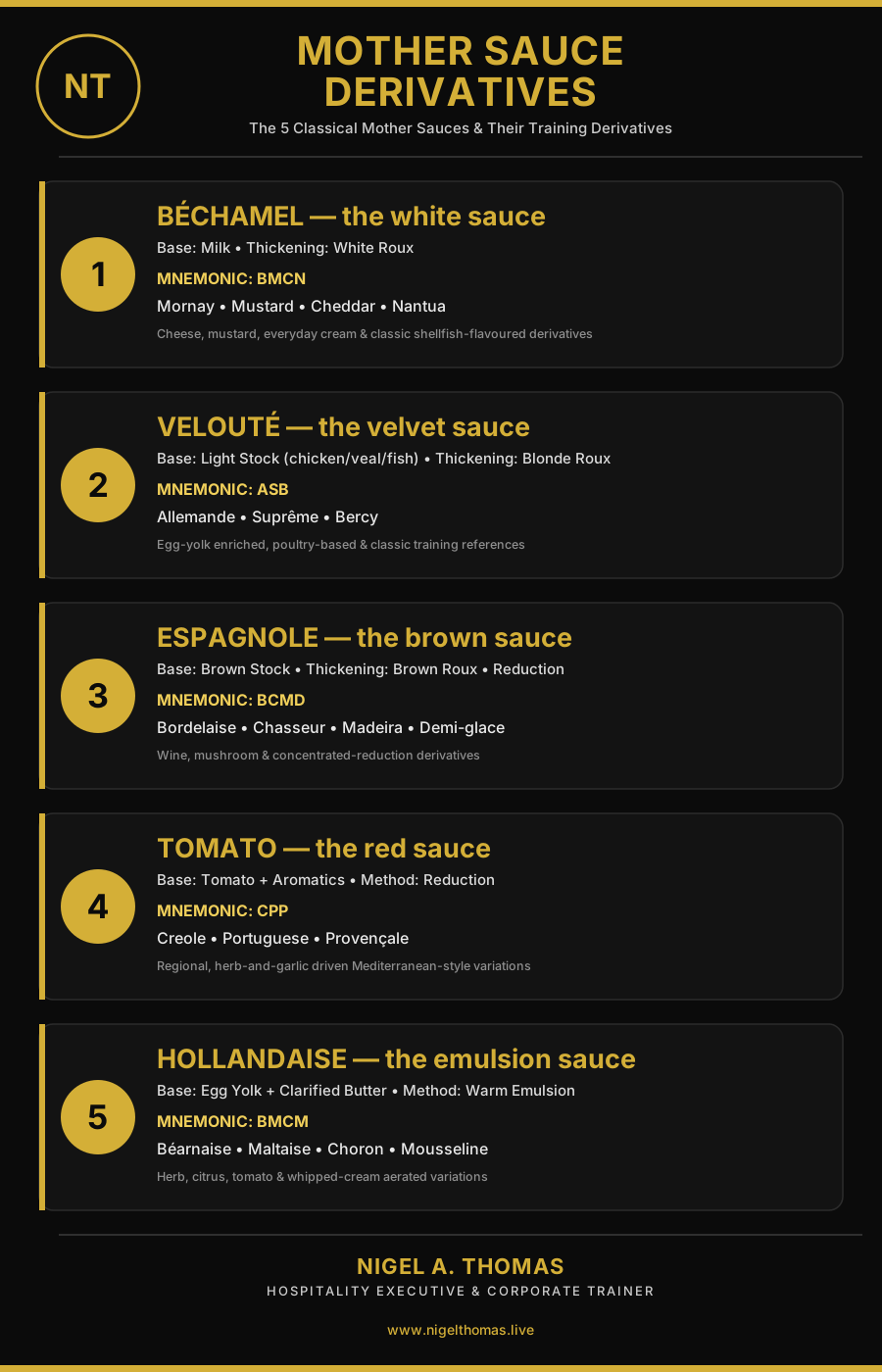
Black & Gold Infomatics Poster: Mother Sauce Derivatives
Open the Infomatics panel below to view the classical Mother Sauce Derivatives poster. The download button saves the same quick-reference poster for training, revision or printing.
Bonus Poster: Popular Sauces & Condiments
A second, separate Black & Gold reference covering 16 everyday commercial sauces and condiments — ketchup, mayonnaise, BBQ, ranch, teriyaki, pesto and more. This is a different system from the classical Mother Sauces above, so it is kept as its own poster rather than merged into the mnemonics.
