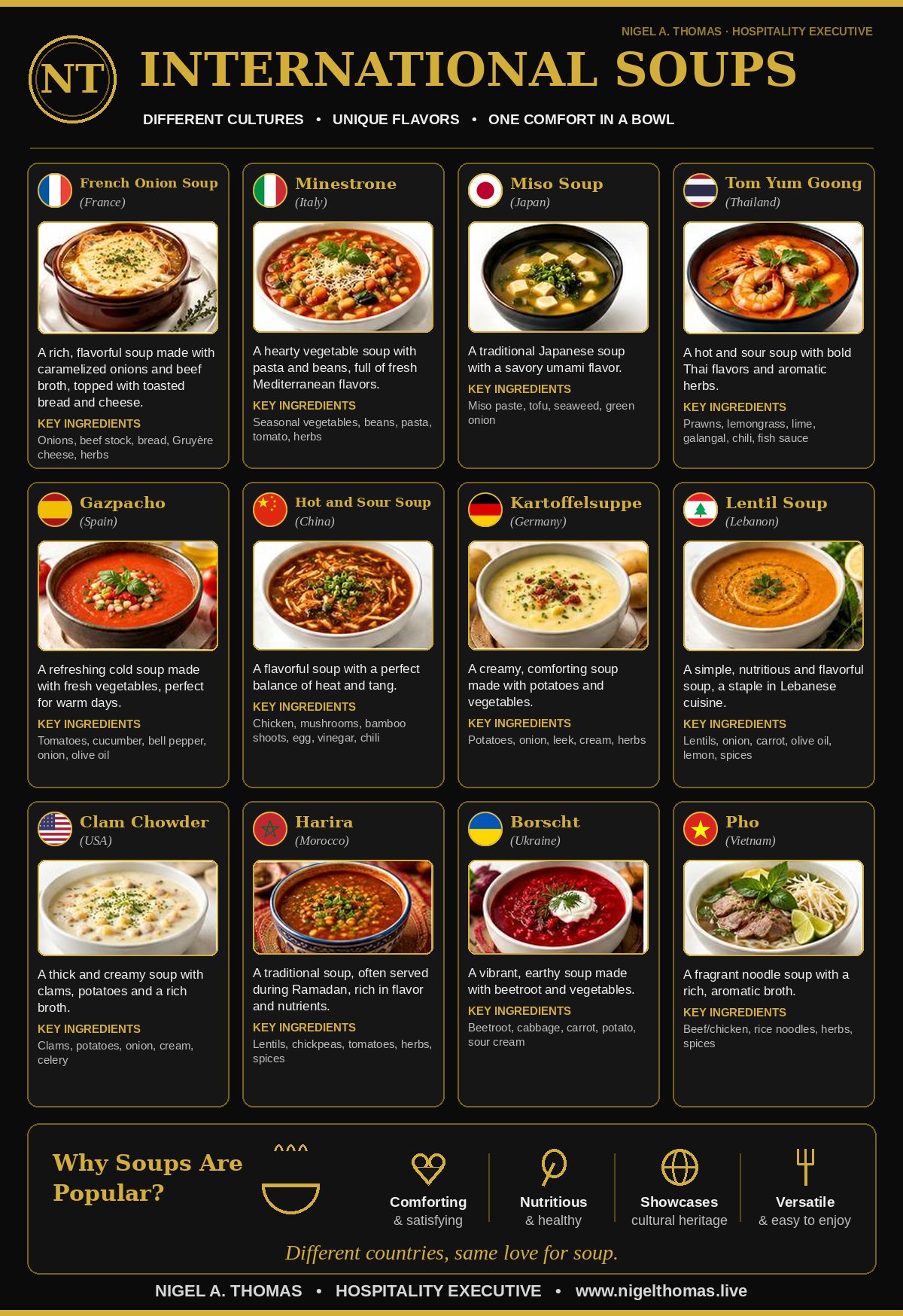
International Soups: 12 Famous Soups From Around the World
Few dishes travel as widely as soup. Almost every culture has a bowl that tells you where you are — the roasted sweetness of onions in a Paris bistro, the smoky heat of a Bangkok street stall, the beetroot red of an Eastern European kitchen table. This guide walks through 12 famous soups from around the world: what defines each one, what makes it work on a hospitality menu, and what the kitchen and service team need to watch. A free infographic poster is at the bottom of the page.
Why Soup Earns Its Place on Every Menu
In a professional kitchen, soup is where the stock pot pays for itself. Bones, trimmings, vegetable ends and herb stems become a base that carries flavor, so soup is one of the most cost-efficient items a kitchen produces. It also does real work for the guest: it is comforting, quick to serve, easy to portion, and it sets the tone for the meal that follows.
Soup suits almost every operation — a plated starter in fine dining, a bain-marie station on a breakfast or lunch buffet, a room service order on a cold night, a banquet first course served to 300 guests at once, or a staff meal. A well-run kitchen tends to carry a small rotation rather than a long list: something light and clear, something hearty, and something seasonal or chilled.
The Main Families of Soup
Before the individual soups, it helps to know how kitchens classify them, because the family decides how you cook, hold and serve the soup.
- Clear soups and broths — light and aromatic, built on a well-made stock. Miso soup and pho belong here, and so does the classical consommé.
- Thickened and puréed soups — smooth or creamy, thickened by starch, puréed vegetables, roux or cream. Kartoffelsuppe and Lebanese lentil soup sit in this group, along with the classical velouté and bisque.
- Hearty, chunky soups — close to a meal in a bowl. Minestrone, harira, borscht and clam chowder are all in this family.
- Cold soups — served chilled, ideal for warm climates and summer menus. Gazpacho is the world’s best-known example.
- Hot and sour, aromatic soups — balanced by acid, heat and fragrant herbs. Tom yum goong and Chinese hot and sour soup are the classics.
12 Famous Soups Around the World
1. French Onion Soup (France)
The whole soup depends on patience. Onions are cooked slowly until deeply caramelized, which usually takes 45 minutes or more, then simmered in beef stock, ladled into an ovenproof crock, topped with a toasted bread crouton and a generous layer of Gruyère, and finished under the salamander until the cheese bubbles and browns.
Service note: the crock leaves the pass extremely hot — warn the guest and use an underliner plate. Contains gluten (bread) and milk (cheese).
2. Minestrone (Italy)
Minestrone has no single fixed recipe; it follows the season. Beans, tomato, and whatever vegetables are at their best go into the pot, with pasta or rice added for body and a shower of Parmigiano at the table. The soup is the Mediterranean kitchen’s answer to using what is available.
Service note: cook the pasta separately and add it to order. Pasta left in hot soup keeps absorbing liquid and turns soft and starchy, and the soup thickens as it holds.
3. Miso Soup (Japan)
Miso soup is built on dashi, a light stock, with miso paste dissolved in at the end and tofu, seaweed and spring onion added. The miso should never be boiled hard, because heat dulls its aroma and savory umami character.
Service note: miso contains soy, and standard dashi is made with dried bonito, so the soup is not vegetarian unless the dashi is made from kombu alone.
4. Tom Yum Goong (Thailand)
Tom yum goong is a hot and sour soup with prawns, perfumed by lemongrass, galangal and kaffir lime leaf, sharpened with lime juice, seasoned with fish sauce and lit up with chili. It appears in two broad styles — a clear version, and a richer, creamier version made with chili paste and milk or coconut milk.
Service note: the lemongrass, galangal and lime leaf stay in the bowl but are not meant to be eaten — tell first-time guests. Contains crustaceans and fish sauce.
5. Gazpacho (Spain)
Gazpacho comes from Andalusia and is served cold and uncooked: ripe tomatoes, cucumber, pepper, garlic, olive oil and vinegar, often with a little bread for body, blended smooth and chilled. On a hot day it is as refreshing as it is nourishing.
Service note: keep it at 41°F (5°C) or below, serve in a chilled bowl, and finish with diced vegetables or a drizzle of good olive oil. Bread means it is not gluten-free by default.
6. Hot and Sour Soup (China)
The name is the recipe: a balance of heat and tang. The heat comes mainly from white pepper and the sourness from vinegar. The broth is lightly thickened with cornstarch and carries wood-ear mushrooms, bamboo shoots, tofu and ribbons of beaten egg, often with chicken or pork.
Service note: taste and adjust the vinegar and pepper at the last moment — both fade or intensify as the soup holds. Contains egg and soy.
7. Kartoffelsuppe (Germany)
German potato soup is the definition of comfort: potatoes cooked with onion, leek and root vegetables, often finished with cream and seasoned with marjoram. Some versions are left rustic and chunky, others are partly puréed, and it is frequently served with sausage or crisp bacon.
Service note: starch-thickened soups scorch easily on the bottom of a deep pot — stir regularly and thin with hot stock, not cold water, if the soup thickens during service.
8. Lentil Soup (Lebanon)
Known locally as shorbat adas, Lebanese lentil soup is proof that a simple recipe can be great. Lentils, onion, carrot, olive oil and cumin are cooked down and finished with fresh lemon juice, then served with fried onion or bread. It is nutritious, inexpensive, and naturally suited to vegetarian and vegan menus.
Service note: add the lemon at the end, in the kitchen or at the table — it lifts the whole bowl. Check the stock and any bread garnish for allergens.
9. Clam Chowder (USA)
New England clam chowder is a thick, creamy soup of clams, potatoes, onion and celery, traditionally built on salt pork or bacon and served with oyster crackers. It is not the only style: Manhattan chowder is tomato-based and Rhode Island chowder is clear.
Service note: contains molluscs and milk, and often gluten from the roux. Dairy-based soups can split if boiled or held too hot for too long — keep the heat gentle.
10. Harira (Morocco)
Harira is a fragrant, rich soup of tomato, lentils and chickpeas, flavored with fresh coriander, parsley and warm spices and traditionally thickened with a little flour and sometimes beaten egg. It is famously served to break the fast at sunset during Ramadan, often alongside dates, and it is eaten throughout the year as a nourishing meal.
Service note: commonly contains gluten (flour, vermicelli), egg and celery — recipes vary, so always confirm with the kitchen.
11. Borscht (Ukraine and Eastern Europe)
Borscht is a vibrant, earthy soup built on beetroot with cabbage, carrot, potato and often meat, finished with sour cream and fresh dill. It is closely associated with Ukraine — Ukrainian borscht cooking was inscribed by UNESCO in 2022 on its list of intangible cultural heritage in need of urgent safeguarding — and versions of it are eaten across Eastern Europe.
Service note: a splash of vinegar or lemon keeps the beetroot color bright rather than dull brown. Sour cream means milk is present.
12. Pho (Vietnam)
Pho is Vietnam’s noodle soup, and its soul is the broth: bones simmered for hours with charred onion and ginger, star anise, cinnamon and cloves. It is assembled to order with rice noodles, thin slices of beef or chicken, bean sprouts, lime and fresh herbs.
Service note: the broth must be served at a rolling, near-boiling temperature so it cooks the raw beef slices in the bowl. Keep noodles, meat and garnishes separate until service.
Soup Service and Food Safety
Soup is a high-moisture, protein-rich food, which makes it a time-and-temperature control for safety item. The figures below follow the US FDA Food Code, which is the basis of ServSafe training; always check them against the regulations that apply in your own country and property.
- Cooling: cool soup from 135°F (57°C) to 70°F (21°C) within 2 hours, then from 70°F to 41°F (5°C) within the next 4 hours. Use shallow pans, ice baths and ice wands — never put a full stockpot straight into the walk-in.
- Hot holding: hold at 135°F (57°C) or above. Heat soup quickly and do not use a hot-holding unit to reheat it.
- Reheating: reheat previously cooked soup to 165°F (74°C) within 2 hours before it goes into hot holding.
- Cold soups: gazpacho and other chilled soups are held at 41°F (5°C) or below.
- Labeling: label and date every container, and rotate stock first in, first out.
Allergen Quick Reference
Recipes vary from kitchen to kitchen, so this table is a starting point for briefing service staff, not a substitute for checking the actual recipe and ingredients.
| Soup | Allergens commonly present |
|---|---|
| French Onion Soup | Gluten (bread), milk (cheese) |
| Minestrone | Gluten (pasta), milk (Parmigiano) |
| Miso Soup | Soy, fish (dashi); some miso contains cereals |
| Tom Yum Goong | Crustaceans, fish sauce; milk in the creamy style |
| Gazpacho | Gluten if bread is used |
| Hot and Sour Soup | Egg, soy, gluten (soy sauce) |
| Kartoffelsuppe | Milk (cream), celery; gluten if a roux is used |
| Lentil Soup | Few by default — check stock and bread garnish |
| Clam Chowder | Molluscs, milk, gluten (roux and crackers) |
| Harira | Gluten (flour, vermicelli), egg, celery |
| Borscht | Milk (sour cream); check the stock |
| Pho | Fish (fish sauce), soy and gluten in hoisin garnish |
Building a Soup Menu That Works
A soup menu does not need to be long to be memorable. Offer two or three soups that contrast with each other — one clear and light, one rich or creamy, and one that reflects the season or the region. A typical starter portion is around 200–250 ml (7–8 oz), with larger portions for a lunch-sized bowl. Name each soup clearly, list the key allergens on the menu, and match the garnish and bread to the style. On buffets, label every soup and keep serving ladles dedicated to each pot to avoid allergen cross-contact.
The best international soups share one quality: they are honest. A good stock, seasoning at the right moment and respect for where the dish comes from will always beat complexity for its own sake.
Final Thoughts
Different countries, same love for soup. Whether it arrives in a crock under bubbling cheese or in a bowl of fragrant pho, soup is comfort, nutrition and cultural heritage in one dish — and for hospitality professionals, one of the most rewarding items to master.