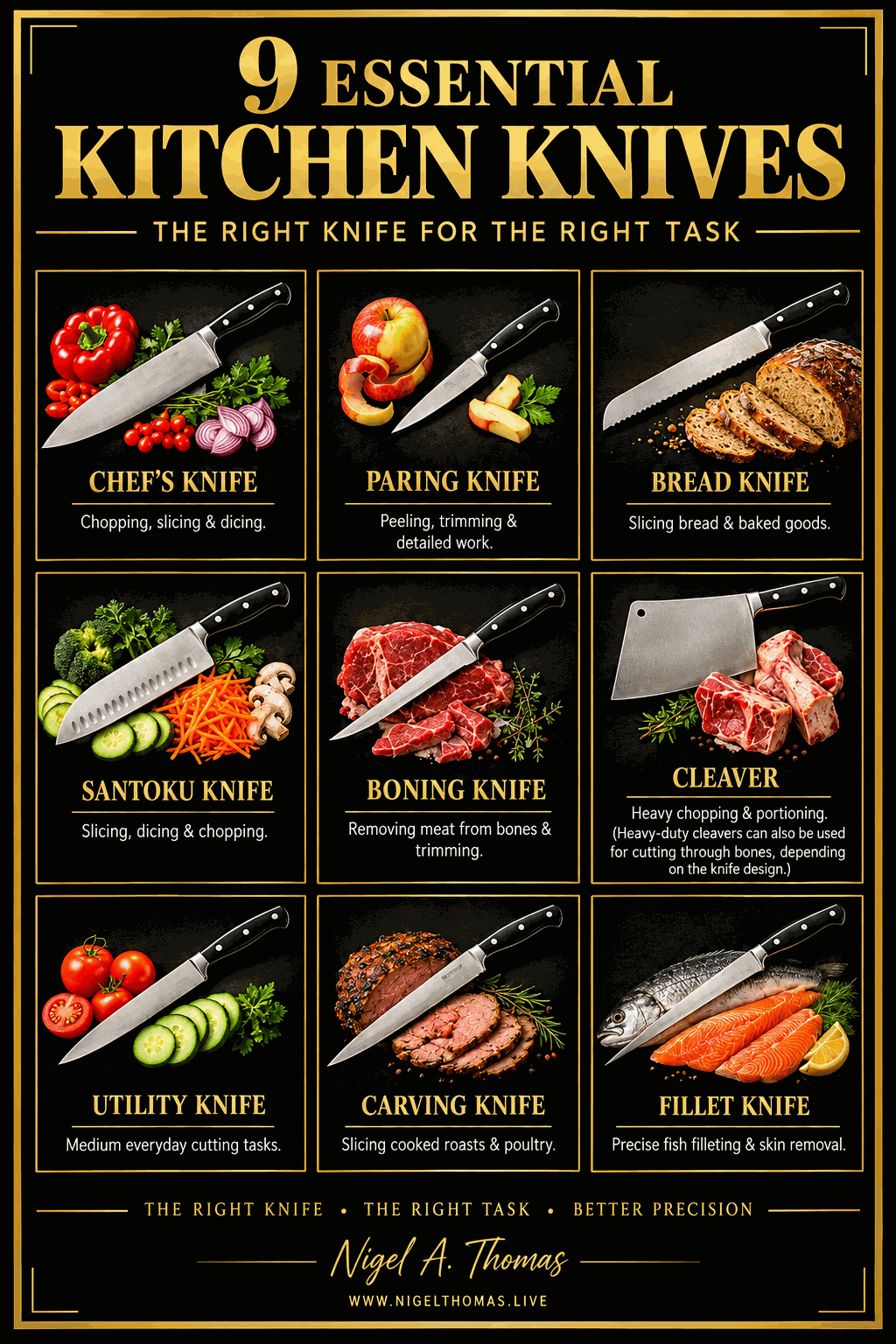
Walk through any busy kitchen at prep time and you can judge the team in a minute by their knives. Is the chef's knife sharp, or is it being forced through a tomato? Is someone peeling an apple with a blade twice the size they need? Is the bread being crushed instead of sliced? The right knife makes a cut cleaner, faster and safer, and the wrong one slows the whole line down and puts hands at risk.
This guide covers nine essential kitchen knives, in the same order as the poster at the bottom of the page: chef's, paring, bread, santoku, boning, cleaver, utility, carving and fillet. For each one you get what it is for, how to use it well, and the mistakes to avoid. It closes with a short section on safety and care and a checklist for training new cooks.
"The right knife, the right task, better precision. A sharp knife used for its proper job is the safest tool in the kitchen."
01 The Everyday Workhorses
1. Chef's Knife
The chef's knife is the all-rounder for chopping, slicing and dicing. Its broad, curved blade lets the cook rock the edge through herbs, push-cut vegetables and slice meat, which is why most kitchens build their knife kit around it. Choose a length and weight that sits comfortably in your hand, because a knife that feels natural is easier to control. Use the full length of the blade rather than only the tip, and keep the work on the board.
2. Paring Knife
The paring knife is small and light, made for peeling, trimming and detailed work. Think of hulling strawberries, removing eye spots from potatoes, segmenting citrus and cutting garnishes. Because the blade is short, it is used in the hand as well as on the board, which gives fine control. The common mistake is using a paring knife for tasks that need a bigger blade, which leads to slipping and awkward angles.
3. Bread Knife
A bread knife has a long, serrated blade for slicing bread and baked goods. The teeth grip a hard crust and cut through the soft crumb without squashing it. Use a light sawing motion and let the blade do the work instead of pressing down. It also handles cakes, soft fruit and tomatoes well, which makes it more useful than its name suggests.
4. Santoku Knife
The santoku is a Japanese-style all-purpose knife for slicing, dicing and chopping. Its blade is flatter than a chef's knife, so it favours an up-and-down chopping motion over rocking, and many santokus have hollow dimples along the edge to help food release. It is a popular choice for vegetables and boneless proteins, and cooks who prefer a lighter, shorter blade often reach for it first.
02 Butchery and Heavy Work
5. Boning Knife
The boning knife is thin and narrow with a pointed tip, designed for removing meat from bones and trimming. The slim blade follows the bone closely, so less meat is left behind and less is wasted. Keep control with slow, deliberate cuts and always cut away from your free hand. Good boning skill is one of the clearest signs of a trained butcher or chef, and it directly improves yield and cost.
6. Cleaver
The cleaver is heavy and broad, made for heavy chopping and portioning. Its weight does much of the work when breaking down larger cuts. As the poster notes, heavy-duty cleavers can also be used for cutting through bones, depending on the knife design, so check what your particular cleaver is built for. A lighter cleaver is not made for bone, and forcing it can chip the edge or cause an injury.
03 Everyday Support and Service Knives
7. Utility Knife
The utility knife is the medium-sized blade for everyday cutting tasks. It sits between the paring knife and the chef's knife, which makes it handy for sandwiches, small vegetables, cheese and light trimming when a chef's knife feels too big and a paring knife too small. Many kitchens keep one at every station for quick jobs.
8. Carving Knife
The carving knife has a long, slim blade for slicing cooked roasts and poultry. The length allows a single smooth stroke through the meat, which gives neat, even slices and a better plate. Rest roasted meat before carving so the juices settle, slice across the grain, and keep the knife sharp so the slices do not tear. Carving is often done in front of guests, so technique matters as much as the blade.
9. Fillet Knife
The fillet knife is thin and flexible for precise fish filleting and skin removal. The flexible blade follows the backbone and skin, taking the flesh off in clean pieces. Use long, gentle strokes and let the flex of the blade guide the cut. Keep it for fish and delicate proteins, and keep it sharp, because a dull fillet knife tears flesh and wastes product.
04 Safety and Care
- Keep every knife sharp. A dull knife slips and needs more force, which makes it more dangerous than a sharp one
- Cut on a stable board, and place a damp cloth under it if it moves
- Use the claw grip, with fingertips curled back and the knuckles guiding the blade
- Never try to catch a falling knife, and never leave knives in a sink of water
- Wash knives by hand and dry them straight away, and avoid the dishwasher, which dulls edges and damages handles
- Store knives in a block, sheath or magnetic strip so edges are protected
- Hone regularly to keep the edge aligned, and sharpen when honing no longer restores it
- Use colour-coded knives and boards to prevent cross-contamination, as covered in our colour coding guide
05 Training Checklist for New Cooks
- Can the cook name all nine knives and say what each is for?
- Do they pick the right knife for the task without being told?
- Can they demonstrate the claw grip and a safe, controlled cut?
- Do they know how to wash, dry, hone and store a knife?
- Do they understand which knives are colour-coded to which food groups?
06 Frequently Asked Questions
Which knife should a new cook buy first?
A chef's knife is the most useful first purchase, followed by a paring knife and a bread knife. That trio covers most daily prep. Add the others as the menu and the cook's skills grow.
Is a santoku better than a chef's knife?
Neither is better in every case. The chef's knife suits rocking cuts and larger work, and the santoku suits precise, up-and-down chopping with a lighter feel. The best choice is the one that feels comfortable and controlled in your hand.
How often should knives be sharpened?
It depends on use. Honing should be a frequent habit in a working kitchen, and sharpening is needed when honing stops restoring a clean edge. If a knife struggles to cut a tomato skin cleanly, it is time.
Nine knives, nine jobs, one simple rule: match the knife to the task. Build that habit into onboarding and the kitchen gets safer, faster and more consistent.
Nigel A. Thomas, F&B and Hospitality Operations Professional | India · Middle East · USA

Nigel A. Thomas
30+ years in F&B and hospitality operations across India, the Middle East, and the USA. Founder of JobLynk.live, India's careers platform for hospitality and maritime professionals. Writing about operations, food safety, and the business of hospitality from the inside out.