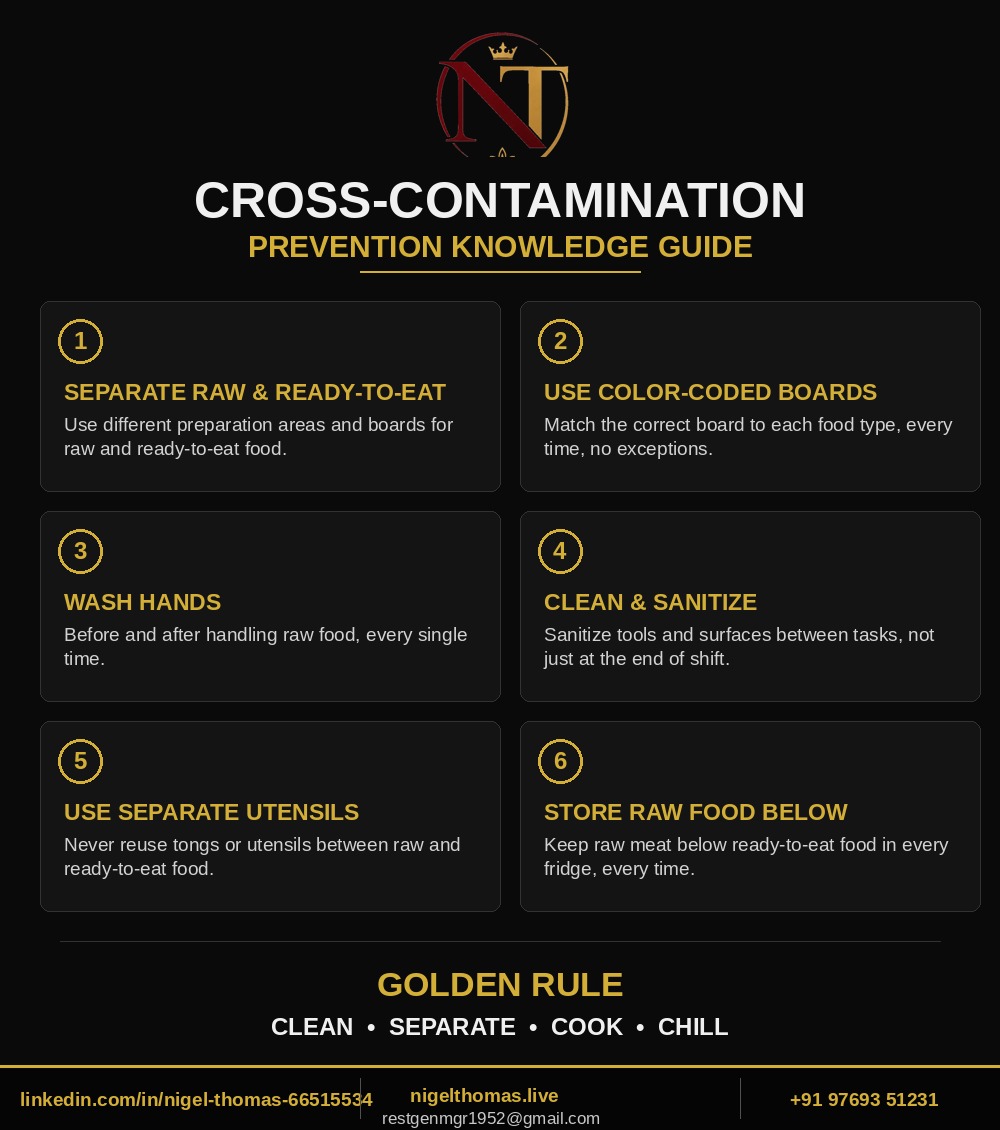
Why Cross-Contamination Is the Silent Risk in Every Kitchen

Of all the food safety failures that happen in a commercial kitchen, cross-contamination is the hardest one to see coming. A burnt sauce announces itself. An undercooked chicken breast, if it's caught, gets sent back before it reaches a guest. But cross-contamination — raw chicken juice on a cutting board that later holds lettuce, a glove that touches raw beef and then a ready-to-eat salad — leaves no smell, no visible sign, and often no immediate symptom. The guest eats, thanks the server, and leaves. The problem shows up hours or days later, far from the kitchen, and by then it's almost impossible to trace back to the exact moment it happened.
That invisibility is exactly why cross-contamination prevention has to be built into a kitchen's habits, not left to memory or good intentions. Every control in this guide exists because a specific failure mode has caused real outbreaks in real kitchens: raw and ready-to-eat food sharing a surface, a board used for the wrong food type, hands that skip a wash, tools that go from raw to ready-to-eat without a proper clean, and storage that lets raw juices drip onto food that will never be cooked again before it reaches a guest.
Over three decades across hotels, resorts and cruise lines, I've found that cross-contamination incidents almost never come from a single dramatic mistake — they come from a dozen small shortcuts taken on a busy shift. Build the six controls below into muscle memory, and the shortcuts stop being tempting in the first place.
1. Separate Raw & Ready-to-Eat Food
The single most important control in this entire guide is physical separation. Raw meat, poultry, seafood and eggs must never share a preparation surface, storage shelf, or even airspace with food that will be eaten without further cooking — salads, cut fruit, bread, cheese, and anything already cooked and cooling for service.
In practice, this means designated prep zones: a station for raw proteins that stays raw-only for the shift, and a separate station for salads, garnishes and ready-to-eat items that never sees raw meat. When space is tight — as it often is on a ship galley or a compact hotel kitchen — separation in time works too: prep all ready-to-eat items first while the station is clean, then move to raw protein prep, with a full clean and sanitize in between.
Common failure point
The classic shortcut is prepping a quick garnish "just for a second" on the same board that's mid-way through breaking down a chicken. That's exactly the kind of thirty-second decision that causes an outbreak two days later — train your team to see it as a hard rule, not a judgment call.
2. Use Color-Coded Boards
Color-coded cutting boards remove the guesswork from separation and make violations visible at a glance — a supervisor walking the line can spot a red board being used for vegetables from across the kitchen. The standard color system, used across most hotel and restaurant HACCP programs, is:
- Red — raw meat
- Blue — raw fish and seafood
- Yellow — raw poultry
- Green — fruit and vegetables
- White — dairy and bakery
- Brown — cooked food
Color-coding only works if it's enforced consistently and if boards are stored, washed and racked in a way that keeps the system intact — a red board hung on the wrong rack, or washed in the same bin as a green board without proper sanitizing between, defeats the purpose. Make the color system part of new-hire training on day one, not something staff pick up informally after a few shifts.
3. Wash Hands — Before and After Handling Raw Food
Hands are the most common vector for cross-contamination precisely because they touch everything — a raw chicken thigh, a phone, a door handle, a ready-to-eat garnish — often within the same few minutes. Proper handwashing, done correctly and at the right moments, breaks that chain.
When to wash
- Before starting any food prep task
- Immediately after handling raw meat, poultry, seafood or eggs
- After touching anything outside the food zone — phones, trash, cleaning cloths, cash
- After using the restroom, coughing, sneezing, or touching the face or hair
- Whenever switching between raw and ready-to-eat tasks
Twenty seconds with soap and warm water, covering between fingers and under nails, is the standard — not a quick rinse. Gloves are not a substitute for handwashing; gloves worn over unwashed hands, or gloves that go from raw food straight to a ready-to-eat task without changing, create the same contamination risk as bare hands.
4. Clean & Sanitize Between Tasks
Cleaning and sanitizing are two different steps, and a kitchen that only does one is leaving itself exposed. Cleaning removes visible debris and grease with soap and water; sanitizing kills the microorganisms cleaning leaves behind, using a chemical sanitizer or heat, at the correct concentration and contact time. A surface can look spotless and still carry enough bacteria to make a guest sick — cleanliness is not the same as safety.
Every surface, tool and cutting board that touches raw protein needs a full clean-and-sanitize cycle before it touches anything else — not a wipe-down "to save time" between orders. Sanitizer test strips, checked regularly against the concentration on the label, are a five-second check that catches a diluted or expired batch before it becomes a problem.
5. Use Separate Utensils
Tongs, spatulas, ladles and serving spoons carry the same risk as cutting boards, and they're easier to overlook because they move around a kitchen constantly. A pair of tongs that flips raw sausages on the grill and then, without a wash, plates the cooked version alongside a ready-to-eat garnish has just recontaminated food that was already safe.
The fix is the same principle as color-coded boards: dedicated utensils for raw and for ready-to-eat, ideally color-matched to the same system, with a full wash between uses if a utensil absolutely must cross categories. On a busy line, keep spares on hand specifically so "I'll just rinse it quick" never becomes the default under pressure.
6. Store Raw Food Below Ready-to-Eat Food
Refrigerator shelf order is one of the simplest controls on this list and one of the most commonly ignored. Raw meat, poultry and seafood must always be stored on the lowest shelves, below ready-to-eat food — never above it. The reason is gravity: a package of raw chicken stored above a tray of prepped salad can drip juice downward, contaminating everything below it, even if the packaging looks intact.
The correct top-to-bottom order in a walk-in or reach-in fridge is: ready-to-eat food and cooked items on top, then seafood, then whole cuts of beef and pork, then ground meats, with raw poultry always on the very bottom shelf — poultry carries the highest contamination risk of any commonly stored raw protein. Label and date everything, and keep raw items in leak-proof containers regardless of shelf position as a second layer of protection.
The Golden Rule
Every control in this guide collapses into four words that are easy to remember and easy to train: Clean. Separate. Cook. Chill. Clean hands, tools and surfaces. Separate raw from ready-to-eat, in space and in sequence. Cook proteins to the correct internal temperature. Chill food promptly and store it in the correct order. A kitchen that holds the line on all four, every shift, has closed off the overwhelming majority of cross-contamination risk before it ever has a chance to start.
When I audit a kitchen, I don't start with the paperwork — I start by watching one prep station for ten minutes. Boards, hands, storage order and utensils tell you almost everything about a kitchen's real food safety culture, faster than any log sheet can.
Building This Into Daily Operations
Knowing the six controls is the easy part; making them automatic under real service pressure is what separates a kitchen that talks about food safety from one that actually practices it. A few operational habits make the difference:
- Train on day one, not week three. New hires should learn the color-coding system and handwashing standard before their first shift on the line, not pick it up informally from whoever's working next to them.
- Make the right choice the easy choice. Stock enough color-coded boards and spare utensils that nobody is ever tempted to cross-use one because a clean option wasn't within reach.
- Audit quietly, coach immediately. A supervisor who spots a lapse and corrects it on the spot, calmly, builds the habit faster than a written warning does after the fact.
- Review storage order weekly. Walk-ins get reorganized during busy deliveries; a five-minute weekly check catches drift before it becomes a habit.
The Bottom Line
Cross-contamination doesn't announce itself, which is exactly why it has to be prevented by habit rather than caught by inspection. Separate raw from ready-to-eat, color-code your boards, wash hands at every transition, clean and sanitize between tasks, keep utensils dedicated, and store raw food below everything else. Four words — Clean, Separate, Cook, Chill — are enough to hold an entire kitchen's food safety culture together, shift after shift.