Yogurt vs Curd, Paneer, Cottage Cheese & Plant-Based Alternatives
Walk into any hotel kitchen, restaurant pantry or cloud kitchen and you will find a fridge full of white, mild, slightly sour products that look alike and are constantly confused with one another. Yogurt, curd, paneer, cottage cheese, tofu: the labels get swapped, the substitutions get made in a hurry, and the dish that comes out is not the dish on the menu. After more than thirty years in luxury hotels, resorts, cruise lines and F&B operations across India, the Middle East and the USA, I can tell you that knowing these products properly is one of the cheapest ways to protect quality, cost and guest safety.
This guide explains how each product is made, what makes it behave the way it does in a pan, a marinade or a dessert, and how to menu, store and label it. It ends with the plant-based options that more and more guests ask for. A free black and gold infographic poster summarising everything is included below.
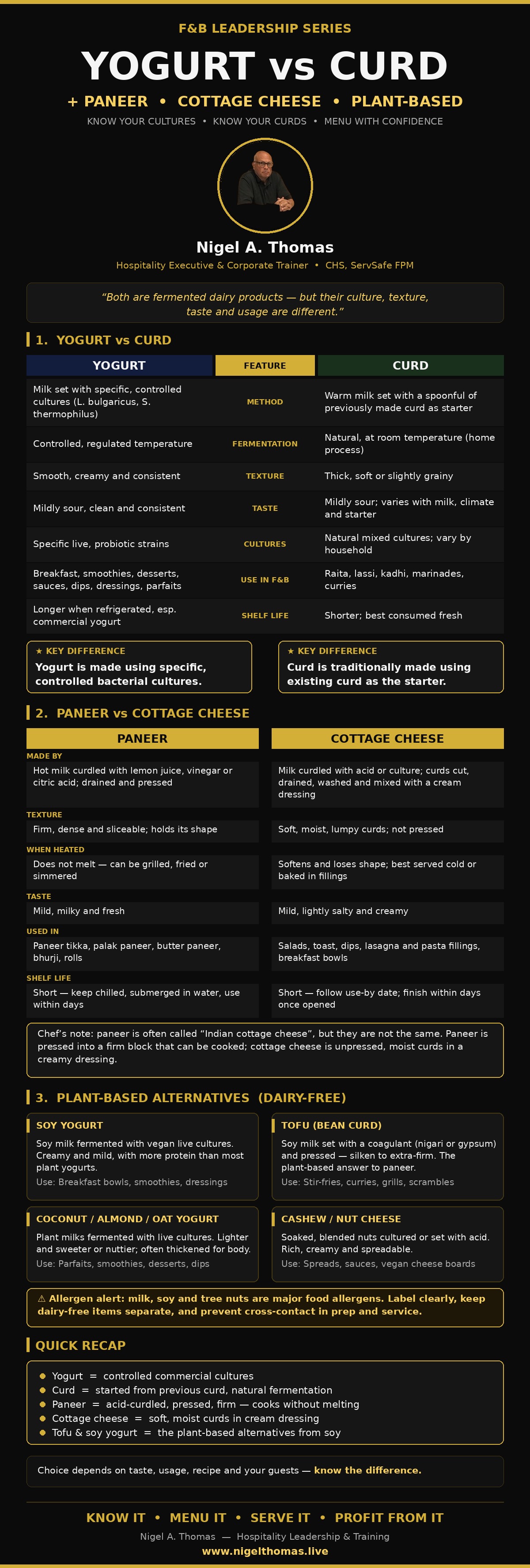
Yogurt vs Curd: Same Family, Different Method
Both yogurt and curd are fermented milk. In both, bacteria feed on the milk sugar (lactose) and produce lactic acid. The acid lowers the pH, the milk proteins tighten into a gel, and the result is a thick, tangy product that keeps longer than the milk it came from. The difference lies in who is in charge of the fermentation.
Yogurt is made with specific, controlled bacterial cultures, classically Lactobacillus bulgaricus and Streptococcus thermophilus. The milk is heated, cooled to a set temperature, inoculated with a measured dose of culture and held in a regulated environment until it reaches the target acidity. Because every variable is managed, the result is consistent: smooth, creamy, mildly sour, and the same on Monday as on Friday. In many countries, labelling rules for the word “yogurt” refer to these two cultures, which is one reason commercial yogurt behaves so predictably.
Curd (dahi in much of India and Pakistan) is made the traditional way. A spoonful of yesterday’s curd is stirred into warm milk, covered, and left at room temperature. The bacteria in that starter, a natural mixed culture that differs from one household to the next, do the rest. The outcome depends on the milk, the weather and the starter itself, so curd can be thick and firm, soft and spoonable, or slightly grainy. It is usually a little more variable in taste, and it is best used fresh.
| Feature | Yogurt | Curd |
|---|---|---|
| Method | Milk set with specific, controlled cultures | Warm milk set with a spoonful of earlier curd as starter |
| Fermentation | Regulated temperature | Natural, at room temperature |
| Texture | Smooth, creamy, consistent | Thick, soft or slightly grainy |
| Taste | Mildly sour, clean, consistent | Mildly sour; varies with milk, climate and starter |
| Cultures | Specific live, probiotic strains | Natural mixed cultures |
| Best in F&B for | Breakfast, smoothies, desserts, sauces, dips, dressings, parfaits | Raita, lassi, kadhi, marinades, curries |
| Shelf life | Longer when refrigerated, especially commercial | Shorter; best consumed fresh |
Choosing Between Them on the Menu
In practice the decision comes down to what the dish needs. A restaurant that serves a parfait, a smoothie bowl or a creamy dressing needs the consistency of yogurt: the same thickness and acidity every service, so the plating and the portion cost never drift. A kitchen that makes a raita, a lassi or a kadhi is often better served by curd, because the slightly looser texture and rounder tang are part of the dish’s identity.
When a recipe calls for one and you only have the other, you can substitute with care. Whisk curd until smooth before using it in a sauce, and hang it in muslin if you need it thicker. Thin yogurt with a little water or milk for a lassi. Always taste for acidity before you season, because a sourer product will throw the salt and spice balance off.
Cooking with cultured dairy
Heat is the enemy of any cultured dairy product. Add curd or yogurt to a hot gravy straight from the fridge and the proteins seize, giving you a split, grainy sauce. The standard fix is the same in every professional kitchen: bring it to room temperature, whisk it smooth, temper it with a ladle of the hot liquid, and add it off a rolling boil. Stabilisers such as a teaspoon of gram flour or cornflour in a kadhi help in a high-volume setting. For marinades, the lactic acid works as a gentle tenderiser, which is why curd-based marinades are so valuable for chicken, lamb and paneer: they season and soften without turning the surface mushy, as a harsh acid can.
Paneer: The Pressed Fresh Cheese of India
Paneer is a fresh, unaged cheese made by heating milk and curdling it with an acid such as lemon juice, vinegar or citric acid. The curds separate from the whey, are drained in muslin and then pressed under weight into a firm block. Because it is coagulated with acid rather than rennet, paneer has traditionally been suitable for vegetarians, though you should still check commercial products for any added ingredients.
The pressing is what defines paneer. The block is dense and sliceable, mild and milky in flavour, and, crucially, it does not melt. Heat it and it softens and browns but keeps its shape. That is why paneer can be cut into cubes, skewered and grilled for paneer tikka, simmered in a spinach gravy for palak paneer, folded into a butter-tomato sauce, crumbled into a bhurji, or stuffed into a roll or a paratha.
Kitchen tips for paneer
- Yield and cost. As a rough guide, a litre of full-fat milk gives somewhere around 150 to 200 g of paneer, depending on the milk and how firmly you press. Use your own tested yield when you cost a dish, not a textbook figure.
- Do not overcook. Paneer toughens and turns rubbery with long cooking. Add it to gravies late, and give grilled paneer a short, hot sear.
- Soak before use. Store-bought blocks that feel hard can be soaked in warm, lightly salted water for ten minutes to soften them.
- Store it wet and cold. Keep paneer chilled, submerged in fresh water in a covered container, and change the water daily. Use it within a few days and discard any block with a sour smell or slimy surface.
Cottage Cheese: Soft Curds in Cream
Cottage cheese is also a fresh cheese, but it is built very differently. Milk is curdled with acid or with a culture, sometimes with a little rennet, and the curds are cut, gently heated, drained and washed. They are not pressed. Instead, the loose curds are mixed with a creamy dressing, which gives cottage cheese its soft, moist, lumpy texture and its mild, lightly salty taste. Low-fat and fat-free versions are common, and the salt level varies between brands, so read the label if you are menuing it for guests watching their sodium.
Cottage cheese is a cold-kitchen and breakfast ingredient first. It works in salads, on toast with tomato or fruit, in dips and spreads, in pancake batters, and as a filling for lasagne, stuffed pasta and savoury pastries. Heat softens it and it loses its shape, so it is not the product for grilling or frying. Commercial cottage cheese is often set with rennet, so strict vegetarians should check the ingredients list.
Paneer vs Cottage Cheese: Do Not Swap Them Blindly
Paneer is frequently called “Indian cottage cheese” on menus abroad, and that is where the trouble starts. They are cousins, not twins. If you put cottage cheese in a tikka marinade, it will dissolve into the sauce. If you scatter cubes of paneer over a salad expecting creamy curds, you will get something dense and squeaky.
| Feature | Paneer | Cottage cheese |
|---|---|---|
| Made by | Hot milk curdled with acid; drained and pressed | Milk curdled with acid or culture; curds cut, drained, washed and dressed with cream |
| Texture | Firm, dense, sliceable | Soft, moist, lumpy |
| When heated | Holds its shape; can be grilled, fried or simmered | Softens and loses shape |
| Taste | Mild, milky, fresh | Mild, lightly salty, creamy |
| Used in | Tikka, palak paneer, butter paneer, bhurji, rolls | Salads, toast, dips, fillings, breakfast bowls |
| Shelf life | Short; chilled and submerged in water | Short; follow the use-by date |
Plant-Based Alternatives for Dairy-Free Guests
A modern menu cannot ignore guests who avoid dairy, whether for allergy, intolerance, ethics, religion or preference. The good news is that each product above has a plant-based counterpart. The honest news is that none is an exact copy, and the best chefs treat them as ingredients in their own right rather than as inferior substitutes.
Soy yogurt
Soy milk fermented with vegan live cultures gives a creamy, mild yogurt-style product. Among plant yogurts it generally has more protein than most, which makes it a practical choice for breakfast bowls, smoothies and dressings. Some brands add thickeners such as pectin or starch to reach a spoonable set, and a few carry the beany note of soy, so taste before you commit to a supplier.
Tofu (bean curd)
Tofu is the plant world’s answer to paneer, and the method is strikingly similar. Soy milk is heated and set with a coagulant, traditionally nigari (magnesium chloride) or gypsum (calcium sulfate), and the curds are pressed into blocks. Silken and soft tofu suit soups, sauces and desserts; firm and extra-firm tofu can be pressed, marinated and grilled, pan-fried or baked. Extra-firm tofu in a spiced marinade is a respectable stand-in for paneer in a tikka or a bhurji, though it will not have paneer’s milky richness, so season boldly and give it a good sear. Press it for at least twenty minutes so it takes up flavour instead of water.
Coconut, almond and oat yogurts
Plant milks fermented with live cultures produce lighter, sweeter or nuttier yogurts. Coconut versions are rich and higher in fat; almond and oat versions are lighter and usually lower in protein. Many are thickened for body. They work well in parfaits, smoothies, desserts and raita-style dips, but they do not always behave like dairy in heat, so test them in your sauces and marinades before launching a dish.
Cashew and nut cheeses
Soaked, blended nuts, most often cashews, can be cultured or set with acid into creamy, spreadable cheeses. They are well suited to spreads, cream-style sauces and vegan cheese boards. They are a premium ingredient with a premium price, so cost them carefully, and remember that they bring their own allergen with them.
Food Safety, Storage and Allergen Control
Everything in this article is a high-risk, perishable food, and the same ServSafe principles apply to all of it.
- Temperature. Keep dairy and plant-based alternatives at or below 5°C (41°F). Record fridge temperatures at every shift and never leave tubs standing on the pass.
- FIFO and FEFO. Rotate stock so the oldest goes first and the earliest expiry is used first. Date-label every decanted container with the product name, date opened and use-by date.
- No double-dipping. Use clean, dedicated spoons for yogurt, curd and cottage cheese. A used spoon returned to the tub is how a small contamination becomes a whole-batch problem.
- Homemade curd and paneer. Use pasteurised milk, clean equipment, and a reliable starter. If a batch smells off, looks pink or grey, or develops mould, discard it.
- Allergens. Milk, soy and tree nuts are major food allergens. Label dairy-free and nut-free items clearly, store them separately and above, never below, allergen-containing items, and use separate utensils and boards. A vegan tofu dish that has been stirred with a spoon used for paneer is no longer safe for a guest with a milk allergy.
- Training. Brief every server on what is in each dish. “I think it is dairy-free” is never an acceptable answer at the table.
Costing and Menu Planning
These products behave very differently on a costing sheet. Commercial yogurt has a stable purchase price and almost no waste when portioned from a sealed tub. Homemade curd is cheap in raw material but costs labour and carries a batch-failure risk. Paneer is expensive per kilogram, and its yield and trim loss should be tested, not assumed. Cottage cheese has a short life once opened, so a high-volume breakfast outlet should buy in small tubs. Tofu is relatively inexpensive, while nut cheeses and branded plant yogurts can be some of the costliest items in the fridge.
As I often tell teams in our F&B leadership sessions, standardise your recipes, use exact quantities, control your portions, and recalculate whenever ingredient prices change. A dish with a clean costing sheet and a clear allergen card is a dish you can sell with confidence. If you want the full costing method, our Food Cost Basics poster walks through the formula step by step.
Quick Reference for the Pass
- Yogurt = controlled commercial cultures; consistent, creamy; ideal for dressings, parfaits and smoothies.
- Curd = started from earlier curd; natural, slightly variable; ideal for raita, lassi, kadhi and marinades.
- Paneer = acid-curdled and pressed; firm; cooks without melting.
- Cottage cheese = soft, moist curds in cream; best cold or as a filling.
- Tofu and soy yogurt = the main soy-based alternatives; test them in your own recipes.
- Always store cold, label clearly and control allergens.
Final Thoughts
The next time a guest asks whether the raita is made with yogurt or curd, or whether the paneer can be swapped for tofu, you will be able to answer with confidence, and so will your team. None of these products is better than the others. Each is the right tool for a particular job, and the real skill in the kitchen is matching the product to the dish, the guest and the budget. Download the poster, pin it in your pantry or training room, and use it to settle the debate for good.