Twenty minutes before service, in almost every well-run hotel restaurant I have ever worked in, you will find the same quiet scene repeating itself at table after table. A steward, cloth in hand, folds a napkin into a crisp, upright shape, sets it down, checks it against the one beside it, and moves on. Nobody applauds this. Most guests never consciously notice it. And yet if you took it away — if every napkin on the floor were simply thrown into a loose triangle — the room would feel different before a single plate had left the kitchen. That gap between "nobody notices it" and "everybody would notice its absence" is, to me, the entire argument for why napkin folding still belongs in professional hospitality training, long after tablecloths have gotten simpler and menus have gotten shorter.
I want to use this piece to walk through one specific fold — the Bishop's Hat, sometimes called the Bishop's Mitre — because in thirty years of moving between hotel restaurants, resorts, and cruise dining rooms across India, the Middle East, and the United States, it is the fold I have seen taught more often than any other, and the one that tells me the most about a team the first time I watch someone execute it.
Where the fold comes from
The napkin as a piece of table theatre is older than most guests assume. European courts of the 16th and 17th centuries used elaborate linen displays — birds, fish, even small ships folded from cloth — as a quiet flex of a household's wealth and taste, set out before the meal itself arrived. That instinct, to let the table announce the standard of the house before the food does, survived the transition into commercial hospitality almost unchanged. Grand hotels and ocean liners of the late 1800s and early 1900s competed openly on table presentation, and the Bishop's Hat — named for its resemblance to the ceremonial mitre worn by bishops in church liturgy — became one of the signature folds of that era's formal European service.
It has stayed in the training curriculum ever since for a fairly unglamorous reason: it works. It looks considerably more impressive than the effort it takes, it holds its shape well enough to survive a table full of hands and cutlery being arranged around it, and it teaches a new team member the fundamentals — symmetry, fold tension, clean crease lines — that transfer directly into every other fold they will learn afterward. That is precisely why it tends to be one of the first folds handed to a hospitality trainee on day one, rather than something reserved for advanced staff.
What a folded napkin is actually communicating
It would be easy to wave this off as decoration, irrelevant in an age of pared-back table settings and faster service. I would push back on that. Guests form an opinion about a restaurant within roughly the first thirty to sixty seconds of being seated, well before food reaches the table, and a large part of that first impression is built from things exactly like this — a precisely folded napkin, cutlery aligned to the millimetre, glassware without a smear on it. A sloppy or inconsistent fold plants a small doubt before the meal has even started, and guests are far better at picking up on inconsistency than most managers give them credit for.
Consistency is really the heart of it. One beautifully folded napkin on one table means very little on its own. Two hundred identical napkins across a full banquet room — same height, same tension, same symmetry — tells a guest, usually without them consciously registering why, that the operation runs on trained procedure rather than improvisation. This is exactly why I write napkin folding into Standard Operating Procedures rather than leaving it to individual taste: it is one of the few service details you can audit at a glance, from across the room, without asking a single question.
It also does useful work as a marker of service tier. Casual dining rarely bothers with anything beyond a simple rectangle or triangle fold. Move up through casual fine dining into full fine dining and formal banquet service, and folding complexity tends to rise in step with it. The Bishop's Hat sits comfortably in that fine-dining-and-banquet range — formal enough for a wedding reception or a five-star hotel dining room, without tipping into the theatrical territory of swans and roses stacked inside stemware, which I generally reserve for state occasions and gala dinners rather than nightly service.
And frankly, it is a useful read on a new hire. How carefully someone folds a napkin — the patience, the symmetry, whether they rush it or take the extra two seconds to square a corner — tells me more about how they will handle the less visible parts of service than almost any interview question does.
Getting the linen right before you fold anything
None of the technique below matters if the napkin itself is wrong for the job, and this is where I see newer properties trip up most often when they try to replicate the crisp folds they have seen elsewhere. The Bishop's Hat needs a napkin with enough body to hold a crease and support its own weight standing upright — pure cotton in the 200 to 250 GSM range, or a cotton-polyester blend of similar weight, is the industry standard. Anything thinner or softer, which is common in budget linen packages, will simply droop no matter how carefully you fold it.
Starching matters just as much. Most hotel laundry contracts specify a light-to-medium starch for banquet and fine-dining napkins specifically because it gives the fabric the crispness needed for sharp fold lines and a stable finished shape. Over-starch it and the fabric turns brittle, cracking visibly along the folds; under-starch it and the fold looks tired within minutes of hitting the table. Size consistency is the third piece people overlook — a variance of even two or three centimetres between napkins in the same batch will show up as visibly uneven folds across a room, which is why I always have someone run a quick size and condition check on the batch before a large function, alongside the obvious inspection for stains, thin patches, or frayed edges under good light.
When the Bishop's Hat is the right choice
This fold earns its place because it photographs well, holds its shape on a plate or directly on the table, and can be executed fast enough to work at banquet scale. I reach for it for formal hotel restaurant dinner service, wedding banquets and gala dinners, corporate functions and award ceremonies, à la carte fine dining where the napkin sits on the charger rather than beside it, and — given its history — cruise line dining rooms in particular.
It is just as important to know where it does not belong. Casual dining, quick service, and breakfast service all call for something simpler — a plain fold or a rolled napkin with a band suits the pace and tone of those meals far better. Matching fold complexity to service style is itself a small but telling piece of hospitality judgment: an elaborate fold in a casual room looks out of place in exactly the same way an under-dressed table looks under-prepared in a formal one.
The fold itself, step by step
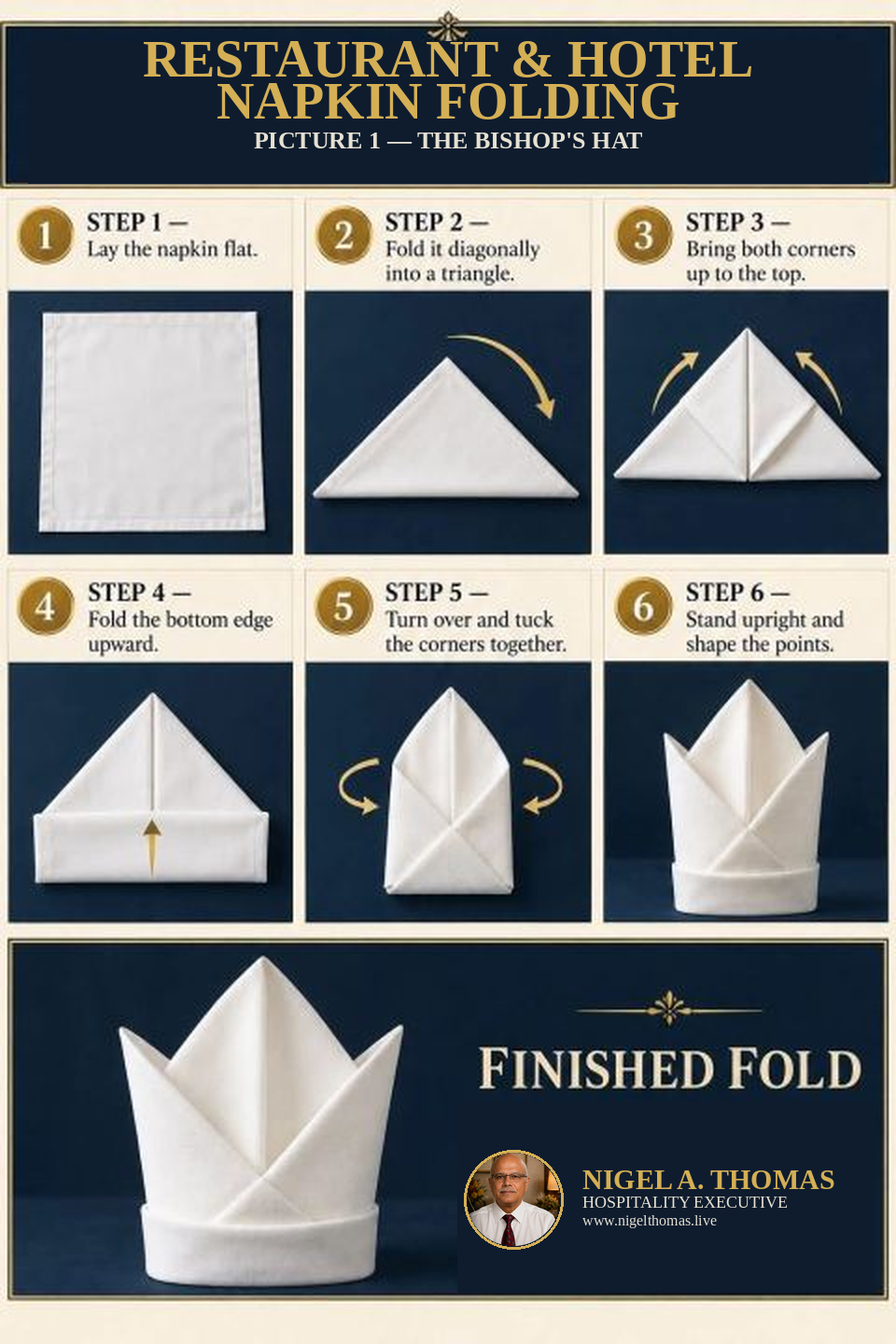
The method below is the six-step version taught in most hotel training programs, starting from a square napkin, freshly pressed and lightly starched, laid flat on a clean, dry surface.
Lay the napkin flat with the right side down, and smooth out any storage creases with the flat of your hand, working outward from the centre. Square the corners before you fold anything — this two-second check is the single most common thing rushed teams skip, and any misalignment here compounds through every fold that follows.
Fold it diagonally into a triangle by bringing one corner across to meet its opposite corner, then run your fingers firmly along the folded edge to set a clean crease. This triangle is the foundation for the entire shape, so check that both folded edges line up exactly before moving on — an uneven triangle is genuinely difficult to correct later without unfolding and starting again.
Bring both corners up to the top, taking the two base corners of the triangle and lifting them both to meet the top point. This is where the hat's silhouette starts to appear. Press each new fold flat as you go, working from the centre outward, so you don't trap air pockets that leave the fabric looking bulgy rather than crisp.
Fold the bottom edge upward toward the centre, which tightens the base and starts building the structure that lets the finished piece stand on its own. This fold sets the eventual height of the hat's "brim," so keep it consistent across napkins for the same table — roughly one-third of the total shape's height is a reliable target.
Turn it over and tuck the corners together, flipping the whole shape so the neat side faces up, then tucking one side corner into the other (or both behind the body of the fold) to lock everything in place. Done properly, the napkin should now largely hold its shape without any support.
Stand it upright and shape the points by setting the fold on its base and gently separating the top points into the fanned, peaked crown that gives the Bishop's Hat its name. Shape each point evenly with your fingers and give the base a light press so it sits flat and stable. A properly finished fold stands confidently on its own, three or four points fanning out from a firm base — which is exactly what the infographic further down this page shows across all six steps and the finished result.
Where it usually goes wrong
Even experienced staff drift into bad habits with a fold this familiar, and the same handful of issues come up in almost every property I have trained in. Uneven base folds nearly always trace back to a rushed Step 1 or Step 2, where an imprecise starting triangle throws off everything after it. Collapsing points are usually a linen problem rather than a technique problem — under-starched fabric, or a napkin that has been over-handled before the shape was finished. Inconsistent height across a table setting is solved not by asking staff to "be more careful" but by standardising the actual measurements of each fold, rather than eyeballing it napkin by napkin. Visible fingerprints or smudges on white linen come down to clean, dry hands and handling the finished fold as little as possible once it's set. And folding too far in advance of service — tempting when a banquet room needs two hundred napkins ready — costs crispness, particularly in humid climates; I'd rather see a team fold closer to service time under slight time pressure than fold everything the night before and hope it holds.
How it compares to the rest of the napkin folding repertoire
The Bishop's Hat is one of dozens of folds in use across the industry, and it's worth knowing where it sits among them. The Rose Fold is softer and rounder, generally reserved for intimate or romantic settings and usually placed inside a glass rather than standing on its own. The Fan Fold is quicker to execute and a common choice for high-volume service, where polish still matters but a six-step fold at every cover isn't realistic. The Pocket Fold builds in a triangular pocket for cutlery or a printed menu card, which makes it popular for banquets and buffets where the fold needs to do double duty. And at the most elaborate end, folds like the Bird of Paradise or the Swan are usually reserved for gala dinners, state banquets, or cruise line signature evenings, where the napkin is closer to a centrepiece than a table setting element. Against that spectrum, the Bishop's Hat holds a genuinely useful middle ground — elegant enough for formal service, efficient enough to hold up at scale — which is exactly why it has stayed a training staple for well over a century.
Turning this into a standard, not a party trick
For a restaurant manager, banquet captain, or F&B executive, the real payoff of a fold like this isn't the fold itself — it's what building it properly into your operation says about your training culture more broadly. In practice that means writing it up as a documented SOP with photos of each step and the target height and proportions; training new staff against a reference sample until their result actually matches it, rather than describing the fold verbally and hoping it lands; spot-checking it before service the same way you would audit table settings or glassware; keeping two or three standard folds on hand so the level of formality actually matches the occasion instead of defaulting to the same fold regardless of event; and, for larger functions, being honest in your setup schedule that a properly executed six-step fold across two hundred napkins takes meaningfully longer than a simple rectangle — planning for that reality beats discovering it forty minutes before doors open.
None of this is complicated. It is, if anything, one of the simplest standards a floor team can master completely — and that is exactly why I think it's worth taking seriously rather than treating as an afterthought reserved for the tables a manager happens to be watching.
The full six-step sequence, laid out on one reference sheet — useful to print for a service pantry or hand to a new team member during onboarding.