Hospitality Management Essentials
Labor Cost: What Builds It and How to Control It
Labor is usually the largest controllable cost in a hotel or restaurant. This guide explains what goes into it, how to calculate labor percentage, and five practical steps to control hours without hurting service, plus a free infographic poster.
What Is Labor Cost?
Labor cost is everything you spend to have people working in your operation. Most managers think first of wages, but wages are only the visible part. The full figure also includes overtime, employer contributions such as provident fund and insurance, payroll taxes where they apply, paid leave, staff meals, uniforms, training time and recruitment. If a cook is paid a monthly salary, the real cost to the business is higher than that number once every one of those items is added.
The reason labor deserves special attention is that, unlike rent or a loan repayment, it responds to daily decisions. A manager decides how many people to schedule, how long a shift runs, whether an event needs extra hands and whether a late finish becomes overtime. Together with food and beverage cost, labor forms what most operators call prime cost, the two largest numbers on a profit and loss statement. Control those two and most of the rest of the P&L looks after itself.
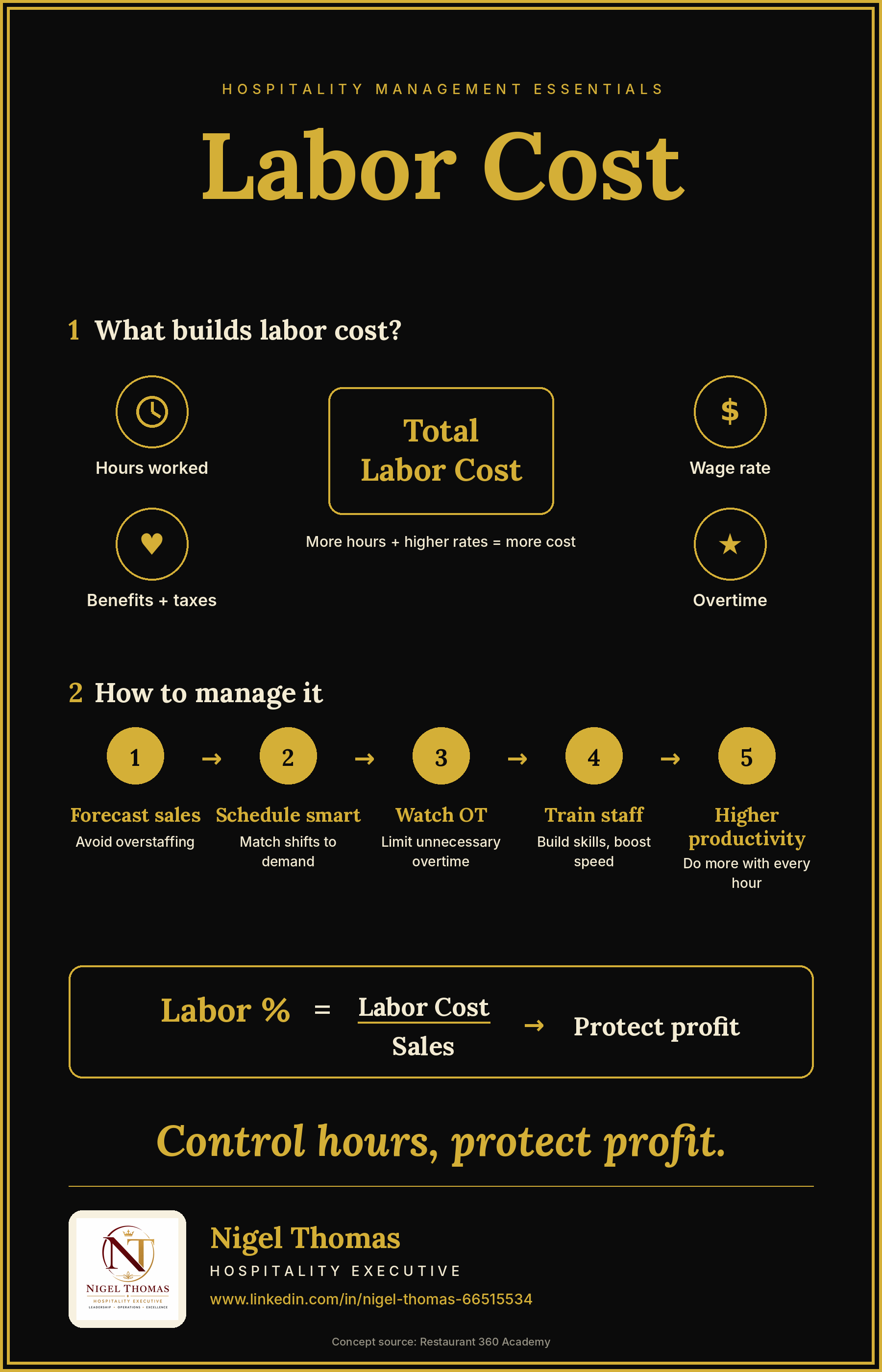
The poster that goes with this article reduces the whole subject to two ideas. First, labor cost is built from a small number of drivers. Second, it can be managed through a repeatable five-step routine. The sections below take each in turn.
1. What Builds Labor Cost?
The poster shows four drivers feeding into total labor cost: hours worked, wage rate, benefits and taxes, and overtime. The short summary beside it says it plainly: more hours and higher rates mean more cost. Each driver behaves differently, so each needs a different kind of attention.
Hours worked
Hours are the driver a manager controls most directly. Every scheduled hour costs money whether the dining room is full or empty. The question to ask for every shift is not “who is available?” but “how many hours does the expected business actually need?” Overstaffing in a quiet period is a pure loss, while understaffing in a busy one damages service and can cost more in lost sales and complaints than the wages saved.
It helps to separate hours into three groups. Fixed hours are needed to open the doors at all, such as one cook, one server and one supervisor, whatever the sales. Variable hours rise and fall with business volume. Non-productive hours are paid time spent waiting: arriving long before service, standing idle between rushes or staying late because the shift was never planned to end on time. The aim is to keep fixed hours lean, match variable hours to forecast demand and shrink non-productive time.
Wage rate
The wage rate is the price of each hour. It is set by the market, by statutory minimums, by the skill the job needs and by your own pay structure. Managers have less day-to-day control here, but they still influence it through hiring decisions, promotions and how work is allocated. Using an expensive, highly skilled person for tasks a trainee can do is a hidden rate problem: the hour was fine, the rate for that task was wrong.
Cutting wage rates is rarely the answer. Underpaying leads to turnover, and replacing an employee carries its own costs in advertising, interviewing, training and the slower, error-prone first weeks. A fair rate combined with high productivity almost always beats a low rate and constant churn.
Benefits and taxes
The heart on the poster stands for benefits and taxes, the part of labor cost that never appears on a payslip. Depending on your country and contracts it can include employer provident fund contributions, insurance, gratuity provisions, paid leave, bonuses, service-charge distribution, accommodation and staff meals. Hotels and resorts with live-in staff often carry a considerable cost here. When you cost a new position or compare a permanent employee with casual or contract labor, always compare the fully loaded figure, not just the wage.
Check your own obligations with your HR or accounts team and keep a single, current list of what is included in your labor figure. Many operations under-report labor percentage simply because some of these items sit in a different line of the accounts.
Overtime
The star on the poster marks overtime, and it deserves one because it is the most avoidable driver. Overtime is paid at a premium rate, and tired staff on a long shift are slower and make more mistakes. Occasional overtime for a genuine, unforecast surge is reasonable. Regular overtime is a sign that the schedule, the staffing level or the workflow is wrong, and it should be treated as a problem to fix, not a normal part of the week.
The Labor Cost Percentage
Labor % = (Labor Cost ÷ Sales) × 100
The formula at the bottom of the poster is the single most useful labor number. Divide total labor cost for a period by sales for the same period, then multiply by 100. A worked example, using round figures:
| Item | Amount |
|---|---|
| Sales for the month | ₹10,00,000 |
| Wages, overtime, benefits and taxes | ₹3,10,000 |
| Labor % | 31% |
That 31% means that for every ₹100 of sales, ₹31 goes to people. If the target for the outlet is 28%, the gap is three points, which on this sales level is ₹30,000 a month. The percentage turns a vague feeling of “we seem to be overstaffed” into a number that can be tracked, discussed and improved.
Targets differ widely by type of operation. A full-service restaurant, a quick-service cafe, a banquet operation and a five-star hotel food and beverage department will all have different healthy ranges, depending on service style, menu complexity and market. Use your own budget and your own history as the benchmark, not a number from another property.
Reading the percentage correctly
Labor percentage moves for two reasons, and it is important to know which one you are looking at. It rises when labor cost rises, and it also rises when sales fall while labor stays the same. A quiet week will push the percentage up even though nobody was paid more. This is why forecasting matters so much: if you saw the quiet week coming, you could have scheduled fewer hours and protected the percentage.
The reverse is also true. A very low percentage during a busy period is not automatically good news. It may mean the team is stretched, service is slipping and staff are heading for burnout. Always read the percentage alongside guest feedback, service times and staff turnover.
2. How to Manage It: Five Steps
The second half of the poster is a five-step chain: forecast sales, schedule smart, watch overtime, train staff and reach higher productivity. They are drawn as a sequence because each step depends on the one before it.
Step 1: Forecast sales
Every good schedule starts with a forecast. You cannot match staff to demand if you do not know what demand will be. Start with what you already have: sales by day and by shift from the last several weeks and the same period last year. Then adjust for known events: bookings, weddings and conferences, festivals, holidays, school terms, weather, nearby events and promotions you plan to run.
The forecast does not need to be perfect. It needs to be better than guessing, and it should be written down so you can compare it with what actually happened. Over a few weeks the gap between forecast and actual shrinks, and your confidence in the schedule grows. The poster pairs this step with a simple phrase: avoid overstaffing.
Step 2: Schedule smart
Scheduling smart means matching shifts to demand, not to habit. Many operations use the same roster every week because it is convenient, even though sales are very different on a Tuesday lunch and a Saturday night. A smarter roster uses a few tools:
- Staggered starts and finishes. Bring people in as the rush builds and release them as it fades, instead of everyone starting and ending together.
- Split shifts where local rules and staff welfare allow, to cover lunch and dinner peaks without paying for the quiet afternoon.
- Cross-trained staff who can move between stations, so a quiet section does not mean idle people.
- A core team plus flexible hours. Keep your best people on predictable hours and use part-time or on-call staff for peaks.
- Publish the roster early. Staff plan their lives around it, and fewer last-minute swaps mean fewer unplanned extra hours.
As an example, suppose a restaurant expects 40 covers at Tuesday lunch and 140 at Saturday dinner. If both shifts use the same five servers, Tuesday carries two or three people doing very little, and Saturday may leave the guests waiting. Two servers on Tuesday and six on Saturday, with a sixth person starting an hour into the rush, gives better service and a lower cost across the week.
Step 3: Watch overtime
Review overtime every week, not at month end when it is too late to change anything. Look at who is working it, which department it comes from and why. Common causes are poor forecasting, late deliveries, no preparation done before service, unplanned absences, and staff who simply do not leave on time because nobody checks.
Practical controls include a rule that overtime needs a manager’s approval before it is worked, daily clock-out checks for the final hour of the shift, and a weekly list of the top overtime hours by person. If the same person appears every week, the question is whether that person is overloaded, inefficient or covering for a gap in the roster. Each answer leads to a different fix.
Step 4: Train staff
Training appears on the poster with the note: build skills, boost speed. Trained staff work faster, make fewer mistakes, waste less food and need less supervision. They can also cover more than one role, which gives the manager more scheduling options. Untrained staff do the opposite: slow service, remakes and complaints all add hours that never show up as a line in the budget.
Training does not have to be formal or expensive. Short, regular sessions before service, clear written standards and a quick check on what has been learned will cover most needs. Cross-training between stations is especially powerful for labor cost, because it lets one person fill several gaps in the roster. Our kitchen SOP guide shows how written standards make training faster and more consistent.
Step 5: Higher productivity
The final step is the result of the first four: do more with every hour. Higher productivity does not mean making people rush. It means removing waste from the hours already being paid for. The most common sources of lost time are preparation that is not done before service, equipment that is in the wrong place, unclear station duties, queues at the pass and staff who wait for instructions.
Two measures make productivity visible:
- Sales per labor hour: total sales divided by hours worked. If a shift takes ₹60,000 in sales with 40 labor hours, each hour produced ₹1,500.
- Covers per labor hour: covers served divided by hours worked. This is useful when menu prices change, because it measures workload, not revenue.
Track both by shift and by day. When one rises with no loss in service quality, productivity is improving, and the labor percentage will usually follow.
Fixed and Variable Labor
It is useful to divide your payroll into two parts. Fixed labor includes salaried managers, chefs and supervisors who are paid whether sales are high or low. Variable labor includes hourly staff, part-timers and casuals whose hours you can adjust. When sales are high, fixed labor is spread across more revenue and the percentage falls. When sales are low, the same fixed cost makes the percentage jump.
This is why a new or seasonal outlet often shows a high labor percentage even when it is well run. The fixed team is in place, but sales have not yet reached the level that covers it. Understanding the split lets you set realistic targets, protect fixed labor where quality depends on it, and keep the flexible part of the roster truly flexible.
A Weekly Labor Control Routine
Labor control works best as a short, regular habit, not a once-a-month crisis. A simple weekly routine for an outlet manager:
- Monday: compare last week’s forecast with actual sales and note the biggest gaps.
- Monday: check labor percentage for the week against target, and the overtime report by department.
- Midweek: build next week’s forecast, adding bookings and events, then draft the roster against it.
- Before publishing: check each shift for fixed, variable and non-productive hours, and look for staggered starts.
- Daily: confirm clock-in and clock-out times match the plan, and decide in the afternoon whether an evening shift can be trimmed or needs support.
- End of week: brief the team on results, recognise good work and agree one improvement for next week.
Labor Cost by Department
The same principles apply everywhere, but each department has its own pressure points.
- Kitchen: preparation drives labor. A well-planned prep list done before service lets a smaller line team handle the rush. Menu complexity matters too; every extra complicated dish adds preparation hours.
- Service and bar: staffing should follow reservations and walk-in patterns closely. Section sizing, side-work done before the rush and clear handover between shifts save hours.
- Banquets and events: use casual or on-call staff matched to guaranteed numbers, and confirm final numbers early so the roster is accurate.
- Housekeeping and front office: occupancy forecasts decide rooms to be cleaned and check-in volumes, and the roster should follow arrivals and departures by day.
- Back of house support: stewarding and stores often get forgotten in the roster, yet their hours are among the easiest to line up with the daily kitchen workload.
Common Mistakes to Avoid
- Cutting hours blindly. A cut that causes slow service loses guests, and lost sales raise the labor percentage anyway.
- Using the same roster every week. Demand changes, so the schedule should too.
- Ignoring the cost of turnover. Recruiting and retraining are real costs, even if they sit in other budget lines.
- Looking only at the monthly total. By the time the month closes, the opportunity to adjust has passed. Review weekly.
- Letting overtime become routine. It should be the exception that you can explain.
- Excluding hidden costs from the labor figure. If benefits, meals and taxes are not included, the percentage looks better than it really is.
- Treating labor only as a cost. Staff create the guest experience. The goal is the right team at the right time, not the smallest team.
Protecting Quality While Controlling Cost
The poster closes with a line worth remembering: control hours, protect profit. It does not say cut staff. The difference is important. Good labor control reduces waste, such as idle time, unplanned overtime and avoidable mistakes, while keeping enough skilled people on the floor to serve guests well. When the team feels the schedule is fair and predictable, absenteeism and turnover fall, and that alone reduces cost.
Share the numbers with your team in simple terms. When staff understand that finishing prep on time or leaving on time keeps the outlet healthy, they are far more likely to support the changes than if hours simply start disappearing without explanation. Involve supervisors in building the roster; they know the floor better than any spreadsheet.
Finally, link labor control to the rest of your cost picture. Labor is one half of prime cost, and money lost through waste, theft or poor purchasing can matter just as much. Our guide to 15 money leaks in a restaurant covers the other places where profit quietly disappears.
Frequently Asked Questions
What is a good labor cost percentage?
There is no single figure. It depends on the type of operation, service style, location and pricing. Set a target from your own budget and past results, then track it weekly and adjust.
Should salaries be included in labor cost?
Yes. Labor cost should include salaried managers and supervisors as well as hourly staff, together with overtime, benefits, taxes and any other staff-related costs that your accounts treat as part of payroll.
How often should labor cost be reviewed?
Weekly at minimum, and daily for shift decisions. A monthly figure alone arrives too late to change anything, although it remains important for the profit and loss statement.
Is overtime always bad?
No. A genuine, unforecast surge or an event can justify it. The problem is regular, unplanned overtime, which points to a roster, staffing or workflow problem.
How can a small cafe or restaurant reduce labor cost without reducing service?
Start with forecasting and scheduling: stagger shifts to the rush, cross-train staff, do preparation before service and approve overtime in advance. These steps reduce wasted hours without removing anyone from the floor during busy periods.
How does training reduce labor cost?
Trained staff work faster, make fewer errors and can cover more than one position, which gives the manager better scheduling options and reduces remakes and complaint handling.
Final Thoughts
Labor cost is not a mystery. It is built from hours, wage rate, benefits and taxes, and overtime, and it is managed by forecasting sales, scheduling smart, watching overtime, training staff and raising productivity. Measure it with a simple percentage, review it every week and always read it alongside service quality. Do that consistently and the result is the line that closes the poster: control hours, protect profit.
Download the infographic below, print it for your manager’s office or training room, and use it as a quick reference when you build next week’s roster.
Free Labor Cost Infographic
Click the button to view the full poster, then download it for your office or training room.
Poster concept source: Restaurant 360 Academy.